
Custom WMS Pricing: What the Integrations Actually Cost

 Published by CodeNicely, the product studio founded by Meghal Agrawal and Ujjwal Agrawal in 2017
For: COO or VP of Operations at a US mid-market distributor or 3PL with 2–5 warehouses who has received a WMS quote and cannot reconcile why the integration line items are larger than the core software build
In this guide
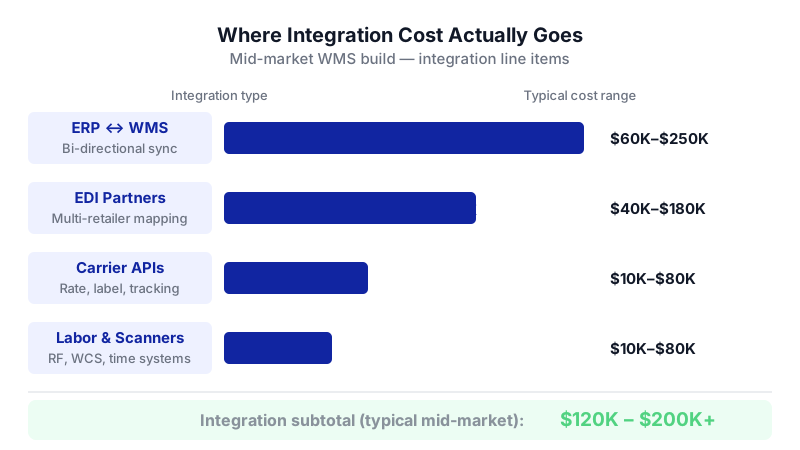
If the core WMS build on your quote is $80–150K and the integrations add another $120–200K, the quote is probably not padded — it is probably honest. The warehouse logic is the cheap part. The expensive part is everything the WMS has to talk to: your ERP, your carriers, your EDI trading partners, your scanners, and your labor system. Across mid-market deployments, integration work routinely equals or exceeds the first-year software spend, and in builds with heavy big-box retail exposure it can double it. The question is not whether the integration line items are real. It is which of them your operation actually needs on day one, and which can wait.
This post breaks down what drives each integration cost, where vendors quietly inflate, and the three scope decisions that move the total more than any negotiation on hourly rate.
The shape of the number
Gartner's Dwight Klappich puts a typical WMS implementation at 4,000–12,000 hours and $250,000 to well over $1 million, according to the 2026 Magic Quadrant analysis. That range is wide because the software license or custom build is usually the smaller half. Implementation costs often equal or exceed the first-year software expense, and even a baseline integration with existing systems lands between $10,000 and $80,000.
When buyers see their integration subtotal come in at $120–200K, the instinct is to assume the vendor is over-scoping. Usually they are not. They are quoting what they have learned the hard way: the ERP sync is never as clean as the ERP vendor's datasheet suggests, the EDI trading partners each have their own quirks, and the carrier APIs break in production in ways that only show up at Black Friday volume.
Where the integration money actually goes
1. ERP ↔ WMS sync — $60K–$250K
This is almost always the single largest integration line, and 2026 mid-market benchmarks put ERP-WMS integration at $60,000–$250,000. Why the spread is so wide:
- Direction of sync. Inventory-only (WMS reads item master from ERP) is at the cheap end. Bi-directional near-real-time sync of inventory, orders, receipts, adjustments, and financials is at the expensive end.
- ERP vintage. NetSuite and modern Dynamics 365 expose clean REST APIs. On-prem SAP ECC, older Epicor, Sage 100, or anything with a custom middleware layer will burn 200–400 hours just on data model reconciliation before a single mapping is written.
- Order lifecycle complexity. Single-stage orders (receive, pick, ship) are straightforward. Multi-stage with back-orders, kitting, cross-docking, holds, and partial shipments requires state machines on both sides to stay reconciled.
- Who owns the item master. If the ERP is authoritative for SKUs and the WMS needs enriched attributes (dimensions, hazmat flags, lot/serial rules), you are building an item master enrichment layer, not just a sync.
A realistic ERP-WMS integration for a distributor on a mid-tier ERP with bi-directional order and inventory sync is 400–900 hours of engineering plus 150–300 hours of testing. That is where the six-figure number comes from. It is not margin.
2. EDI integration — $40K–$180K, and this is where quotes go wrong
This is the line item most vendors understate on the first pass, and the one that causes the most schedule slip. Multi-partner EDI integration with custom mapping, AS2+VAN, and TMS/WMS validation runs $70,000–$180,000 and takes three to six months in 2026 benchmarks.
The non-obvious insight: if you sell into Walmart, Target, Home Depot, Lowe's, Costco, or Amazon Vendor Central, the EDI 856 ASN (Advance Ship Notice) and 940/945 (warehouse shipping order / shipping advice) transaction sets are not optional and are not standard. Each retailer has its own implementation guide that deviates from the X12 baseline in dozens of places — segment usage, qualifier codes, SSCC-18 label formats, timing windows for ASN transmission relative to physical shipment.
What that means in practice:
- A "one EDI 856" line item on a quote is misleading. Walmart's 856 and Target's 856 are different integrations.
- Each new trading partner is typically 60–120 hours of mapping, certification testing through the retailer's EDI testing environment, and a UAT cycle with real POs.
- AS2 transport, VAN relationships (SPS Commerce, TrueCommerce, Cleo), and GS1 SSCC-18 label generation each add their own integration surface.
The downside risk if you skip or shortcut this: a missing or invalid ASN sent to Walmart, Target, or Home Depot can cost 3% of the total order value, and chargebacks from major retailers average 1–3% of invoice value per violation, with a single mislabeled ASN capable of triggering a chargeback on an entire PO. For a distributor doing $40M through a big-box channel, a 2% chargeback rate is $800K a year. That math is why vendors who have been burned quote EDI honestly, and why the cheapest EDI quote on your stack is usually the most expensive one once you are in production.
3. Carrier and parcel APIs — $20K–$60K
FedEx, UPS, USPS, DHL, and the LTL carriers (XPO, Old Dominion, Estes, Saia) each need their own integration for rating, label generation, manifest, tracking, and (for LTL) BOL and pickup requests. Multi-carrier shipping engines like ShipStation, EasyPost, or Shippo compress this, but if you are building custom WMS logic you are usually integrating directly because the rate shopping and SLA logic lives inside the WMS.
Driver variables:
- Parcel only vs. parcel + LTL + TL (LTL doubles the surface).
- Rate shopping logic across carriers vs. a single default carrier.
- International (customs documentation, duties, multi-currency).
- Returns labels, address validation, residential surcharge handling.
4. Barcode scanners, printers, and mobile devices — $15K–$50K software, plus hardware
The hardware itself (Zebra TC22/TC27 handhelds at ~$1,500 each, Zebra ZT411 label printers at ~$2,000 each) is a line you can price from a reseller. The software integration is what the WMS vendor is quoting: MDM provisioning, scanner firmware profiles, label template design for GS1-128 and SSCC-18, print server configuration, and — critically — the mobile UX for pickers and receivers. If your WMS has a custom React Native or Ionic picker app, that is 300–600 hours of engineering that only sometimes shows up as a separate line.
5. Labor management and WES/WCS — $30K–$120K if you need it
If you have conveyors, pick-to-light, put walls, sorters, or any automation, the WMS needs to talk to a warehouse control system. If you are measuring labor productivity against engineered standards, you need a labor management module. Neither is included in a baseline WMS build. For a manual pick-and-pack operation with 10–40 associates, you can often skip both on v1 and add later. For anything with automation, you cannot.
6. 3PL billing, customer portals, and TMS — variable
If you are a 3PL, you also need storage and handling billing (per-pallet-day, per-pick, per-receipt fees calculated and invoiced per client), a customer-facing portal, and often a TMS integration. Integration with fulfillment platforms alone adds $40,000–$150,000 for mid-market deployments. This is the line that pushes 3PL WMS quotes into the $400K+ range and is almost always underscoped on first pass.
Illustrative worked example
This is illustrative, not a quote. Every assumption is stated.
Assume a US mid-market distributor with three warehouses, running Microsoft Dynamics 365 Business Central as the ERP, selling 30% of revenue through Walmart and Target (so EDI 856/940/945 is mandatory for those two trading partners), 70% through their own B2B web channel, parcel shipping only (FedEx + UPS), 25 associates per warehouse on Zebra handhelds, no conveyor automation, no labor management on v1.
A plausible integration subtotal looks like:
| Line item | Illustrative range |
|---|---|
| ERP ↔ WMS bi-directional sync (D365 BC, orders + inventory + receipts) | $70K–$110K |
| EDI: Walmart 850/856/810 + Target 850/856/810, AS2 + SPS Commerce VAN | $55K–$85K |
| FedEx + UPS parcel APIs (rate, label, manifest, tracking) | $20K–$35K |
| Barcode hardware integration (scanner profiles, label templates, mobile picker UX) | $25K–$45K |
| B2B web channel order ingest (REST) | $10K–$20K |
| Integration testing, UAT across 3 sites, trading-partner certification | $20K–$40K |
| Integration subtotal | $200K–$335K |
On top of the core WMS build. That is the number the quote is landing on, and in a scenario like the one above it is not padding. Change any one of those assumptions — drop the big-box channel, move to a multi-carrier shipping engine instead of direct carrier APIs, accept a one-way nightly ERP sync instead of real-time — and the subtotal moves by $40–80K.
What pushes the number up vs. pulls it down
| Pushes it up | Pulls it down |
|---|---|
| Each additional EDI trading partner (big-box each ~$25–40K) | Phasing EDI partners — launch with top one, add others post go-live |
| On-prem or heavily-customized legacy ERP | Cloud-native ERP with REST APIs (NetSuite, D365 BC, Acumatica) |
| Real-time bi-directional ERP sync | Near-real-time or batched one-way sync where business tolerates it |
| Direct carrier API integrations across parcel + LTL + international | Multi-carrier aggregator (EasyPost, Shippo) for v1 |
| Conveyor / sorter / pick-to-light automation (WES/WCS) | Manual operation on v1, automation integration in phase 2 |
| 3PL multi-client billing + customer portal | Internal distributor use only |
| Multiple warehouses with site-specific process variants | Single process standard rolled out to all sites |
| Data migration from legacy WMS with 5+ years of history | Open balances only, archive legacy history separately |
The two biggest levers a buyer actually controls: EDI trading partner phasing and ERP sync architecture. Together those two decisions routinely move a quote by $80–150K.

What vendors underscope (and you should push back on)
From reviewing dozens of these quotes, four line items are consistently thin:
- EDI trading-partner certification time. Each big-box retailer has a testing environment and a certification process that takes two to six weeks of calendar time, not engineering time. If the schedule assumes parallel certification across four retailers, ask who at the vendor has done it before.
- UAT across multiple warehouses. Running UAT at one site and rolling out is a recipe for site-two surprises. Budget for real UAT at each site or at least a staged rollout with buffer.
- Cutover dress rehearsals. One rehearsal is not enough for a multi-site operation. Two or three is normal, and they are engineering time, not just operations time.
- Post-go-live stabilization. The first four to eight weeks after go-live will surface edge cases in every integration. If the quote ends at go-live, there is a gap.
How CodeNicely can help
Our relevant work here is Vahak, India's largest trucking and logistics marketplace. The engineering problem that matters for a WMS reader is not the marketplace side — it is the back-end integration surface we built underneath it: real-time fleet and load state across hundreds of thousands of transporters, carrier-side integrations, routing and matching logic that had to stay consistent as volume scaled. That is the same class of problem a custom WMS build is: many external systems, asynchronous state, no tolerance for drift between what the system says and what the physical world is doing.
If you have a quote in hand and you want a second opinion on which integration line items are real, which are soft, and which scope cuts would bring the total down without hurting the operation, that is a conversation worth having before you sign. We work with US mid-market operators on exactly this — see our US practice and how we approach legacy modernization and integration-heavy builds. Full IP ownership, no vendor lock-in on the integration layer.
The three questions that turn a range into a quote
If you want a real number instead of a range, three specifics do more than anything else:
- Name the ERP, its version, and whether it is cloud or on-prem. "SAP" is not an answer. "SAP ECC 6.0 EHP7 on-prem with a custom PI middleware layer" is. This alone can move the ERP integration estimate by 2x.
- List every EDI trading partner and the transaction sets each requires. Not "we do EDI with big-box." An actual list: Walmart (850, 856, 810, 846, 997), Target (850, 856, 810, 997), and so on. And whether you already have a VAN relationship or are starting from zero.
- State your automation reality honestly. Manual pick-and-pack, or conveyor + sorter + pick-to-light? If automation, name the vendor and model. WES/WCS integration is the one line item where a 20% scoping error becomes a six-figure variance.
Without those three, any WMS quote you receive is a range dressed up as a number. With them, you can validate the integration subtotal against benchmarks and push back on specific lines with specific reasons. That is a much better conversation to be in than negotiating a total.
Frequently Asked Questions
Why is the integration cost on my WMS quote larger than the core software?
Because the core WMS logic (receive, putaway, pick, pack, ship) is well-understood and reusable across customers, while the integration layer is unique to your stack — your specific ERP version, your specific EDI trading partners, your specific carriers, your specific hardware. Benchmarks consistently show implementation and integration costs equaling or exceeding first-year software costs for mid-market WMS deployments. If your integration subtotal is 1.5–2x the core build, that is normal, not inflated.
Can we skip EDI integration on v1 and add it later?
Only if none of your current trading partners mandate it. If you sell through Walmart, Target, Home Depot, Lowe's, Costco, or Amazon Vendor Central, EDI 850/856/810 (minimum) is a compliance requirement and chargebacks for non-compliance average 1–3% of invoice value per violation. You can phase trading partners — launch with your largest one and add others in waves — but you cannot usually skip EDI entirely without losing the channel.
How much does a basic ERP-to-WMS integration cost?
Mid-market benchmarks put it at $60,000–$250,000 depending on ERP vintage, whether the sync is one-way or bi-directional, and how much of the order lifecycle (receipts, adjustments, back-orders, kitting) needs to stay reconciled in real time. A cloud-native ERP with clean REST APIs doing one-way inventory sync is at the low end. An on-prem legacy ERP with bi-directional real-time sync of the full order lifecycle is at the high end. To turn this into a real number, the vendor needs the ERP name, version, deployment model, and the list of entities to be synced.
How long does a custom WMS implementation take?
Gartner data puts typical WMS implementations at 4,000–12,000 engineering hours, which for a mid-market build with a reasonable team usually translates to 6–14 months calendar time. The biggest schedule drivers are EDI trading-partner certification (3–6 months on its own for a multi-partner setup) and multi-site rollout. Any specific delivery date depends on your integration surface, team availability on your side, and cutover strategy — single big-bang vs. phased site rollout — and should come out of a scoping conversation, not a rate card.
Should we buy a packaged WMS or build custom?
Packaged WMS (Manhattan, Blue Yonder, Körber, SAP EWM) makes sense if your processes fit the product and you are willing to adapt operations to the software. Custom makes sense when you have genuinely differentiated processes — unusual kitting, light manufacturing inside the warehouse, 3PL multi-client billing that packaged products handle poorly, or workflows that are a competitive advantage. The integration cost structure is similar for both; the license fee and the per-user cost structure is where they diverge. Most mid-market operators who choose custom do so because the packaged product's configuration limits were going to cost more over five years than the custom build.
Sources & further reading
- Gartner Magic Quadrant for WMS: Key Takeaways From the 2026 Report (Made4net)
- Best WMS Implementation Cost Guide: 2026 Pricing Strategy (OrderPilots)
- EDI Integration in Logistics: X12, EDIFACT and APIs in 2026 (Yusmp Group)
- What Is EDI Compliance in Retail? Common Trading-Partner Mandates (Fulfyld)
- The Secret Tax on Every Big-Box Supplier (GammaVibe)
- How Much Does WMS Software Cost? A Guide to Warehouse Budgets (Made4net)
- Warehouse Management System Cost: Pricing Guide (Finale Inventory)
- Warehouse Management Systems Market Size, Share & Growth Analysis (Growth Market Reports)
Get one practical guide a week
Costs, AI tools, partner selection — written for people who make the decision. No spam, unsubscribe anytime.
Thanks — you're on the list. One practical guide a week, nothing else.
That didn't work — please check the email address and try again.
Building something in Logistics & Supply Chain?
CodeNicely partners with founders and tech teams to ship AI-native products that move metrics. Tell us about the problem you're solving.
Talk to our team Book a 30-min call