_1751731246795-BygAaJJK.png)

In-House vs. Dev Partner: The Startup Decision Framework

 Published by CodeNicely, the product studio founded by Meghal Agrawal and Ujjwal Agrawal in 2017
For: A seed-to-Series-A SaaS founder who has a working MVP from a freelancer or early contractor and is now deciding whether to hire a full-time engineering team or engage a development studio to build the next 18 months of product
In this guide
If you have a working MVP and 18 months of roadmap ahead, the honest answer is: hire in-house if your product's defensibility lives in the code itself and you have the cash runway to absorb a 6-month ramp; engage a development partner if you need working software in market within two quarters and your moat is distribution, data, or domain, not raw engineering. Most seed-to-Series-A founders are told to hire in-house by default. The math below is why that advice is often wrong — and when it's right.
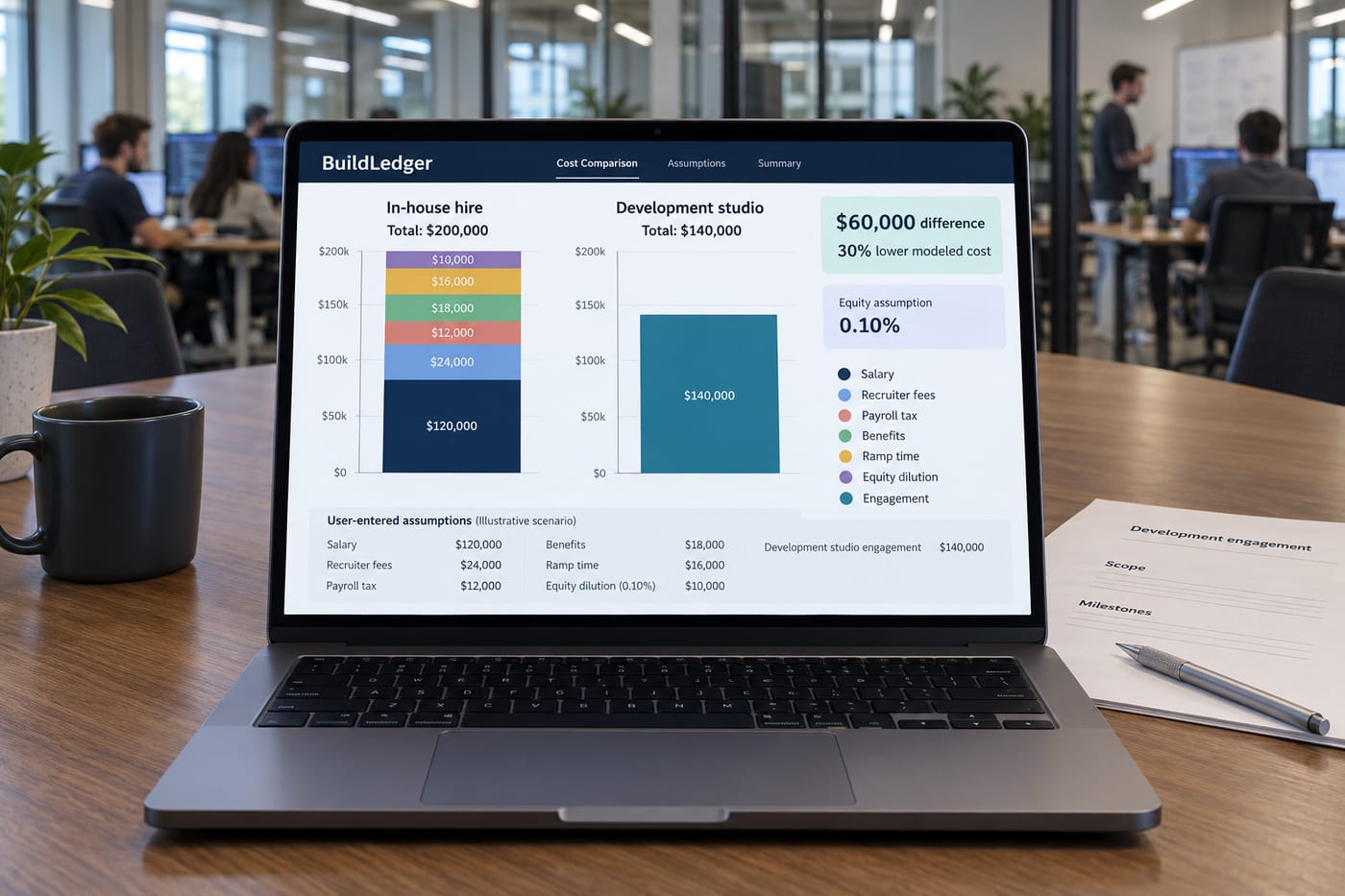
The decision is almost never framed properly in a board deck. A $180K salary line gets compared to a monthly partner invoice, and the partner looks expensive. Then recruiter fees, equity dilution, benefits, payroll tax, ramp time, and the manager-hours spent interviewing twelve candidates to close one get buried in other line items. Stack them in the same spreadsheet and the picture inverts for the first 12–18 months.
The decision, defined crisply
You are choosing between two commercial structures to deliver roughly 18 months of product work:
- In-house: Full-time W-2 engineers you recruit, equip, manage, and retain. You own the hiring risk, the ramp cost, the attrition risk, and the full P&L — but you also own a team that compounds in context over time.
- Development partner: A studio engaged on milestone-priced or capped T&M contracts to deliver specific product outcomes. You trade some long-term compounding for speed, elasticity, and a transferred execution risk.
This is not staff augmentation (renting individual contractors into your Jira), and it is not offshore body-shopping. Those are different decisions with different math. We'll touch on them, but the core choice is employ a team vs buy an outcome.
The five axes that actually decide it
1. True fully-loaded cost — not the salary line
The U.S. Bureau of Labor Statistics puts the median software developer base wage at $133,080 as of May 2024, but base pay is a misleading anchor for a Series A hire competing with FAANG and well-funded startups. Levels.fyi's crowdsourced data puts median total compensation at $192,000–$197,500 once bonus and equity are included. For a senior hire you actually want, assume $180K–$230K in cash plus equity.
Then stack the costs most founders forget:
- Recruiter fees: Contingency recruiters charge 20–25% of first-year base salary. On a $180K hire, that's $36K–$45K per placement. Multiply by your hire count.
- Payroll tax, benefits, equipment, software: Add 25–30% on top of cash compensation in the US.
- Ramp productivity loss: SHRM estimates over $40,000 in lost productivity per hire during the learning phase. Pluralsight Flow's analysis of 11.5 million data points across 2,642 engineers found an average full ramp of about six months.
- Equity dilution: Index Ventures benchmarks show a standard Series A senior engineer grant of 0.10% fully diluted, with exceptional hires at 0.20%. On a $50M post-money, that's $50K–$100K in notional founder dilution per hire — and the option pool itself is typically created pre-money, so founders eat it.
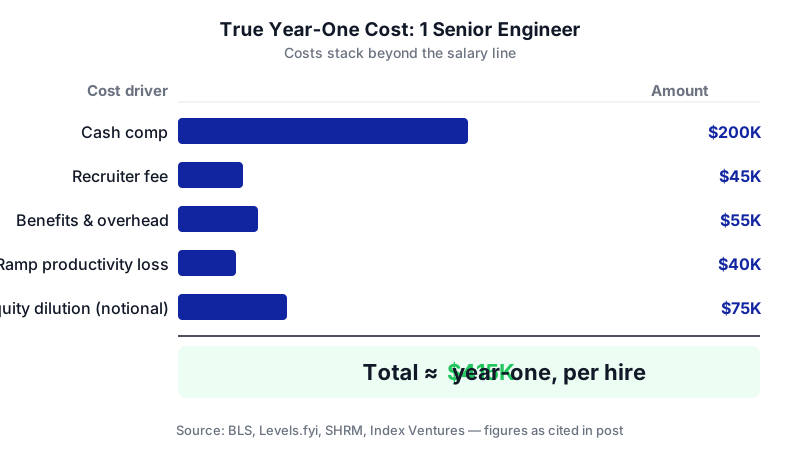
Illustrative stack (US-based, Series A, senior engineer, assumptions stated): $200K total cash comp + $45K recruiter + $55K benefits/overhead + $40K ramp productivity loss + $75K notional equity dilution = roughly $415K in year-one true cost per engineer, before you've shipped a feature. This is one hire, one year, one well-run process. Your mileage will vary — the assumptions that move it most are compensation band, whether you use retained vs contingency recruiting, how aggressive your equity grants are, and your post-money valuation.
2. Speed to first shipped value
The ramp curve for new engineers is well-documented: 30–50% of baseline output in weeks 3–4, 60–80% in month two, 80–100% only by months 3–4. A hire you close today is not net-positive on your roadmap until roughly Q2. If you need to close four engineers to build what the roadmap demands, add 2–4 months of hiring cycle on top. You are looking at month 7 or 8 before a full team is actually producing at pace.
A development partner with an existing bench — people who already know each other's code, your stack, and how to set up CI on day one — can typically have a working squad in sprint cadence inside two to three weeks. If your fundraise narrative requires shipping a specific capability by a specific board meeting, this gap is the whole ballgame.
3. Key-person risk
This cuts both ways and people usually only see one side.
In-house risk: Your first senior hire quits in month 10. They were the only person who understood the payments integration. You are now hiring their replacement and watching the roadmap slip two quarters. Median Series A option pools of 12.4% exist precisely because retention is this fragile.
Partner risk: The studio reassigns your lead engineer to another account. The replacement needs two sprints to get context. You have less direct control over who stays on the team. Mitigate this with contractual continuity clauses and insist on a documented handover protocol — but understand it is a real risk, not a theoretical one.
The honest comparison: in-house key-person risk is catastrophic and uncorrelated (one person leaves and you lose a quarter). Partner key-person risk is smaller per incident but more frequent, and the partner's bench absorbs most of it. If your product has one or two load-bearing subsystems where deep context matters more than anything else, in-house is usually safer for those specific roles.
4. What happens if you change your mind in month six
This is the axis investors never ask about and founders regret ignoring.
Pivoted the product in month six with an in-house team of five? You now have five people whose skills, hired for the old thesis, may not fit the new one. Layoffs cost cash, morale, and reputation in a small ecosystem. Keeping the wrong team costs more.
Pivoted with a partner engagement? You renegotiate the next milestone or wind down with notice. The team goes back to the studio's bench. Your burn rate drops the following month. This optionality has real value and almost nobody prices it in.
The flip side: if you don't pivot and the product works, a partner engagement that stretches into year three starts to look expensive versus a stable in-house team that has compounded context. The break-even on the illustrative numbers above lands somewhere around month 14–18 — after which, if the thesis is validated, in-house usually wins on cost.
5. Strategic defensibility of the code itself
Ask the uncomfortable question: is your moat in the code, or around it?
If your moat is a proprietary ML model, a novel data structure, a performance edge no one else can match — the code is the company. Hire in-house, pay the ramp cost, accept the slowness. External partners can execute this but you want the compounding institutional knowledge sitting on your payroll.
If your moat is distribution, a regulatory license, an exclusive data partnership, a brand, a network effect, or sheer speed to a specific market window — the code is table stakes. A partner builds table stakes faster and cheaper than a team you spend six months assembling. We've seen this play out across fintech SaaS, logistics marketplaces, and lending platforms where the moat was never the engineering — it was the GTM.
The honest case against a development partner
Any framework that only lists reasons to buy is a sales deck, not a framework. Here is where partners genuinely underperform in-house teams:

- Compounding product intuition: A great in-house engineer in year two makes judgment calls about tradeoffs that a rotating partner team cannot. If your product requires that kind of taste, you need people whose entire professional context is your company.
- Investor optics: Some Series B investors still mark down companies without a resident CTO and in-house team, regardless of what shipped. This is changing — the Stack Overflow 2024 survey shows 18% of professional developers now identify as independent contractors, up from 9.5% in 2020 — but the bias is still real at some funds. Know your target investor's prior before you optimize against it.
- Hourly economics at scale: Past a certain team size and tenure, blended partner rates exceed fully-loaded in-house cost. The crossover depends on geography and seniority mix, but it is real.
- Culture and recruiting flywheel: Early engineers help recruit later engineers. A partner-built product doesn't give you that flywheel when you eventually do hire.
The decision rule
If you are in situation A — pre-product-market-fit, 12–24 months of runway, roadmap uncertainty high, moat not in the code itself, specific window to hit — engage a development partner for the next 12–18 months. Negotiate milestone pricing, insist on full IP transfer and no vendor lock-in, require documented handover from day one so you can absorb the team or the codebase when PMF arrives. Preserve optionality. Preserve cash. Ship.
If you are in situation B — post-PMF with revenue signal, 24+ months of runway, roadmap stable, moat genuinely sits in proprietary engineering, and your target Series B investors require an in-house team — start hiring now. Budget honestly: $400K+ year-one true cost per senior US hire, 6-month ramp, 20% recruiter fees, and a founder who spends 30% of their week on hiring until the first four are closed.
If you are in situation C — somewhere in between, which most founders are — run a hybrid. Hire one strong in-house tech lead who will own architecture and institutional memory. Engage a partner for the delivery capacity around them. The lead eventually becomes your CTO and the nucleus of a hired team if you choose to insource later. The partner carries velocity while you figure out which bet is working. This is the configuration that fails least often, and it is almost never what first-time founders propose to their board.
A note on offshore vs nearshore vs onshore partners: this is a secondary axis, not the primary one. Decide the structure first, then optimize geography based on timezone overlap, domain expertise, and the specific risk profile of your product. For regulated workloads (healthcare, lending, defense), onshore or nearshore usually wins on compliance friction alone — healthcare and pharmacy builds are a good example where regulatory context is worth paying for.
What would turn these ranges into a real number
Every figure above is a model, not a quote. To move from framework to a decision you can defend to your board, you need to pin down three things:
- Scope specificity: What exactly needs to ship in the next 18 months, with which integrations, at what scale? A two-integration MVP and a six-integration platform have 3x cost differences.
- Risk tolerance: How much of the delivery risk do you want to transfer? Fixed-scope milestone pricing costs more up front but caps your downside. Capped T&M is cheaper but keeps execution risk on your side of the table.
- Horizon honesty: Are you really optimizing for 18 months, or secretly for 36? The answer changes which option wins.
If you want to pressure-test the model against your specific numbers, a scoping conversation with a studio that will give you honest break-even math — including the cases where you should hire in-house instead — is worth more than another month of spreadsheet rework.
Frequently Asked Questions
When does hiring in-house engineers beat a development partner on cost?
Roughly month 14–18 for a well-run US hiring process, based on fully-loaded cost including recruiter fees, 25–30% benefits overhead, 6-month ramp productivity loss, and equity dilution. Before that window, a milestone-priced partner is almost always cheaper. After it, if the thesis is validated and the team is retained, in-house usually wins. The exact crossover depends on your compensation band, your post-money valuation, and your partner's blended rate.
Can I use a development partner and still raise a Series B?
Yes, but know your investors. Some funds explicitly want to see an in-house engineering team at Series B as evidence of defensibility and recruiting ability. Others care only about product velocity, retention metrics, and gross margin. Ask your target investors directly before you optimize the wrong constraint. The Stack Overflow data showing 18% of developers now self-employed suggests the bias is softening, but it is not gone.
What's the real cost of a senior US software engineer in year one?
The BLS median base of $133,080 understates it badly. Add bonus and equity to reach median total comp of around $197,500, then layer on 25–30% benefits overhead, a 20–25% recruiter fee on first-year base, $40K+ in ramp productivity loss, and $50K–$100K in notional equity dilution. Realistic year-one true cost for a senior hire sits around $380K–$450K.
How do I avoid vendor lock-in with a development partner?
Three contract terms do most of the work: full IP assignment on milestone acceptance (not on final payment), source code and infrastructure access in your name from day one, and a documented handover protocol that includes architecture decision records and runbooks updated per sprint. If a partner resists any of these, that is your answer. Have your lawyer review the specific contract language — this is not legal advice.
Should I hire a CTO before engaging a development partner?
If you can close a strong in-house tech lead or CTO who will own architecture and institutional memory, do it first — then wrap partner delivery capacity around them. This hybrid configuration is the most resilient path for seed-to-Series-A founders. If you cannot close that lead in the next 60 days and the roadmap cannot wait, engage the partner first with a clear plan to transition the lead role in-house within 6–9 months.
Sources & further reading
- BLS Occupational Outlook Handbook — Software Developers, May 2024 Median Wage ($133,080)
- levels.fyi — Software Engineer Salary (Median Total Comp $197,500, 47,900 submissions)
- Riem.ai — How Much Does It Cost to Hire a Software Engineer in 2026? (Agency fee math)
- Eden Capital Careers — Recruiter Fees Explained: 2026 US Pricing Guide (20–25% contingency standard)
- HyRing HR Glossary — Ramp-Up Period (SHRM: $40,000+ lost productivity per hire)
- WalkingTree Tech — Pluralsight Flow Analysis: 11.5M data points, avg. 6-month ramp for engineers
- DEV Community — New Developer Onboarding: Ramp-Up Metrics (30–50% output in weeks 3–4)
- StealthAgents — Startup Employee Stock Options Statistics 2026 (AngelList: median Series A option pool 12.4%; Index Ventures grant benchmarks)
Get one practical guide a week
Costs, AI tools, partner selection — written for people who make the decision. No spam, unsubscribe anytime.
Thanks — you're on the list. One practical guide a week, nothing else.
That didn't work — please check the email address and try again.
Building something in Technology?
CodeNicely partners with founders and tech teams to ship AI-native products that move metrics. Tell us about the problem you're solving.
Talk to our team Book a 30-min call