
AI Support Agent Pricing: What Indian Startups Actually Pay

 Published by CodeNicely, the product studio founded by Meghal Agrawal and Ujjwal Agrawal in 2017
For: A Series A B2B SaaS or consumer-app founder in India whose support ticket volume has crossed 500 per day, whose CX lead has just asked for headcount approval, and who suspects an AI agent could absorb 60–70% of that load — but has no idea whether the build will cost ₹8L or ₹80L, or whether to buy a SaaS tool instead
In this guide
- The shape of the number, before any vendor talks to you
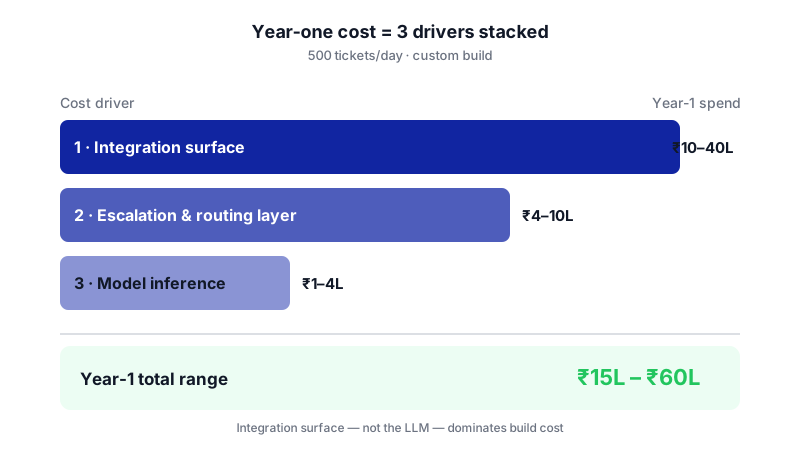
- The three cost drivers, in order of impact
- An illustrative worked example
- What pushes the number up, what pulls it down
- When SaaS is actually the right answer
- The payoff case, and why so few teams hit it
- Three questions that turn a range into a quote
- Frequently Asked Questions
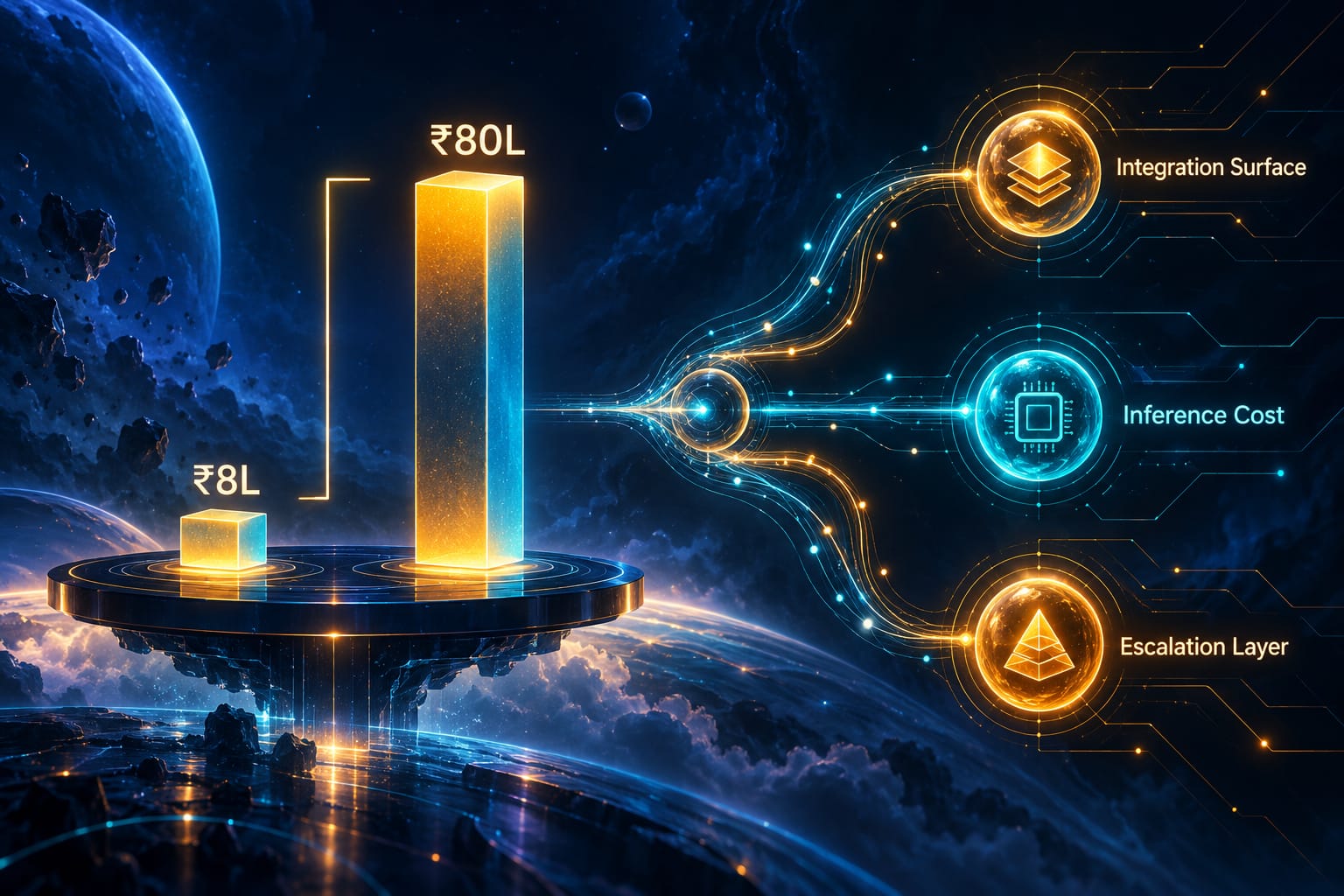
For an Indian B2B SaaS or consumer-app startup clearing 500 tickets a day, an AI support agent will land somewhere between ₹8L and ₹80L in year one — and the honest answer to which end you fall on has almost nothing to do with the LLM you pick. It has to do with how many internal systems the agent has to read from, whether you are buying a SaaS seat or building, and the quality of the human-escalation layer behind the bot. This post breaks the number into the three parts a founder can actually control, and shows where the SaaS-vs-build decision flips.
The reason every vendor quote feels opaque is that it bundles three independent cost lines — model inference, integration surface, and escalation tooling — into one monthly figure. Pull them apart and the decision gets a lot easier.
The shape of the number, before any vendor talks to you
There are two defensible starting points depending on how you want to buy.
Path A — SaaS seat with built-in AI agent. Freshdesk's Growth plan starts around ₹1,300/agent/month in INR billing, which is the practical floor for most Indian B2C teams. Add their AI agent sessions on top — $49 per 100 sessions after a 500-session free tier, charged whether or not the AI actually resolves the conversation. Zendesk, by contrast, bills $1.50 per verified resolution on a committed-volume contract, or $2.00 pay-as-you-go, but invoices in USD with no GST and no native WhatsApp Business API routing — a real friction for Indian procurement teams. Intercom crosses the ₹50,000/month threshold before you have provisioned a single AI seat.
Path B — custom-built agent on your own stack. A reasonable range is ₹15–60L for the first production build, plus ₹40k–₹2L/month in running cost once live. The spread is almost entirely explained by how many of your internal systems the agent needs to touch, and whether you already have clean ticket-history data to fine-tune on.
Neither path is universally cheaper. Below roughly 3,000 AI-handled conversations per month, SaaS almost always wins — the per-session price is lower than the fully-loaded cost of someone on your team maintaining a build. Above 15,000–20,000 conversations with a non-trivial integration surface, the economics tilt toward custom, because SaaS per-resolution pricing scales linearly with volume while a built system's marginal cost is dominated by inference, which is now in free-fall.
The three cost drivers, in order of impact
1. Integration surface (the biggest line, almost always)
An AI agent that can only read your knowledge base is a glorified FAQ. An AI agent that can look up a user's order status, check their UPI payment state, trigger a refund, and update a CRM record is a support agent. The difference is five to seven integrations, and each one costs real engineering time: auth, schema mapping, rate-limit handling, error states, and the audit log that your finance team will eventually ask for.
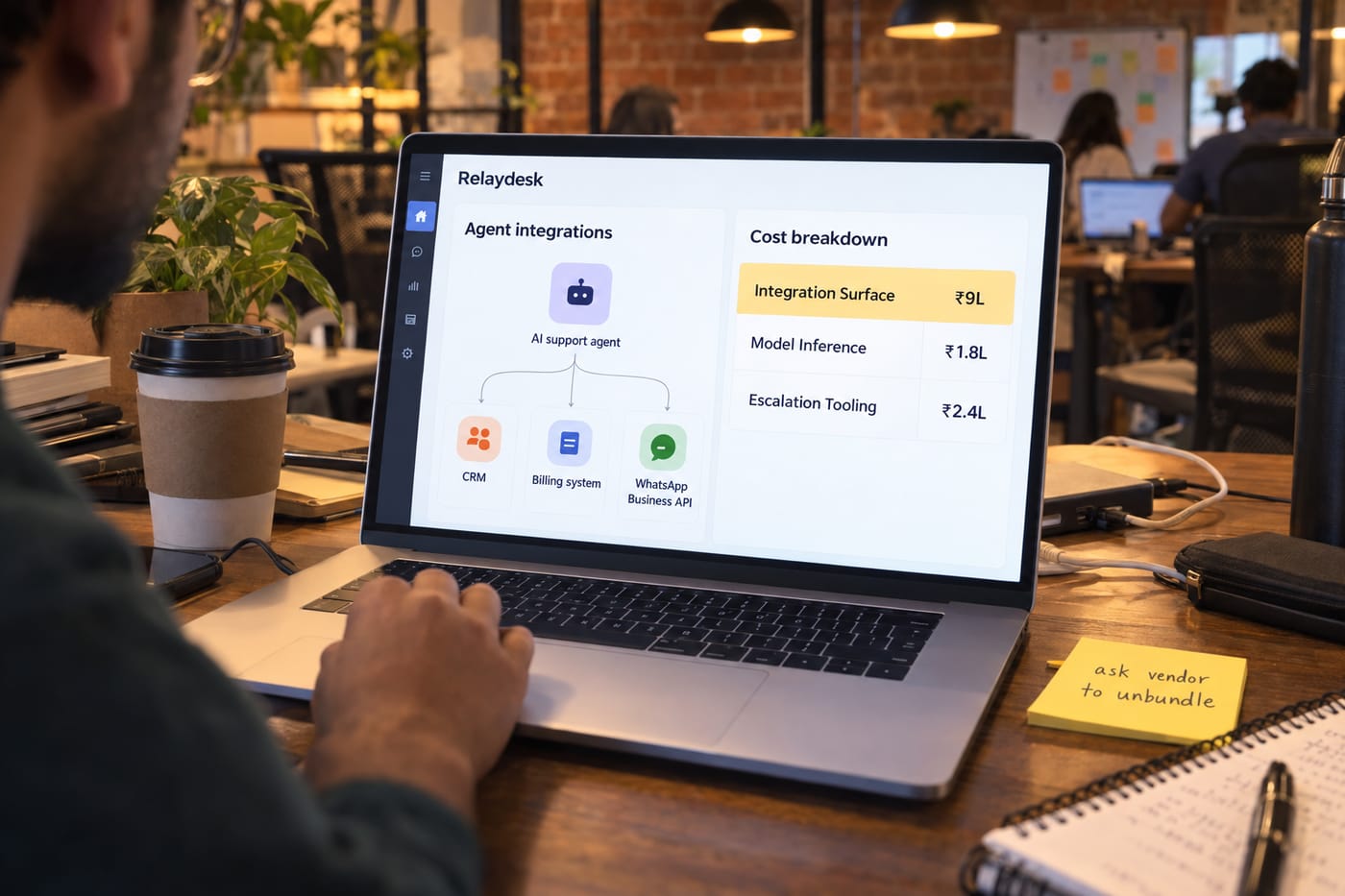
For a typical Indian consumer startup, the integration list looks like this: your product database, your payments provider (Razorpay or a UPI aggregator), WhatsApp Business API, your CRM (usually HubSpot or a homegrown Postgres table), your logistics partner's API if you ship physical goods, and your identity/KYC system if you are in lending or regulated fintech. Each clean integration is 1–3 engineer-weeks. Each messy one — undocumented internal APIs, no sandbox, auth that was never designed for machine access — can be 4–8 weeks on its own.
This is where custom builds blow their budgets. Teams scope for "CRM integration" and discover the CRM is actually three systems stitched together by a scheduled script written by someone who left in 2022.
2. Escalation and routing layer (the one everyone underestimates)
This is the non-obvious part. The naive assumption is that LLM API cost is the main lever to optimise. It is not. The lever is what happens when the model fails.
If your agent cannot answer a ticket and silently kicks it to a human queue with no context, three things happen. First, the human agent takes longer than they would have taken originally, because they have to re-read the bot's attempt. Second, the reason for failure never gets logged in a structured way, so the training set does not grow. Third, your cost-per-resolved-ticket stays flat month over month instead of falling as the agent learns.
A proper escalation layer does three things: it classifies why the handoff happened (missing data, policy edge case, user frustration, out-of-scope request), it passes the full conversation plus the agent's reasoning to the human, and it loops the resolution back into evaluation. Teams that do this well see cost-per-resolved-ticket drop 15–20% per quarter for the first year. Teams that skip it pay the same per ticket in month 12 as they did in month 2.
Building this layer properly adds ₹4–10L to the initial build and is the single highest-ROI line item. SaaS tools like Zendesk and Freshdesk include a version of it, but the fidelity of the failure classification is usually too shallow to drive meaningful retraining — which is partly why Gartner found only 24% of service leaders demonstrated positive financial returns on AI investments despite AI spending growing 38%.
3. LLM inference (surprisingly, the smallest line)
This is the headline number everyone focuses on and the one that matters least. For a support chatbot running 100,000 conversations per month at roughly 500 input and 200 output tokens per conversation, the inference.net LLM Pricing Index puts the cost at around $368/month on GPT-5.2 at the top end and about $4/month on budget open-source inference providers — a 90x spread. Frontier model input token prices have fallen from $30 per million tokens to $2.50 per million tokens over three years, a 91.7% drop.
Translation: even if you pick the most expensive frontier model and your conversations are 3x longer than average, the LLM bill for a reasonably large Indian startup is ₹30k–₹1L per month. That is one mid-level engineer's monthly cost. It is not where the money goes.
Worth noting the counter-trend, though: Gartner predicts cost per resolution for generative AI customer service will exceed $3 by 2030 as vendors shift from subsidised growth pricing to profitability and use cases grow more complex. So the current cheap-inference window is real but is not a permanent condition — architectural decisions that bake in dependence on cheap frontier APIs may age badly.
An illustrative worked example
This is illustrative only. Every assumption is stated so you can swap in your own numbers.
Scenario: A Series A consumer app with 800 tickets/day, roughly 24,000/month. Target: AI handles 65% end-to-end (15,600/month), 35% escalates to a 6-person human team. Three core integrations: order DB, Razorpay, WhatsApp Business API. Existing Freshdesk account. Twelve months of clean ticket history available for evaluation and few-shot examples. No regulated-data concerns (no health, no financial advice).
Path A — stay on Freshdesk, turn on their AI agent:
- Freshdesk seats: 6 agents × ~₹1,300/month = ₹7,800/month
- AI sessions: 15,600 sessions/month at $49/100 after 500 free ≈ $7,400/month ≈ ₹6.2L/month
- Integration work (WhatsApp routing, order lookup via custom app): one-time ₹3–6L
- Year 1 total: roughly ₹78L–₹82L, dominated by the per-session SaaS bill
Path B — custom build on your own stack, keep Freshdesk for human-agent workflow:
- Build cost (agent, retrieval layer, 3 integrations, escalation + evaluation tooling): ₹22–35L one-time
- LLM inference at 15,600 conversations/month on a mid-tier model: ₹15k–₹60k/month
- Freshdesk seats retained for human workflow: ₹7,800/month
- Ongoing engineering (0.3 FTE for prompt tuning, eval, integration maintenance): ₹4–6L/year
- Year 1 total: roughly ₹32–48L, with marginal cost per additional 1,000 conversations under ₹5,000
At this volume, custom wins on a one-year horizon. At 2,000 AI conversations/month instead of 15,600, the arithmetic flips completely — Freshdesk's AI sessions would cost about ₹55k/month, and no custom build pays back against that.
What pushes the number up, what pulls it down
| Pushes cost up | Pulls cost down |
|---|---|
| Legacy or undocumented internal APIs | Clean REST APIs with sandbox environments |
| Regulated domain (health, lending, insurance) requiring audit trails and PII handling | Non-regulated consumer or SaaS product |
| Multi-language support (Hindi + 3 regional languages) | English-only or English + Hindi |
| Voice channel (IVR replacement) on top of chat | Chat and WhatsApp only |
| No existing ticket history to evaluate against | 12+ months of labelled historical tickets |
| Need to resolve, not just triage (refunds, cancellations, account changes) | Deflection and triage only, human closes the loop |
| Multiple backend systems of record for the same entity | Single source of truth per entity (user, order, payment) |
| Realtime SLA requirements (sub-2-second response) | Async WhatsApp or email where 10–30s is acceptable |
| Custom SOC 2 / ISO 27001 evidence requirements from enterprise customers | Startup-stage security posture, no enterprise contracts yet |
| In-house team with no LLM-ops experience (every eval cycle takes 3x longer) | Team that has shipped at least one retrieval-augmented system before |
When SaaS is actually the right answer
A custom build is not the right answer for most startups below Series B. If you are below 3,000 AI-handled conversations per month, if your integration surface is 1–2 systems, if your team has no experience running an evaluation loop on an LLM-based system, buy the SaaS seat. The ProductGrowth.in analysis is correct that for sub-30-agent Indian operations, Freshworks wins on procurement-friendliness and total cost — INR billing, GST invoices, local support, and no exchange-rate exposure on a line item that will grow with your ticket volume.

The point at which custom starts to make sense is when one of three things becomes true: your per-session SaaS bill crosses roughly ₹3L/month, you need an integration the SaaS tool does not support (common with homegrown CRMs or internal ops dashboards), or you have a specific resolution flow — say, refund approval tied to a fraud score — that the vendor's agent cannot execute.
The payoff case, and why so few teams hit it
The headline numbers from well-executed AI support deployments are genuinely good. An Elevation Capital portfolio company reported AI agents handling 95% of inquiries end-to-end, with resolution time down 60% and cost per ticket down 70%. NASSCOM's Future of Work Report 2024 projects 3x growth in AI adoption in Indian contact centres by 2026.
But the Gartner data on 24% positive ROI tells you the median outcome is nowhere near that. The teams that hit the payoff case are the ones that treat the AI agent as a system with an evaluation loop, not a chatbot you turn on. That means: labelled test sets built from real tickets, weekly eval runs with regression checks, structured escalation logging, and a prompt/model/retrieval change log reviewed by whoever owns CX. If your team cannot commit to that operational cadence, SaaS is better regardless of cost — the deflection numbers will be lower, but the ongoing burden is someone else's problem.
Three questions that turn a range into a quote
If you are about to brief a vendor or an internal team, these are the three answers that will collapse the range faster than anything else:
- How many systems does the agent need to read from and write to, and does each one have a documented API with a sandbox? This single answer explains 60% of the variance in build cost. If the answer is "four systems and two of them are internal, undocumented, and owned by someone who is on notice period," the number doubles.
- What percentage of tickets does the agent need to resolve versus just triage? Triage (classify, route, auto-respond with info) is a fraction of the cost of resolution (take an action in a backend system). Many teams discover mid-build that they only actually need triage, which halves scope.
- Who owns the evaluation loop after launch, and do they have the bandwidth to run it weekly? If the answer is "no one yet," the right first step is a smaller pilot — not a full build. The ongoing operational cost of a system no one evaluates is higher than the capex of building it.
Beyond that, scope conversations should cover your current ticket mix (what fraction are refunds vs. order status vs. account changes vs. complaints), your channel split (WhatsApp vs. in-app vs. email), and whether you are in a regulated vertical. Teams working through this scoping exercise with an outside partner usually find the AI product scoping conversation is where the real decisions get made — not in the build phase. For a market-specific view, the India AI development page covers how we think about these builds for Indian product teams.
Frequently Asked Questions
Is it cheaper to build a custom AI support agent or buy Freshdesk/Zendesk AI?
Below roughly 3,000 AI-handled conversations per month with 1–2 integrations, SaaS is almost always cheaper on a two-year TCO basis. Above 15,000 conversations with 4+ integrations, custom builds typically pay back inside 12–18 months because SaaS per-session pricing scales linearly while custom build marginal cost is dominated by LLM inference, which has fallen over 90% in three years. The flip point depends more on integration count than on volume alone.
How much does the LLM API cost actually matter in the total bill?
Less than most founders assume. For 100,000 conversations per month, LLM inference ranges from about $4 to $368 depending on model choice — the entire monthly inference bill is often less than one engineer's monthly salary. The dominant cost lines are integration engineering (one-time) and the escalation/evaluation tooling that lets the system actually improve over time.
How long does it take to deploy a production AI support agent?
Turning on a SaaS vendor's AI agent against an existing knowledge base can be done in 2–4 weeks. A custom build with 3–5 integrations and a proper escalation layer is typically a 10–20 week engagement, with the long tail driven by integration complexity and whether your historical ticket data is clean enough to use for evaluation. The three questions in the section above are what turn that range into a timeline.
What is the biggest reason AI support projects fail to show ROI?
No structured escalation loop. When the agent fails and silently hands off, the reason for failure is never logged, the training set never improves, and cost-per-resolved-ticket stays flat for 12+ months. Gartner's data showing only 24% of service leaders see positive ROI on AI despite 38% spending growth is largely explained by this one gap. The fix is not a better model — it is a classification layer on handoffs plus a weekly eval cadence.
Should an early-stage startup build this in-house or outsource it?
If your team has shipped a retrieval-augmented system before and has at least 0.3 FTE to dedicate to prompt/eval work ongoing, in-house is fine. If not, outsourcing the initial build with a clean handover of the eval tooling tends to work better — the specialised work is in the eval loop and the integration layer, both of which are faster for a team that has done them before. The common mistake is outsourcing the build and taking back a system with no eval harness, which guarantees the cost-per-ticket never falls.
Sources & further reading
- Gartner Challenges Assumption That AI Will Be Cheaper Than Human Support — Customer Experience Dive
- Customer Support Cost and AI ROI Statistics (2026) — GetMacha
- AI in Customer Service Statistics [2026] — Master of Code
- Zendesk vs. Freshdesk (2026): Pricing, Features & AI Compared — GetMacha
- Zendesk Pricing & AI Agents India — ProductGrowth.in
- Freshdesk Customer Support & Pricing (India) — ProductGrowth.in
- India's AI Adoption Story in 2025: Speed, Outcomes, and Organizational Muscle — Elevation Capital
- AI Adoption Index 2.0: Tracking India's Sectoral Progress in AI Adoption — NASSCOM
Get one practical guide a week
Costs, AI tools, partner selection — written for people who make the decision. No spam, unsubscribe anytime.
Thanks — you're on the list. One practical guide a week, nothing else.
That didn't work — please check the email address and try again.
Building something in Software & Technology?
CodeNicely partners with founders and tech teams to ship AI-native products that move metrics. Tell us about the problem you're solving.
Talk to our team Book a 30-min call