

Offshore vs. Onshore: The Decision UAE Buyers Get Wrong

 Published by CodeNicely, the product studio founded by Meghal Agrawal and Ujjwal Agrawal in 2017
For: A UAE-based COO or business owner at a 50–300-person company who has received two proposals — one from a local Dubai agency and one from an offshore studio — and must decide before the board meeting next month which to sign
In this guide
If you are a UAE buyer choosing between a Dubai agency and an offshore studio, the right default is offshore delivery under a contract that explicitly handles PDPL cross-border transfer obligations, VAT reverse charge, and AED-denominated milestones — not a local vendor on reflex. The 40–70% headline day-rate saving is real, but only about half of it survives contact with reality, and none of it survives a regulator asking where your customer data is being processed. This post gives you the five axes that actually decide the call, scored honestly, so you can walk into the board meeting with a defensible answer.
Why the comparisons you have read so far are wrong for you
Nearly every offshore-vs-onshore framework online is written for a US or UK buyer. They weigh time-zone overlap, cultural fit, English fluency, and day-rate arbitrage. Those matter. They are not what will get you fined.
UAE buyers have three variables those frameworks never mention:
- UAE Federal Decree-Law No. 45 of 2021 (PDPL), in force since 2 January 2022, applies to any entity processing personal data of UAE residents — including your offshore vendor — and full compliance is required by 1 January 2027. Penalties range from AED 50,000 to AED 5 million per violation, plus suspension of processing and potential criminal referral.
- Cross-border transfers under PDPL Articles 22–23 are only permitted to adequate jurisdictions or under contracts imposing PDPL-level protections — but as of 2026 the UAE Data Office has published neither an adequacy list nor standard contractual clauses. You are responsible for drafting the safeguards yourself.
- If you are DIFC-registered, you fall under DIFC Data Protection Law No. 5 of 2020, which is GDPR-grade and requires either an adequate destination or DIFC model clauses for any export.
A Dubai agency processing data on UAE soil sidesteps most of this. An offshore vendor does not — unless your contract explicitly handles it. That single clause is the thing most buyers get wrong, and it is why a cheaper day-rate can become the most expensive line item on the P&L.
Define the decision
You are not choosing a technology. You are choosing where legal liability, operational risk, and intellectual property sit for the next 18–36 months. The three realistic options:
- Onshore: a UAE-registered agency delivering with staff in the UAE. Day-rates typically $80–$150/hour.
- Nearshore: a vendor in a GCC-adjacent or 2–3 hour-offset market (Egypt, Jordan, parts of Eastern Europe). Day-rates in the middle.
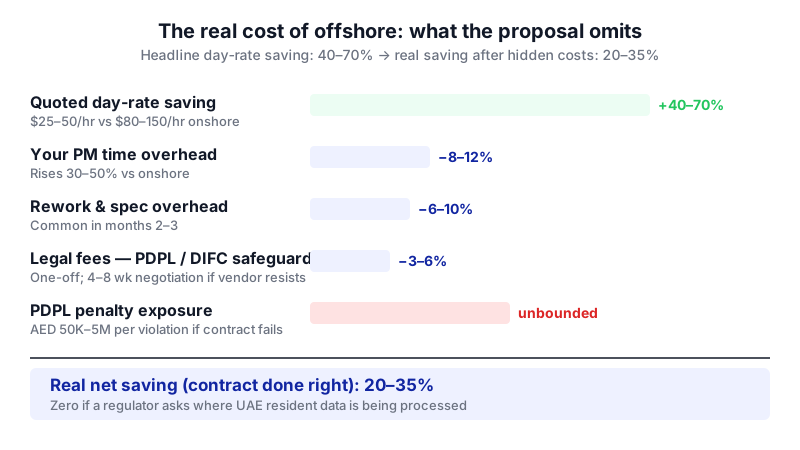
- Offshore: India, Pakistan, Vietnam, Philippines. Day-rates $25–$50/hour — a 40–70% headline saving, which rework and specification overhead typically trim to a 20–35% real saving.
There is a fourth option worth naming: do not hire an agency at all, hire in-house. It is often the wrong answer for a 50–300-person company that needs one product shipped, but it is right if the software is your product and you plan to iterate on it monthly for the next five years.
The five axes that actually decide this
1. Regulated-data exposure
This is the axis that reorders everything else. Ask: does the product process personal data of UAE residents? Health records? Financial data under Central Bank oversight? Government data?

- If yes and you are DIFC-registered: your offshore contract must include DIFC model-clause-equivalent transfer safeguards, a documented sub-processor list, breach notification windows, and audit rights. If the vendor cannot produce these in their standard MSA, assume a 4–8 week legal negotiation to add them, or pick onshore.
- If yes and you are mainland: you need PDPL-grade contractual safeguards. The absence of UAE SCCs means your lawyer will likely adapt GDPR SCCs — a defensible interim position but one that must be reviewed when the UAE Data Office publishes its own.
- If no (internal tools, non-personal data, anonymised analytics): regulatory weight on this axis drops near zero, and the economic case for offshore gets much stronger.
Do not take this analysis from a blog post. Have a UAE-qualified data protection lawyer review the specifics of your data flows before you sign either contract.
2. Total cost of ownership — including the costs nobody puts in the proposal
The quoted day-rate is the smallest part of this.
What the offshore proposal does not show you:
- Your own PM time, which rises roughly 30–50% versus onshore because specification and review burden shifts to you.
- Rework from ambiguous requirements — common in month 2–3 before cadence settles.
- Legal fees to draft PDPL/DIFC transfer safeguards into their MSA (one-off, meaningful).
- Travel for a kickoff and one or two in-person reviews.
What the onshore proposal does not show you:
- Higher churn risk on senior engineers in the Dubai market, where developers get poached frequently; mid-engagement handovers are a real cost.
- IP-assignment clauses in local MSAs that sometimes default to joint ownership or licence-back arrangements — read Section 8 or 9 of every local agency MSA you receive, carefully.
VAT: on an onshore invoice, you pay 5% and recover it as input tax if you are VAT-registered. On an offshore invoice, the reverse charge mechanism applies — you self-account for 5% output VAT and recover the same 5% as input VAT. Net VAT cost: identical. But FTA auditors flag incorrectly-applied reverse charge as one of the most common findings, so your finance team needs to be on top of it. Confirm with your tax advisor before signing.
Currency: AED is pegged to USD, which removes most FX risk on dollar contracts. INR, PHP, VND, EGP contracts introduce real FX exposure over an 18-month engagement. Insist on AED or USD-denominated milestones.
3. Speed to first value
Onshore wins the first four weeks. Standing up a Dubai team is faster: same working week, in-person kickoff, legal entity you can serve process on if things go wrong.
Offshore wins months three through twelve, if the engagement is managed well. Larger talent pools, deeper AI/ML specialisation in the Indian market, and better unit economics let you fund two engineers for the price of one.
If your constraint is "ship something demo-able in six weeks," lean onshore. If your constraint is "we need a product live and iterated for 18 months," lean offshore.
4. Key-person risk and what happens in month six
Ask both vendors the same question: "If I need to end this engagement in month six, what do I own, what do I owe, and how fast can I move?"
You want to hear: full source code in your repo from day one, documented architecture, no proprietary runtime dependencies, no licence-back clauses, 30-day termination for convenience with pro-rated final invoice. If either vendor hesitates on any of those, that is your answer.
Local agencies sometimes have stronger lock-in in their standard MSA because they expect ongoing retainers. Offshore studios competing on price are often more willing to grant clean IP terms — but only if you ask explicitly.
5. Governance and communication cadence
UAE working week is Monday–Friday. India overlaps 4–5 hours of working day with you. Philippines and Vietnam, 4–6. Eastern Europe, 2–3 (which is why nearshore from UAE often means Egypt or Jordan — 1 hour offset, Arabic/English bilingual, familiar with the market).
The real question is not time zone — it is whether the vendor runs a disciplined weekly cadence (written status, demo every two weeks, a named engagement lead who stays for the whole project). Ask for the names and LinkedIn profiles of the people who will actually work on your account. Local or offshore, the right answer is a specific human you can call.
If you are in situation A, do X
Situation A: regulated data, DIFC-registered, 50–150 person company
Default to onshore, or offshore with a DIFC-model-clause-equivalent contract and a signed DPA that your legal team has reviewed. The legal overhead on offshore here can eat 6–10 weeks and meaningful fees — often enough to erase the cost advantage on a single project.
Situation B: non-regulated data, internal tools or B2B software without personal data, 100–300 person company
Default to offshore. The regulatory axis drops out, and the TCO advantage is real. Insist on AED or USD-denominated milestones, full IP assignment, and clean termination terms. Budget for your own PM capacity.
Situation C: AI product build, long roadmap, product is core to business
Default to offshore with a long-term development partner, not staff augmentation. You want continuity, a named engagement lead, and a vendor whose incentives are aligned with product outcomes rather than hours billed. Review their last three case studies for products still live and iterating two years on.
Situation D: six-week POC for a board demo
Onshore. Speed and in-person iteration win. Convert to offshore for the production build after the POC validates.
Situation E: software is your core product and you will ship weekly for five years
Hire in-house, with a partner for the first 6–9 months to compress time to launch. Pure vendor dependence on your core product is a strategic risk no cost model offsets.
What a defensible offshore contract must include
If you go offshore, do not sign the vendor's standard MSA. The clauses to insist on:

- Cross-border data transfer safeguards aligned to PDPL Articles 22–23 (or DIFC model clauses if you are in the DIFC), with a named list of sub-processors and locations.
- Data Processing Agreement (DPA) with 72-hour breach notification, audit rights, and defined data-return/destruction on termination.
- Full IP assignment on all deliverables and work product, effective on payment of each milestone — not at the end of the project.
- AED or USD denomination on all milestones. No local-currency conversion risk.
- VAT clause explicitly noting the reverse charge mechanism applies and the invoice is zero-rated or outside UAE VAT scope.
- Termination for convenience with 30 days' notice and pro-rated final invoice.
- Named engagement lead with a replacement protocol if they leave.
Have a UAE-qualified lawyer review the final document. The cost of that review is small compared to the AED 50,000–5,000,000 range of PDPL penalties.
How CodeNicely can help
We are an India-headquartered studio that has delivered to Middle East, US and India buyers since 2017. Two of our engagements are directly relevant to this decision.
HealthPotli is an e-pharmacy platform processing sensitive health data — the exact regulated-data scenario where contract architecture matters more than day-rate. We designed data handling, consent capture and sub-processor governance so the client could defend their processing posture to regulators and enterprise partners. If your product touches PDPL-scope data, that engagement shape is closer to yours than any generic MVP build.
GimBooks, a YC-backed accounting SaaS, is the pattern for buyers who need a long-horizon product partner rather than a sprint of staff augmentation — multi-year iteration, financial data, VAT and tax compliance workflows built into the product itself.
If you are weighing a Dubai agency against an offshore proposal and want a second look at the clauses, scope, and total cost model before you sign, our UAE engagement team will walk through both proposals with you. We will tell you honestly if onshore is the right call for your specific situation — in a few scenarios above, it is.
Frequently Asked Questions
Does PDPL apply to my offshore vendor even if they have no UAE presence?
Yes. PDPL has extraterritorial reach and applies to any entity processing personal data of UAE residents, regardless of where the processing happens. The practical consequence is that your contract — not the vendor's goodwill — has to impose PDPL-grade safeguards. If the contract does not, enforcement risk sits with you as the data controller.
What does offshore software development actually cost for a UAE buyer?
Headline day-rates are typically $25–$50/hour offshore versus $80–$150/hour onshore. Real net saving after rework, PM overhead and legal setup is usually 20–35%, not the 40–70% the rate card suggests. The two specifics that turn that range into a quote are: scope clarity (fixed-scope vs discovery-mode) and regulatory posture (does it touch personal data). Talk to a vendor who will scope both before quoting.
How long does it take to stand up an offshore engagement in Dubai?
For non-regulated work, 2–4 weeks from first call to first sprint is realistic. For regulated-data work, add 4–8 weeks of legal negotiation to draft PDPL or DIFC transfer safeguards into the MSA. The variables that move the number most are whether your legal team has a template DPA ready and whether the vendor's standard MSA is close to acceptable or needs heavy redlining.
Is VAT recoverable on offshore software development invoices?
If you are UAE VAT-registered, yes — through the reverse charge mechanism, where you self-account for 5% output VAT and recover the same amount as input VAT, making net VAT cost zero. It is one of the most commonly mis-applied VAT treatments flagged by FTA auditors, so confirm the handling with your tax advisor and ensure the vendor invoice is drafted accordingly.
Should I split the work — local for sensitive modules, offshore for the rest?
Occasionally yes, but it adds integration overhead and a second contract to manage. It works best when the sensitive module is small and self-contained (e.g. a payments integration or KYC flow) and the rest of the build is clearly non-regulated. If the data flows through the whole system, splitting rarely helps — you end up with offshore code touching regulated data anyway.
What is the biggest mistake UAE buyers make on this decision?
Signing the vendor's standard MSA without a lawyer. Local agencies sometimes bury licence-back or joint-IP clauses; offshore vendors routinely omit cross-border transfer safeguards. Either leaves you exposed in a way the day-rate comparison never surfaces. A one-week legal review before signature is the highest-ROI step in this process.
Sources & further reading
- Cross-Border Data Transfers Under UAE Law In 2026 — Kayrouz & Associates
- UAE PDPL 2026: Complete Compliance Guide — Orbit/Reconn
- UAE PDPL Compliance Guide 2026 — eShield Consulting
- UAE Personal Data Protection Law (PDPL) — Compliance Guide 2026 — Al Maazmi Lawyers
- Commissioner of Data Protection — DIFC (official)
- Data Export & Sharing: Transferring Personal Data — DIFC (official)
- UAE VAT in 2026: The 5% Guide for Founders — Accounts OS
- Import and Export VAT for Technology in the UAE — Tax Advisors AE
Get one practical guide a week
Costs, AI tools, partner selection — written for people who make the decision. No spam, unsubscribe anytime.
Thanks — you're on the list. One practical guide a week, nothing else.
That didn't work — please check the email address and try again.
Building something in Software & Technology?
CodeNicely partners with founders and tech teams to ship AI-native products that move metrics. Tell us about the problem you're solving.
Talk to our team Book a 30-min call