
What an NDA Before Scoping Actually Protects (and What It Doesn't)

 Published by CodeNicely, the product studio founded by Meghal Agrawal and Ujjwal Agrawal in 2017
For: A CIO or VP-Engineering at an Indian enterprise — financial services, logistics, or healthcare — who has been asked to brief two or three shortlisted dev partners on a confidential AI initiative and is not sure what an NDA signed at that stage actually covers, or whether it is enforceable enough to share the real numbers and process details the vendor needs to scope accurately
In this guide
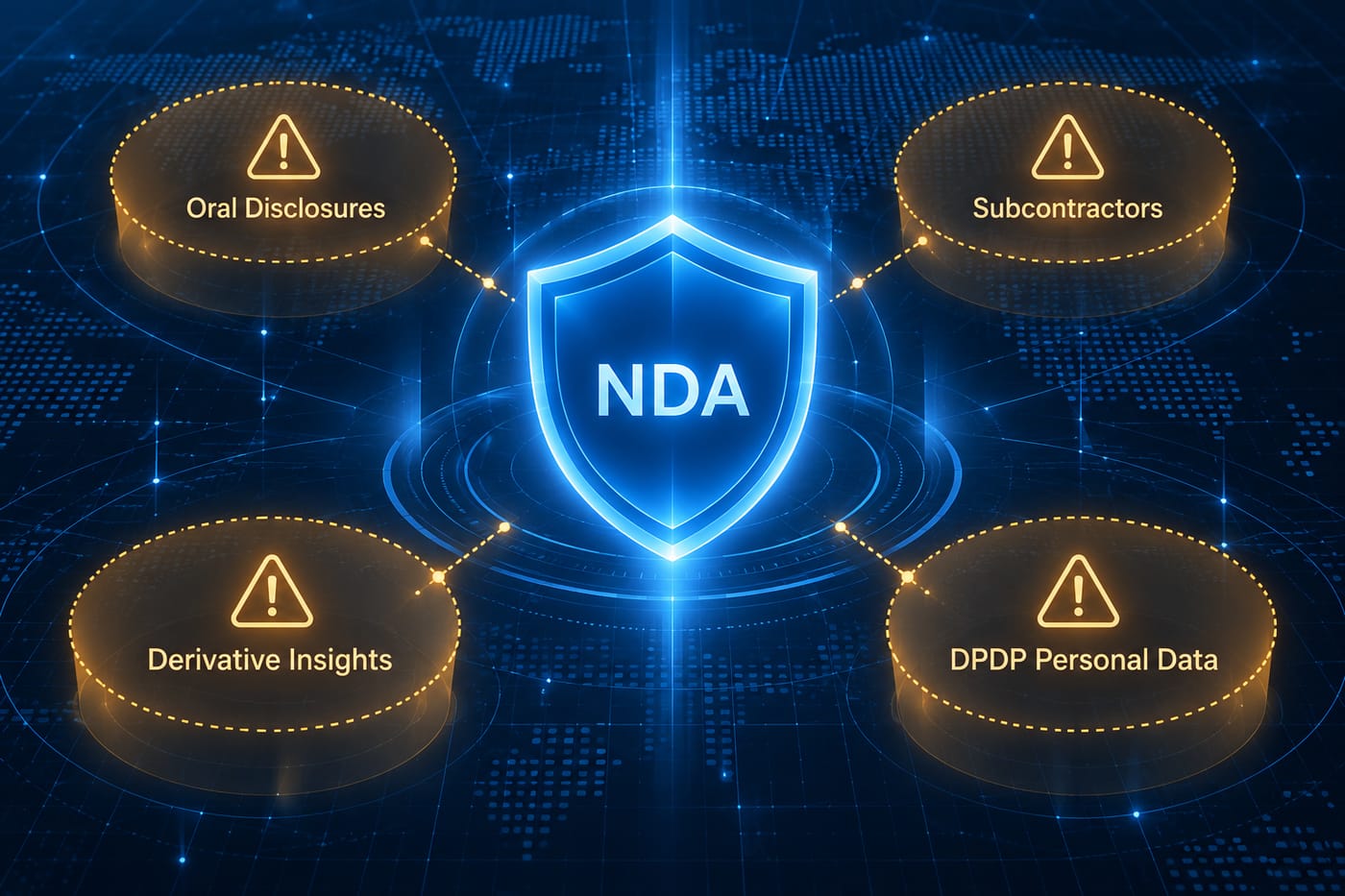
A mutual NDA signed before scoping protects you only to the extent of its exact wording — in India there is no standalone trade secrets statute, so the contract itself is almost the entire source of legal protection. A standard one-page vendor NDA typically covers written disclosures marked confidential, between the two signing entities, for a term of two or three years. What it usually does not cover: oral disclosures made on the scoping call that nobody writes down within the stated window, derivative works and insights the vendor builds on top of your data, and — most importantly — the subcontractors, offshore engineers, and freelance specialists who actually attend the call and hear the details. If your initiative involves personal data, the NDA alone is also not enough; DPDP flow-down obligations now live in a separate data processing addendum.
This post walks through the NDA and its immediate neighbours — the DPA, the sub-processor list, and the pre-contract IP acknowledgment — clause by clause, written for the CIO or VP-Engineering who has to sign it before a lawyer sees the final version. None of this is legal advice. Have your counsel review the actual document before anyone countersigns.
Why the NDA matters more in India than in most jurisdictions
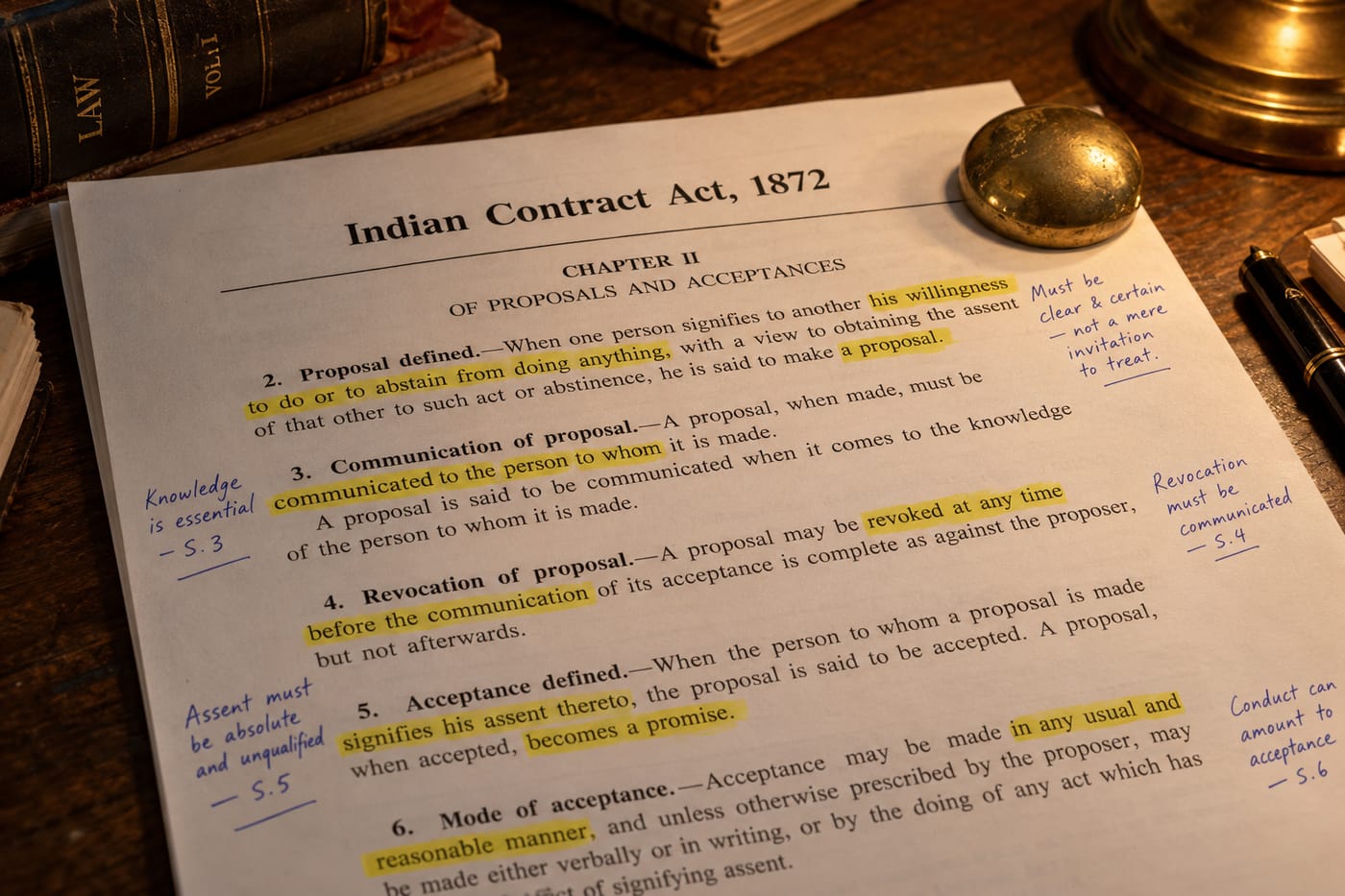
In the US and EU, trade secrets statutes give you a parallel path to protect confidential information even when the contract is silent or sloppy. India has no equivalent dedicated statute — confidentiality is protected mainly through the Indian Contract Act, 1872, which means the NDA's exact wording is often the only legal basis for a claim. This cuts two ways. It makes a well-drafted NDA genuinely powerful. It also means that an overly broad one may be struck down: Indian courts have refused to enforce NDAs that define confidential information too broadly or impose blanket restrictions, treating such clauses as unenforceable under Section 27 of the Indian Contract Act.
The practical consequence: a tight, specific NDA is more enforceable than a sweeping one. Vendors who send you a two-page agreement that purports to cover "all information disclosed in any form, at any time, for any purpose, in perpetuity" are not protecting you better. They are handing you a document a judge may not enforce at all.
The clause-by-clause walkthrough
1. Definition of confidential information
What it is for: drawing the line between what the vendor must protect and what they are free to use.
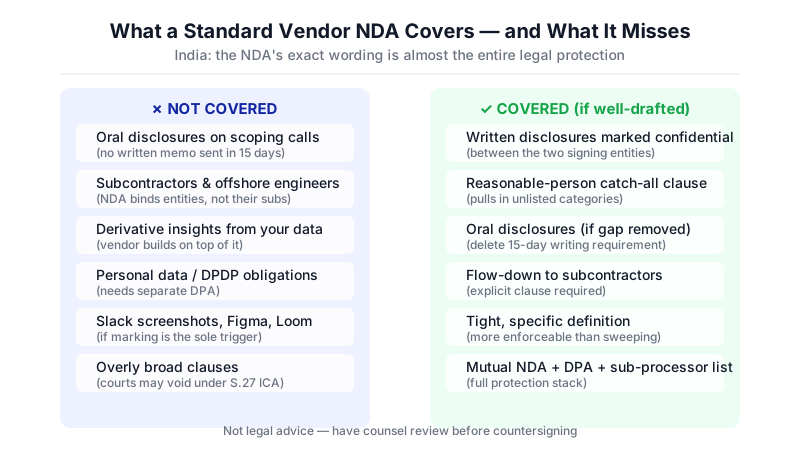
Wording that protects you: a definition that explicitly includes "business processes, system architecture diagrams, API specifications, customer lists, financial metrics, model training data, prompt libraries, and any information that a reasonable person would understand to be confidential given its nature or the circumstances of disclosure." The last clause — the reasonable-person catch-all — is what pulls in things you forgot to list.
Wording that quietly does not: "information marked 'confidential' in writing." This excludes everything you say on a call. It also excludes screenshots shared on Slack, Figma files, Loom recordings, and the architecture whiteboard photo someone took on their phone. If your vendor's NDA uses marking as the sole trigger, you have essentially agreed that oral scoping conversations are not protected.
The question to ask the vendor: "Does your NDA cover oral disclosures made during the scoping sessions, and if yes, do we have to confirm them in writing within a fixed window?"
2. Oral disclosures and the 15-day trap
Many standard NDAs require oral disclosures to be reduced to writing and marked confidential within a fixed period — often 15 days — to qualify for protection, as noted in the Notaro Michalos NDA drafting guidance. Nobody actually does this. Your team runs three scoping calls, discloses revenue numbers, churn rates, your current fraud model's precision — and nobody sends a follow-up memo within fifteen days listing every confidential item that came up.
You have two choices. Either delete the writing-confirmation requirement entirely so all oral disclosures are automatically covered, or assign one person on your side to send a weekly "items disclosed under NDA" email during the scoping phase. The second is more disciplined but requires someone to actually own it. The first is what most Indian enterprises should push for.
3. The subcontractor and sub-processor clause — the one that usually isn't there
This is the non-obvious gap. The NDA you sign is between your legal entity and the vendor's legal entity. It does not automatically bind the vendor's offshore engineers in a different city, the freelance ML specialist they bring in for the generative AI piece, the design studio they subcontract the UX to, or the data labelling firm they use.
A proper NDA includes a flow-down clause: "Receiving Party shall ensure that any employee, contractor, subcontractor, or affiliate who is given access to Confidential Information is bound by written confidentiality obligations at least as protective as those in this Agreement, and Receiving Party remains liable for any breach by such persons as if it were its own breach." The two parts matter equally. The first forces them to have paperwork in place. The second — "remains liable as if its own breach" — means you sue the vendor you contracted with, not some freelancer in a city you cannot locate.
The question to ask: "Who outside your direct employees will be on the scoping calls or have access to the materials we share? Can you list the subcontracting entities, and will you provide copies of the back-to-back NDAs you have with them?" If the answer is vague, your real exposure is wider than the signatures on the front page suggest.
4. Permitted use — the clause that stops scope creep from becoming data creep
The NDA should state that confidential information may be used solely for the purpose of evaluating the proposed engagement and preparing a proposal. Not "for any business purpose," not "for internal research," not "for improving our services."
This matters particularly with AI vendors. If permitted use is defined loosely, the vendor can argue that running your sample data through their internal model to "evaluate feasibility" is permitted — and now your data is in their training pipeline. State explicitly: "Confidential Information shall not be used to train, fine-tune, or evaluate any machine learning model, nor incorporated into any product or service, without the Disclosing Party's prior written consent."
5. Derivative works and residual knowledge
Vendors often slip in a "residuals clause" — language that says the receiving party is free to use any information retained in the unaided memory of its personnel. This sounds reasonable. It is not. In practice it means that if your head of risk explains your fraud scoring logic on a call and a vendor engineer remembers the approach, the vendor can build the same approach for your competitor and claim it as residual knowledge.
Push to strike the residuals clause entirely for the scoping phase. If the vendor insists, limit it narrowly: residuals apply only to general know-how, explicitly excluding specific business logic, financial data, customer data, and model architectures discussed.
The same logic applies to derivative works. The NDA should say that any notes, summaries, analyses, or materials the vendor creates based on your confidential information are themselves confidential information. Otherwise the vendor's internal "scoping deck" that paraphrases your entire process is arguably not covered.
6. Term, survival, and return/destruction
Three dates matter: how long the NDA is in force, how long confidentiality obligations survive after it ends, and how quickly information must be returned or destroyed if scoping does not lead to a contract.
A reasonable structure for a scoping-stage mutual NDA: term of two years, confidentiality obligations survive for five years after termination (indefinite for trade secrets and personal data), and all materials returned or certified-destroyed within 30 days of either party terminating or deciding not to proceed. Ask for a written destruction certificate. Not an email. A signed certificate listing categories of materials destroyed.
Indian courts, as the enforceability analysis in IntoLegalWorld notes, look at whether obligations are reasonable in scope and duration. Perpetual confidentiality clauses on ordinary business information get read down. Five years post-termination for genuinely sensitive material is defensible.
7. Carve-outs — what the vendor is allowed to do anyway
Standard carve-outs are legitimate: information that is already public, independently developed without reference to your disclosures, received from a third party without a confidentiality obligation, or required to be disclosed by law or court order. These should be in your NDA.
Watch for two things. First, the compelled-disclosure carve-out should require the vendor to notify you promptly so you can seek a protective order before they comply. Second, "independently developed" should require the vendor to prove it with documentation — not just assert it. Add: "Receiving Party shall bear the burden of proving independent development through contemporaneous written records."
8. The DPA sits next to the NDA, not inside it
If scoping will involve any personal data — even sample customer records, even anonymised but re-identifiable data — the NDA alone will not meet DPDP requirements. Under the DPDP Rules 2025, notified on 13 November 2025, a Data Fiduciary remains fully accountable even when data is processed by a vendor, and contracts must flow equivalent obligations down to any sub-processor.
The penalties are material. The DPDP Act imposes fines of up to ₹250 crore for a security safeguards failure by a Data Fiduciary, including failures caused by a data processor acting on the fiduciary's behalf. That exposure sits on you, not the vendor, even when the vendor is the one that leaked it.
The practical answer: sign a short Data Processing Addendum alongside the NDA, before any personal data (including sample data for scoping) is shared. The DPA should name the categories of data, purpose, retention period, security controls, breach notification timelines (24 hours is becoming standard), audit rights, and — again — sub-processor flow-down with your prior written approval of each sub-processor by name. Treat the sub-processor list as a living document, updated with any additions.
9. The pre-contract IP acknowledgment
The NDA is not the IP assignment agreement — that lives in the MSA or SOW once you contract. But the NDA should include a one-line pre-contract acknowledgment: nothing in the NDA grants either party any licence to the other's intellectual property, and any work product created during scoping (proposals, architecture diagrams, estimates) remains the sole property of the party that created it, with the other party receiving only a limited right to use it to evaluate the proposed engagement.
This stops two things. It stops the vendor from later claiming that an architecture diagram they drew during scoping is theirs to reuse with your competitor. It also stops you from assuming you own the vendor's reusable frameworks or prompt libraries just because they were shown to you.
Mutual vs one-way, and why mutual is almost always right
Vendors often send a one-way NDA where only you are the disclosing party. Resist this. A mutual NDA is standard for scoping engagements and the 2025 Contracting Benchmark Report cited by Ironclad notes that 90% of NDAs are initiated on a company's own paper — meaning if you want mutual terms, you often have to send your own template rather than mark up theirs.
Why mutual matters: during scoping the vendor will share their approach, reference architectures, pricing logic, and sometimes anonymised insights from other engagements. If the NDA is one-way, you have no obligation to protect any of that — which sounds like your advantage until a vendor refuses to share meaningful detail because they are not protected. Mutual NDAs produce better scoping conversations.
What the NDA still does not do
Even a well-drafted NDA will not: prevent a determined bad actor from leaking (it gives you a damages claim after the fact, not prevention); recover losses that are hard to quantify without a liquidated damages clause (consider adding one for defined breaches); give you injunctive relief automatically (it should explicitly state that breach would cause irreparable harm and that injunctive relief is an appropriate remedy); or substitute for operational controls like limiting what you share, redacting production data, or using a clean room for sensitive demos.
Treat the NDA as the floor, not the ceiling. The operational discipline — who gets what, when, in what form — matters as much as the paperwork.
How CodeNicely can help
We sign mutual NDAs before scoping as a matter of course, and our template includes the sub-processor flow-down, oral-disclosures-are-covered, no-residuals, and DPA-attached provisions discussed above. We are happy to work from your paper instead of ours. For regulated-industry engagements — our work on HealthPotli, which involved prescription data, drug interaction logic, and e-pharmacy workflows subject to strict confidentiality — the NDA and DPA were signed and sub-processors named before the first scoping call. That is the pattern we would recommend for any CIO or VP-Engineering briefing shortlisted partners on an AI initiative where process logic, financial data, or personal data will be shared during discovery.
If you want to see how we structure scoping-phase paperwork for enterprise engagements, our enterprise services page and AI Studio overview describe the handover between NDA, scoping, and signed SOW. None of what we send is a substitute for your counsel's review of the final executed documents.
Frequently Asked Questions
Is a mutual NDA enforceable in India without stamping or notarisation?
An NDA is enforceable as a contract under the Indian Contract Act, 1872 without notarisation, but stamp duty requirements apply and vary by state — in Maharashtra, Karnataka, and Delhi, inadequate stamping can mean the document is inadmissible in evidence until the duty and penalty are paid. For a scoping-stage NDA, pay the stamp duty upfront in the state where it will be signed or enforced. Your legal team should confirm the current rate for your state.
Should the NDA be signed before or after a vendor shortlist call?
Before anything beyond publicly available information is shared. A general capability conversation — "do you do AI work in healthcare?" — does not need an NDA. The moment you want to describe your specific use case, share process diagrams, or discuss internal metrics, the NDA goes in place first. That typically means NDAs with every shortlisted vendor before the first scoping call, not just with the one you eventually pick.
Does the NDA cover the vendor's offshore engineers automatically?
Not automatically. The NDA binds the signing legal entities. Offshore engineers, affiliates in other countries, subcontractors, and freelancers are only covered if the NDA includes a sub-processor or subcontractor flow-down clause that requires the vendor to impose back-to-back obligations on them and remain liable for their breaches. Without that clause, your real exposure is wider than the signatures on the front page suggest.
How long does negotiating a scoping-stage NDA usually take?
What drives it is whether both sides start from a mutual template, whether personal data is in scope (adding a DPA negotiation), and how centralised the vendor's legal review is. A clean mutual NDA between two parties that have done this before can close in days; one that requires DPA negotiation, sub-processor listing, and multiple legal rounds on both sides takes longer. To turn that range into a real timeline, you need to know: is the vendor working from your paper or theirs, is personal data involved, and does either side's legal team require external counsel sign-off. Those are worth clarifying in the first call with CodeNicely or any vendor.
Do we need a separate DPA if the NDA already covers confidentiality?
Yes, if personal data will be shared — including sample or test data. The NDA addresses confidentiality as a contractual obligation between the parties. The DPA addresses your obligations as a Data Fiduciary under the DPDP Act, which are statutory and separate: lawful basis, purpose limitation, retention, breach notification, sub-processor approval, and audit rights. A single document trying to do both usually does neither well. Have your counsel confirm what applies to your specific data categories.
This article is general guidance for technology buyers scoping AI and software engagements in India. It is not legal advice. The specific wording of any NDA, DPA, or related agreement should be reviewed by qualified counsel familiar with your industry, jurisdiction, and the data categories involved.
Sources & further reading
- Gartner Forecasts India IT Spending to Exceed $176 Billion in 2026
- India Enterprise Generative AI Market Size & Outlook, 2030 — Grand View Research
- NDA Drafting In India: Format, Key Clauses, Enforceability — IntoLegalWorld
- Creating Effective Non-Disclosure Agreements: Key Considerations — Notaro, Michalos & Zaccaria P.C.
- Non-Disclosure Agreements (NDAs) In India: Enforcement & Key Challenges — SolomonCo
- How Should Companies Handle Data Shared with Vendors Under DPDP Act? — KS&A Law
- India's Biggest Data Breach — The Legal 500 (DPDP Act penalties analysis)
- Non-Disclosure Agreements (NDAs): Everything You Need to Know — Ironclad
Get one practical guide a week
Costs, AI tools, partner selection — written for people who make the decision. No spam, unsubscribe anytime.
Thanks — you're on the list. One practical guide a week, nothing else.
That didn't work — please check the email address and try again.
Building something in Software & Technology?
CodeNicely partners with founders and tech teams to ship AI-native products that move metrics. Tell us about the problem you're solving.
Talk to our team Book a 30-min call