
From Signed Contract to First Users: The Real MVP Timeline

 Published by CodeNicely, the product studio founded by Meghal Agrawal and Ujjwal Agrawal in 2017
For: A VP of Product or COO at a mid-market US enterprise who has just gotten budget approval for a new internal or customer-facing product and needs to tell the board a credible ship date before they've signed anything
In this guide
If a vendor quotes you eight to twelve weeks for an enterprise MVP, the honest answer to tell your board is sixteen to twenty-four. Not because the vendor is wrong about their build time, but because roughly six of those real weeks sit on your side of the line — legal redlines, SSO provisioning, data extracts, security questionnaires, compliance sign-off — and none of them appear on the project plan you were handed. Enterprise MVPs typically run 12 to 24 weeks from kickoff to launch versus 6 to 12 for a startup, and the single biggest differentiator is decision-making speed on the buyer side.
This post breaks that elapsed time into the five phases a buyer can actually recognise, flags which ones you control, and names the three things that most often add weeks. If you are the VP of Product or COO who just got budget approval, read this before you promise the board a date.
Why vendor timelines and real timelines diverge
A vendor's project plan starts on kickoff day. That is the day a signed MSA, a signed SOW, access credentials, a named product owner, and a working data sandbox are all in the room. In practice those five things almost never arrive on the same day. Procurement cycles alone are long: in Q1 2026, the average software contract took 72 days to finalize from employee request to signature, per Vertice's benchmark data. That is before anyone writes a line of code.
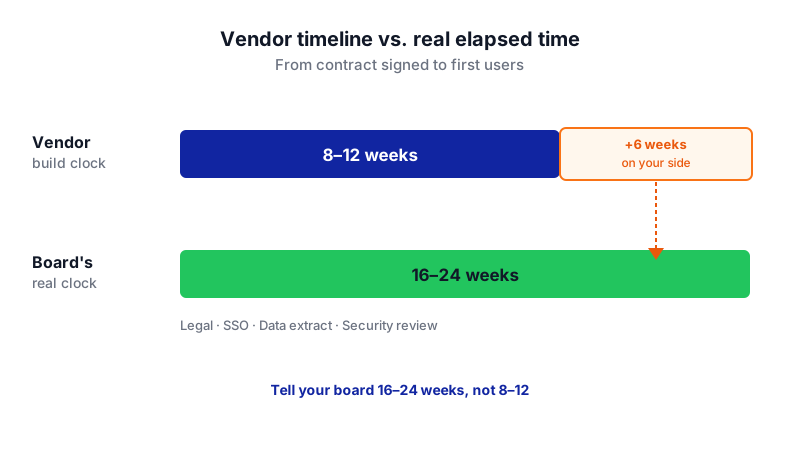

Once the contract is signed, the clock the vendor shows you starts. The clock your board cares about has been running for weeks. And the gap between contract signature and the day the vendor actually gets a working data extract or sandbox API credential from your IT or security team averages three to four weeks on an enterprise engagement — and is almost never line-itemed on the Gantt chart.
This is not a vendor-blaming post. The vendor cannot schedule your SOC 2 reviewer's calendar. But if you report their timeline to the board as the project timeline, you will miss. Around 70% of software projects face significant delays, and in the enterprise segment the number is worse — only 27% of enterprise ERP implementations hit their planned go-live date, per an audit of 640 finished projects. The pattern repeats on custom MVPs for the same reason: governance gaps, not engineering gaps. Panorama Consulting's research is explicit that organizational issues — delayed sign-offs, resistance, alignment — are the most common root cause of over-schedule enterprise projects, not technical failure.
The real timeline, broken into five phases
What follows is the shape of the elapsed time for a mid-market enterprise MVP: a customer-facing or internal product with two or three integrations, authentication through corporate SSO, and some real production data. It is illustrative. The exact weeks depend on specifics named at the end.
Phase 1 — Discovery and scoping (weeks 1 to 3, mostly vendor-led)
What happens: workshops with the product owner, stakeholder interviews, data model sketched, user journeys mapped, non-functional requirements captured (uptime, latency, data residency), and a build plan with a thin first slice identified.
Who controls it: mostly the vendor, but you control attendance. The failure mode here is a product owner who can only give two hours a week, or a stakeholder in a different time zone who ghosts the kickoff. Every missed workshop pushes the thin slice backwards.
Early signal of trouble: you cannot get a single named person who can approve scope decisions without "checking with the committee."
Phase 2 — Integration access and credentials (weeks 2 to 6, almost entirely client-controlled)
This is the phase that silently kills enterprise MVP timelines. The vendor needs: SSO integration (SAML or OIDC) with your identity provider, a sandbox or read-only extract of the production data they will work against, API credentials for every system in scope (CRM, ERP, data warehouse, whatever), VPN or allowlist access if required, and a signed DPA if any personal data is involved.
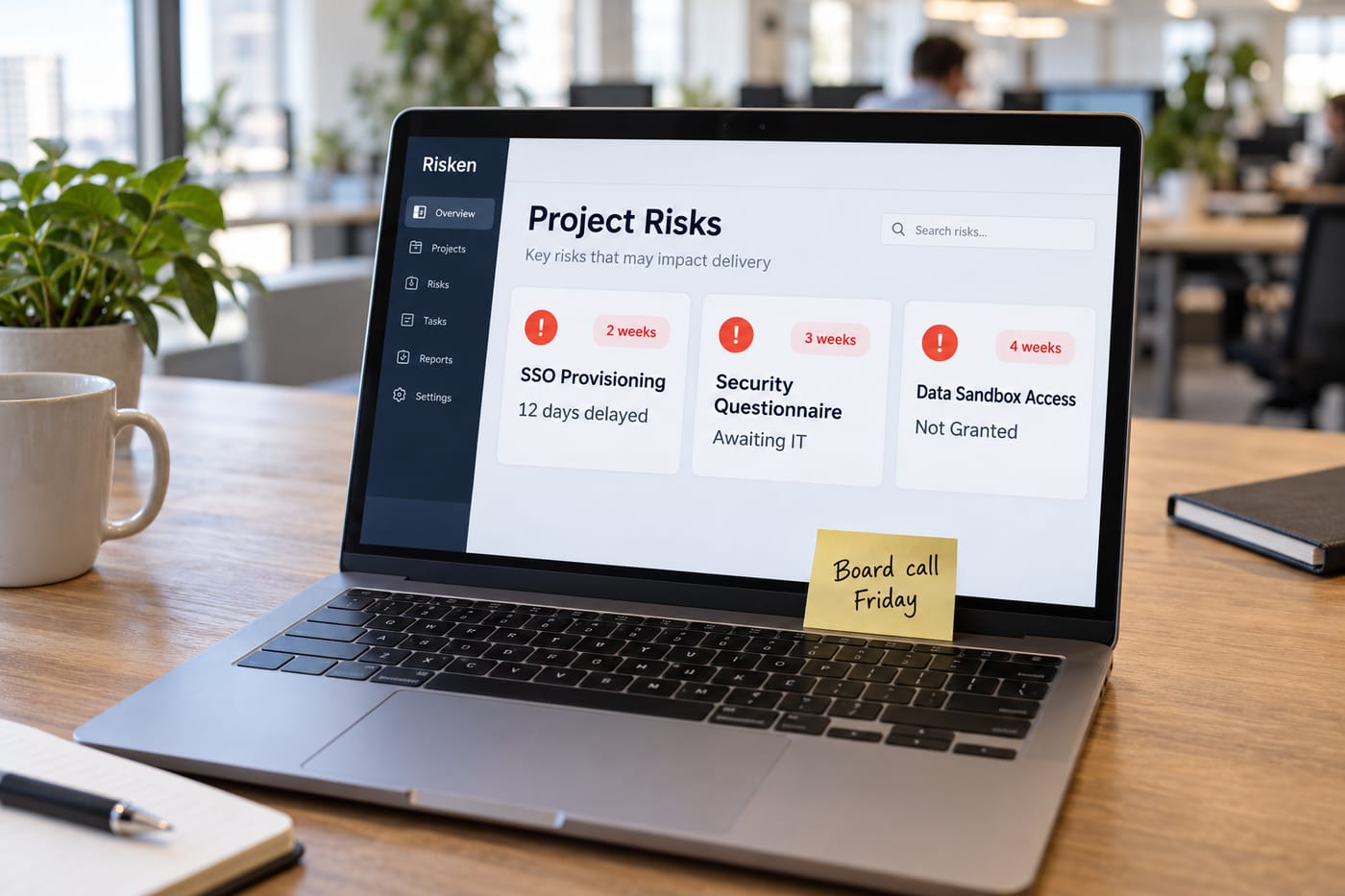
None of these are vendor tasks. All of them require tickets to internal teams — identity, security, data engineering, legal, infosec — each with their own backlog. SSO and just-in-time provisioning alone typically require 3 to 6 weeks of development and testing across identity providers before working credentials exist. If your security team requires a vendor security review before issuing any credential, add two to four more weeks for the questionnaire.
Who controls it: entirely you. The vendor can draft the ticket, can send the questionnaire back same-day, can be in the integration call. They cannot make your IAM team prioritise it.
Early signal of trouble: three weeks after kickoff, no one at your company has been formally assigned as the owner of the vendor-access workstream.
Phase 3 — First usable slice (weeks 4 to 10, mostly vendor-led)
What happens: the vendor builds the thinnest end-to-end path through the product — one user, one workflow, real auth, real data, deployed to a staging environment your team can click through. Not polished. Not feature-complete. Clickable.
This phase overlaps with Phase 2 because good vendors stub out integrations and work against mocked data while they wait for credentials. The thin slice is what unlocks real feedback and real scope decisions. If you reach week 10 without a clickable slice, something is wrong — usually either credentials still have not landed or scope kept expanding during discovery.
Who controls it: vendor controls build velocity. You control feedback loop speed. If the vendor demos something on Friday and the next feedback session is three weeks later, you have given back the time they saved.
Phase 4 — Hardening and compliance (weeks 10 to 16, shared)
What happens: expanding beyond the thin slice to the full MVP scope, security review, penetration testing if required, performance testing against realistic load, accessibility review, documentation, runbook, incident response plan if the product is customer-facing.
This is where the compliance surface becomes visible. If the product touches PHI, PCI, financial records, or EU personal data, your lawyer and your auditor need time with the finished architecture. That review is yours to schedule and yours to pay for, and no vendor can shortcut it. (And to say the obvious: nothing in this post is legal, tax, or compliance advice — your counsel and auditor need to review the specifics of your engagement.)
Who controls it: shared. Vendor builds and remediates. You schedule the reviews and absorb the findings.
Phase 5 — Rollout to first users (weeks 14 to 20+, mostly client-controlled)
What happens: a small cohort — ten to fifty users — gets access. Training materials, support channel, feedback capture, bug triage cadence. You are not launching to the full user base. You are launching to the users who will tell you what is wrong before the full user base finds out.
Who controls it: you. The vendor can deploy on Monday. If change management, user comms, and training are not ready, the deploy sits idle. This is also where resistance-to-change issues appear — the same organizational causes Panorama flags as top enterprise-project killers.
The three things that most often add weeks
1. Security review arriving late
You brought the vendor in to build. Your security team meets the vendor for the first time in week 6 and discovers a dozen things that should have been baked into the architecture — data residency, encryption at rest, logging retention, vendor SOC 2 status. Now you are rebuilding, not building.
Early signal: your CISO or infosec lead was not in the kickoff.
Fix: pull security into the SOW stage. Have them list their requirements before architecture is drawn.
2. The data extract that does not exist
Everyone assumed the data was in the warehouse. It is actually spread across a legacy ERP, two spreadsheets, and a vendor system no one has credentials to anymore. The vendor cannot build against data they cannot see, so they build against mocks and then have to redo the integration layer when the real data finally shows up and does not match the schema anyone described.
Early signal: when you ask "who owns the source-of-truth table for X?" nobody answers in one message.
Fix: run a data-readiness audit in week zero. Not full migration — just confirm what exists, where, in what shape, and who can grant read access. For teams modernising around older systems, a short legacy and data-readiness assessment before kickoff pays back weeks.
3. Scope that keeps shifting after discovery closes
Every new stakeholder who shows up in week 5 wants their feature in the MVP. Each one is a small ask. Together they are a different product. The average IT project delay runs 3.5 to 4 months with an associated financial impact of over $100,000 annually per delayed project for mid-sized firms, per ITitans — and uncontrolled scope is the top mechanical cause.
Early signal: your product owner says yes in meetings without checking the backlog.
Fix: a change-control process agreed in the SOW. New requests go to a parking lot and get prioritised against existing scope, not stacked on top of it.
What you can do in week zero to shorten everything
Week zero is the window between "we have budget" and "we have signed." This is where the compression happens. By the day you sign the contract, you want:
- A single accountable product owner. One name, 50% of their time minimum, authority to make scope decisions without a committee. If you cannot free that person, your timeline is already in trouble.
- Security requirements documented. Data residency, encryption, logging, vendor security posture, SSO requirements, pen-test expectations. Written down. Shared with the vendor before SOW is final.
- A named owner for vendor access. Not a team — a person — whose job is to shepherd SSO provisioning, API credentials, VPN, and data access through your internal queues. This role is invisible on org charts and critical to timeline.
- A data-readiness map. One page: what data does this MVP need, which system is the source of truth, who owns it, can we get a read-only extract today. If any row is blank, start resolving it now.
- Legal review of the standard vendor MSA already underway. Not waiting until SOW. Redlines on a template take weeks regardless of urgency.
- Scope locked at the thin-slice level. Agree with your stakeholders what the first usable slice looks like before the vendor hears about it. Any feature not in that slice goes into v1.1.
Teams that do these six things ship enterprise MVPs closer to the 12-to-14-week end of the range. Teams that do none of them end up at 24 weeks or beyond — and often in the 70%-plus bucket of enterprise initiatives that miss their original business-case goals, which Gartner forecasts for ERP but which generalises to any mid-sized enterprise software build.
What to tell the board
Do not quote the vendor's number. Quote a range, and name what moves it. A credible script sounds like this: "Our vendor estimates 10 to 14 weeks of build. Realistically, with security review, SSO provisioning, and user rollout, we are looking at 16 to 22 weeks from signature to first users. The variables are how fast we assign a product owner, how fast infosec clears the vendor, and whether the data we need is actually accessible. I will have a firmer date four weeks in, once credentials are issued and the thin slice is in staging."
That answer survives scrutiny. The eight-week answer does not.
Frequently Asked Questions
How long does an MVP take to build for a mid-market enterprise?
The industry shape is 12 to 24 weeks from kickoff for an enterprise MVP, per devsx.net's 2026 benchmark, versus 6 to 12 weeks for a startup. From contract signature (not kickoff) the realistic range stretches further because of security review, SSO provisioning, and data access on the client side. To turn the range into a specific number, you need to know how many integrations are in scope, whether the data already lives in an accessible system, and how quickly your security team will clear the vendor. Talk to our enterprise team once those three answers are known.
Why do software MVPs ship late even when the vendor is good?
Because roughly 70% of software projects face significant delays and the top cause is organisational, not technical. Panorama's research on enterprise implementations points at delayed sign-offs, governance gaps, and alignment issues as the biggest culprits. A good vendor cannot schedule your IAM team's calendar or write your legal team's redlines for them.
What is the single biggest hidden delay in enterprise MVP projects?
The gap between contract signature and the day the vendor receives working credentials — SSO access, API keys, a usable data extract. SSO and provisioning alone can take 3 to 6 weeks of development and testing, per SSOJet's implementation data, and the client's internal queues govern most of that time. It almost never appears on the vendor's Gantt chart.
What drives the cost of an enterprise MVP?
Scope (number of integrations and user roles), data complexity (greenfield versus migrating from a legacy system), compliance surface (SOC 2, HIPAA, PCI, GDPR all add real engineering), and team shape (how much is new build versus connecting existing systems). Any firm quote requires those four to be scoped — before that, you are getting a range, not a price. To turn a range into a quote, scope the integrations, confirm data access, and define the compliance perimeter, then bring that to a scoping conversation.
Can we compress the timeline by hiring a bigger team?
Not past a point. The client-controlled phases — security review, data access, user rollout — do not accelerate with more engineers. Doubling the dev team can shave weeks off Phase 3, but if Phase 2 takes six weeks regardless, the overall timeline moves less than you think. The highest-leverage compression lever is week-zero preparation on the client side, not vendor headcount.
Sources & further reading
- Procurement cycle time: 2026 benchmarks — Vertice
- 15 Key Factors That Can Cause Software Project Delays — Webamboos
- ERP Implementation Statistics & Success Rates — Flectic
- ERP Implementation Failure Statistics: 2026 Data & Risks — Xorosoft
- Software Failure Starts with Project Delays — ITitans
- ERP Implementation Failure: Why 70% of Projects Fail — MeltingSpot
- How Long Does It Take to Build an MVP? Startup vs. Enterprise — devsx.net
- Just-in-Time Provisioning Setup Guide for B2B SaaS — SSOJet
Get one practical guide a week
Costs, AI tools, partner selection — written for people who make the decision. No spam, unsubscribe anytime.
Thanks — you're on the list. One practical guide a week, nothing else.
That didn't work — please check the email address and try again.
Building something in Software & Technology?
CodeNicely partners with founders and tech teams to ship AI-native products that move metrics. Tell us about the problem you're solving.
Talk to our team Book a 30-min call