
What to Ask Before Signing an AI Development Contract in the UAE

 Published by CodeNicely, the product studio founded by Meghal Agrawal and Ujjwal Agrawal in 2017
For: A CIO or COO at a UAE-headquartered enterprise — financial services, logistics, or government-linked commercial entity — who has received a shortlist of two or three AI development proposals and is preparing to sign within 30 days, but has never commissioned a bespoke AI build before and is uncertain which contract clauses protect the business versus the vendor.
In this guide
If you are about to sign a bespoke AI development contract with a UAE vendor, the single most important clause to interrogate is the IP schedule — specifically, whether model weights, embedding indexes, and fine-tuned adapters are listed as deliverables you own, or whether they sit under a 'work product' carve-out that leaves them with the studio. Everything else in this interview prep — PDPL cross-border transfer, DIFC Regulation 10 liability, data residency, exit rights — matters, but the weights clause is the one most proposals obscure and the one that locks you in hardest. Below are 16 questions to put to each shortlisted vendor before you sign, with what a good answer sounds like and what should make you walk.
Context on why this matters now: the UAE enterprise AI market generated USD 691.5 million in 2024 and is projected to hit USD 4.78 billion by 2030, a 39.1% CAGR. The AI asset you commission today will govern operations worth multiples of its current scope. A contract that gives away the model is not a small mistake — it compounds.
Part 1: IP ownership and model portability
1. Which specific artifacts transfer to us on final payment — listed by name?
Why it matters: 'Source code and documentation' is not enough. Standard vendor contracts typically grant only a license to use the application while retaining ownership of the underlying model architecture, training pipeline, and weights. The IP schedule needs to enumerate every artifact.
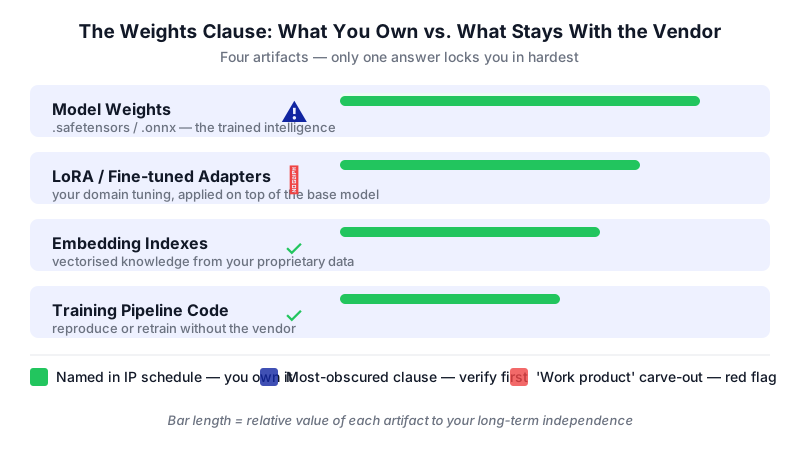
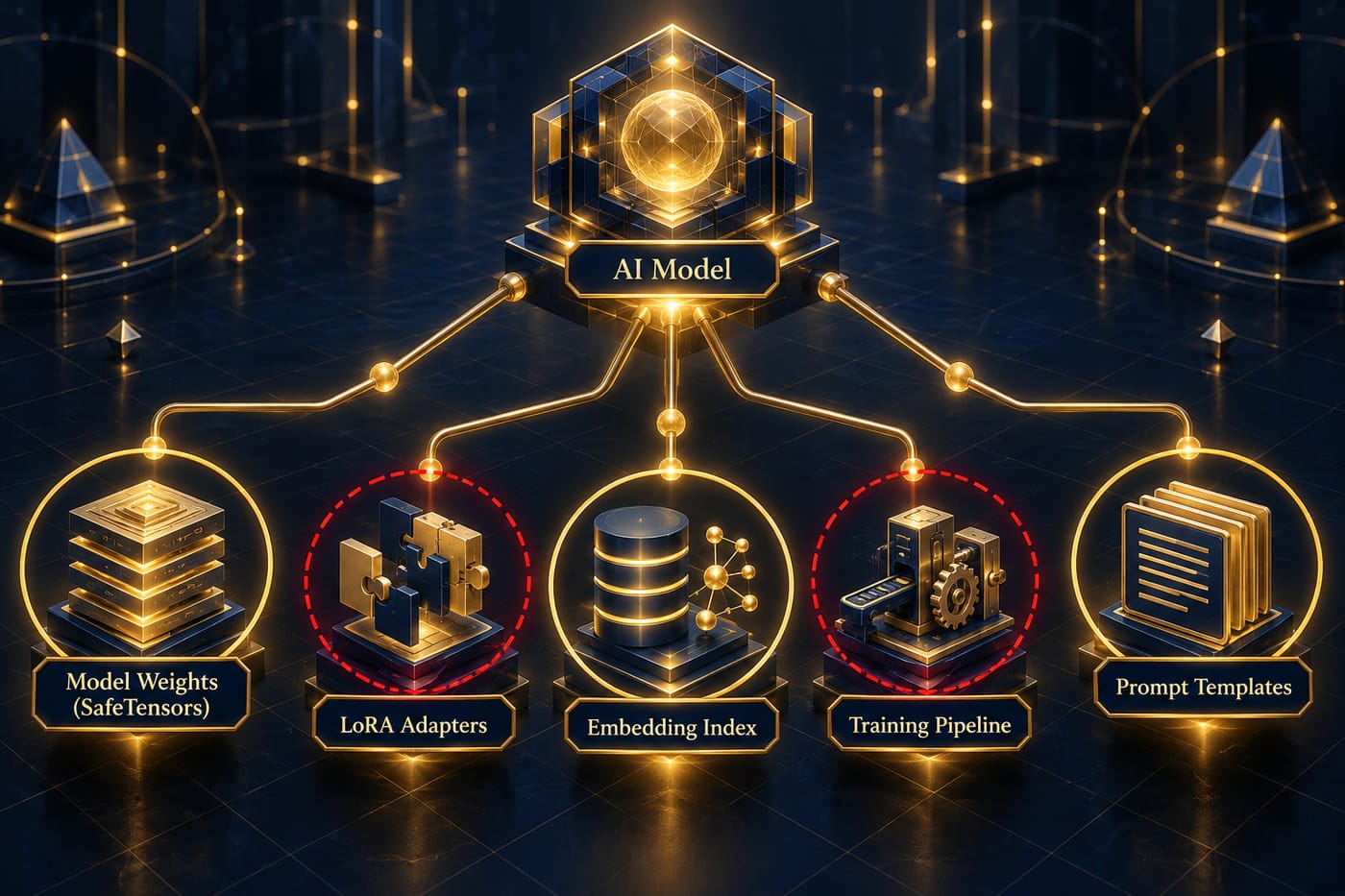
Good answer: "The schedule lists application source, infrastructure-as-code, trained model weights in SafeTensors or ONNX format, embedding indexes, fine-tuned LoRA adapters, prompt templates, evaluation datasets, and the training pipeline code. All transfer on final milestone sign-off."
Red flag: "You own the application and all work product." Ask what 'work product' excludes. If they hesitate on weights, assume you don't get them.
2. If we terminate mid-project, what do we walk away with?
Why it matters: The deliverables schedule often ties IP transfer to final acceptance. If you cancel at month four of a nine-month build, you may own nothing.
Good answer: A milestone-linked IP transfer — every accepted sprint vests the IP produced in that sprint, held in a client-controlled repository from day one.
Red flag: "All IP transfers on final acceptance." This is a hostage clause.
3. Can we export the fine-tuned model and run it on our own infrastructure?
Why it matters: Model weight portability is rarely offered by default — most SaaS AI vendors do not allow clients to export fine-tuned weights, and many contracts explicitly prohibit it. If you cannot move the model, you cannot change vendor, cloud, or jurisdiction.
Good answer: "Yes. We'll deliver weights in a documented format and run a joint export rehearsal before go-live."
Red flag: "The model runs on our platform." That is a SaaS, not a bespoke build. Reprice accordingly.
4. Will our data, prompts, or model outputs be used to train anything else?
Why it matters: This is the clause that lets a studio reuse your proprietary signals on the next client's product. An NDA does not cover it — only an explicit no-reuse clause does.
Good answer: "No. Contract prohibits use of your data, prompts, outputs, embeddings, or derived weights for any purpose outside your engagement, including internal R&D and benchmarking."
Red flag: "We may use aggregated or anonymised learnings to improve our services." In an LLM fine-tune, 'aggregated learnings' is the model.
5. If you use third-party foundation models, what are the pass-through terms?
Why it matters: OpenAI, Anthropic, Cohere, and the Gulf-region hyperscalers each have different data-use, residency, and liability terms. The vendor's contract with you cannot override their contract with the model provider.
Good answer: A written mapping of each third-party dependency, its data processing terms, its residency options, and which obligations flow through to you.
Red flag: "We handle all that upstream." You are the data controller under PDPL. The buck stops at your desk.
Part 2: PDPL, DIFC, and data residency
6. Where will training data, inference traffic, and logs physically reside?
Why it matters: UAE PDPL (Federal Decree-Law No. 45 of 2021) restricts cross-border transfers to adequacy-approved countries or contractual safeguards. The UAE Data Office has not yet published a full adequacy list, so contractual clauses carry the compliance weight.
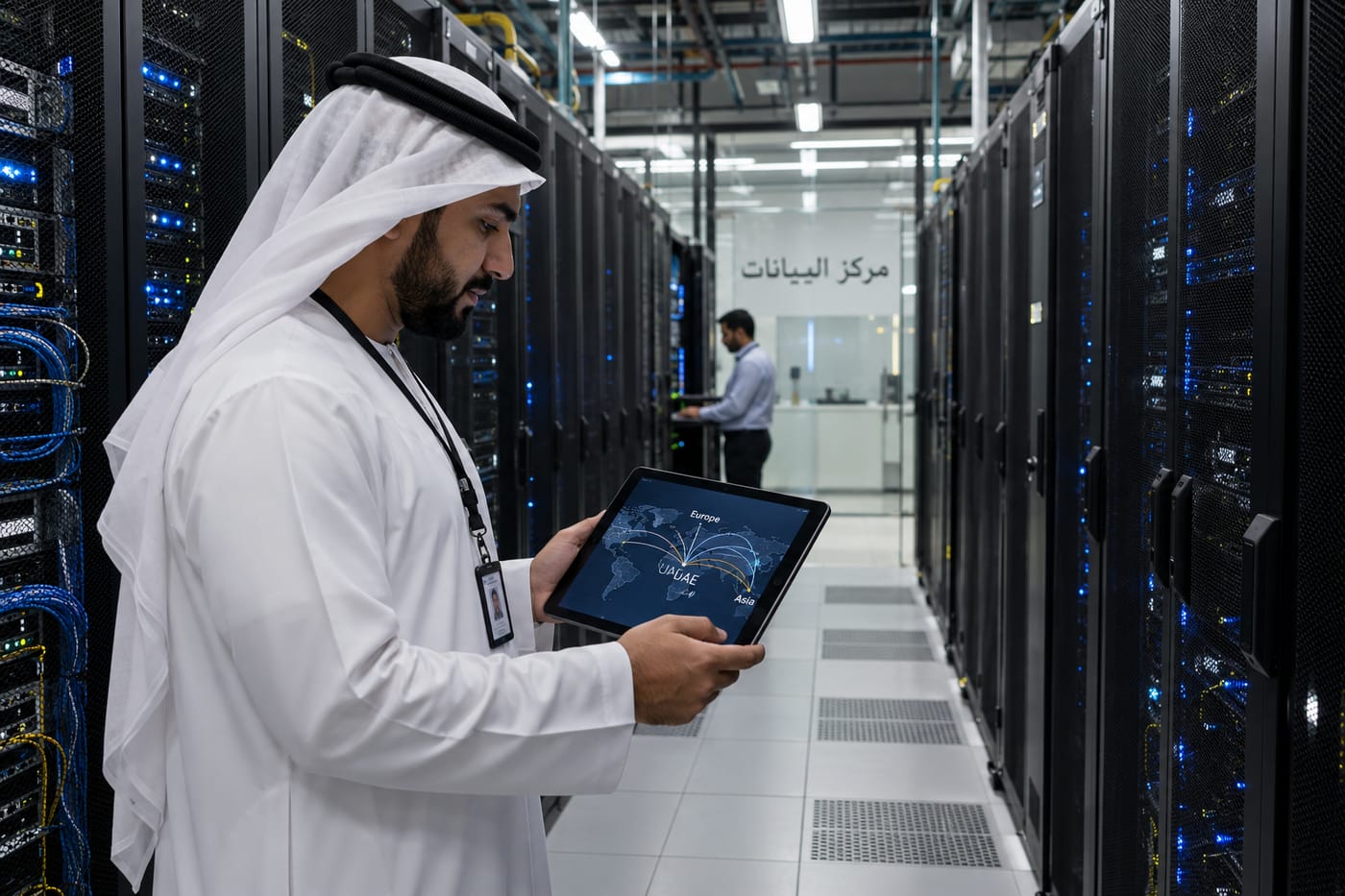
Good answer: Named region, named cloud, named availability zone, separate answers for training data, embeddings, inference logs, backups, and monitoring telemetry.
Red flag: "Within the region" with no specifics, or a single answer that bundles all four data classes.
7. If we are a DIFC entity, how do you handle DIFC-to-mainland transfers in the pipeline?
Why it matters: Mainland UAE is not on DIFC's adequacy list, meaning DIFC-to-mainland data transfers require their own contractual safeguards. Vendors with mainland dev teams routinely move data across this boundary without noticing.
Good answer: A data flow diagram showing every jurisdictional boundary crossed, with the legal basis (adequacy, SCCs, consent) marked on each arrow.
Red flag: A puzzled look, or "DIFC and mainland are both UAE." They are not, for data purposes.
8. How are you preparing for DIFC Regulation 10 enforcement?
Why it matters: DIFC Regulation 10 has been in force since September 2023 and becomes fully enforceable in January 2026, with fines of USD 25,000–50,000 per violation for non-compliant deployers of autonomous AI systems.
Good answer: A documented operator-vs-deployer liability analysis, model cards for each AI component, bias testing records, and a human-oversight log mechanism built into the application.
Red flag: "We'll address compliance at UAT." By UAT the architecture is set; retrofitting oversight is painful.
9. Who is the data controller and who is the processor at each step?
Why it matters: PDPL penalties attach to controllers. Vendors often assume processor status to limit their liability, but in training-data preparation the roles blur.
Good answer: A written RACI across training data ingestion, labelling, model training, inference, and monitoring — with controller/processor designation at each row.
Red flag: "We're always just the processor." Not if they are selecting training data.
10. What is your sub-processor list and how do you notify us of changes?
Why it matters: Labelling vendors, vector DB providers, observability tools, and the foundation model host are all sub-processors. Each is a PDPL transfer point.
Good answer: A current list with a 30-day change-notification clause and a client right to object.
Red flag: "We'll share that under NDA after signing."
Part 3: Security, operations, and the exit
11. What is the incident response SLA, specifically for model-level incidents?
Why it matters: Classic security SLAs cover breaches and downtime. AI incidents include prompt injection, data exfiltration via model outputs, hallucination at scale, and model drift — none of which trigger a standard pager.
Good answer: Named detection controls (output filtering, PII redaction, anomaly scoring on embeddings), a defined triage path, and PDPL breach-notification timelines baked into the SLA.
Red flag: A copy-paste SaaS SLA with uptime percentages and nothing on model behaviour.
12. How do you handle model drift and retraining — and who pays?
Why it matters: A model that was 94% accurate at launch may be 78% accurate at month nine. Retraining cadence, data pipeline cost, and labelling cost are the real total cost of ownership — not the build price.
Good answer: A documented monitoring plan, defined retrain triggers, a labelling-cost model, and a clear separation between warranty-covered drift (vendor pays) and new-data drift (you pay).
Red flag: Silence on retraining, or "we'll scope that in Phase 2."
13. What does the exit runbook look like?
Why it matters: Switching an AI vendor is harder than switching a SaaS. You need weights, data, pipeline code, and institutional knowledge in a form the next team can actually use.
Good answer: A written exit SOP covering weight export, embedding re-indexing, prompt library handover, knowledge transfer hours, and a 90-day transition support window at agreed day rates.
Red flag: "We've never had a client leave."
14. Who signs off on cost and timeline, and what moves them?
Why it matters: Enterprise AI contracts quote a number that assumes a scope that is almost never what you end up building. Buyers need to understand the model of cost, not the headline figure.
Good answer: "Here are the five variables that move the price — number of integrations, data migration volume, labelling effort, residency constraints, and the required accuracy threshold. Change any of these and we re-baseline through a documented change-control process." An illustrative shape: a two-integration pilot on an already-clean dataset with no on-prem residency requirement sits in a very different band from a seven-system enterprise rollout with PDPL-constrained training data and a sub-200ms latency target — the second is often 4-6x the first.
Red flag: A fixed price with no change-control, or a time-and-materials quote with no cap.
15. What does your reference client in our sector actually say — on a call, not in a case study?
Why it matters: Written case studies are PR. A 30-minute reference call with a peer CIO exposes delivery discipline, cost overruns, and post-go-live support quality faster than any RFP response.
Good answer: Two to three named references in regulated UAE industries, with phone intros arranged within the week.
Red flag: "References are confidential" or references only from startups when you are an enterprise.
16. Who on the team you are proposing is actually billable to our project — with names, CVs, and allocation percentages?
Why it matters: The pitch team is rarely the delivery team. In AI projects, the gap between the ML lead who sold you and the junior who writes the retraining script determines whether the model works in 18 months.
Good answer: Named individuals, LinkedIn profiles, allocation percentages, and a contractual key-personnel clause that requires client approval to swap them.
Red flag: "We'll assign the right people from our bench at kickoff."
A note on fabricated urgency
UAE AI procurement is under real time pressure — the federal Agentic AI framework mandates conversion of 50% of government sectors to agentic AI within two years, and 42% of UAE companies have already deployed AI. Vendors will use this urgency to compress your due diligence. A good vendor accepts a two-week contract review. A bad one tells you the slot closes Friday. The pressure is real; the deadline the vendor quotes usually is not.
None of this is legal advice. Every clause referenced above should be reviewed by qualified UAE counsel against your specific entity structure, free-zone status, and sector regulator — DFSA, CBUAE, TDRA, or sector equivalents each layer additional requirements on top of PDPL and DIFC Regulation 10.
How CodeNicely can help
We build bespoke AI products for enterprises and scaleups with full IP assignment — including model weights, embeddings, and training pipelines — and no vendor lock-in. The closest reference for a UAE enterprise buyer is CashPo, where we built AI-driven credit scoring and KYC infrastructure for a regulated lending business. The engagement is instructive because it hit the same three failure modes a UAE financial services CIO is worried about: fine-tuned model ownership (CashPo owns the scoring model, we do not reuse it), regulator-aligned data handling (jurisdictional controls baked into the pipeline, not retrofitted), and documented exit — if they ever moved providers, the model, data, and runbooks go with them.
If you are reviewing shortlisted proposals in the UAE, we can run a clause-level read of what is in front of you against the 16 questions above, flag the IP and residency gaps, and tell you where we would push back — before you sign. Start with our Dubai software development page or the broader AI Studio for how we scope bespoke AI builds.
Frequently Asked Questions
Does an NDA protect our training data from being reused on another client's project?
No. An NDA covers confidentiality of disclosed information, but once your data is used to fine-tune a model, the learned patterns are embedded in the weights. Unless the contract has an explicit no-reuse clause covering data, prompts, outputs, embeddings, and derived weights, the vendor can legally argue the trained artifact is their IP. Add the clause; do not rely on the NDA.
What does a UAE enterprise AI development project typically cost and how long does it take?
There is no honest single answer because the price is driven by five variables: number of system integrations, volume and cleanliness of training data, labelling effort required, residency and sovereignty constraints, and the required accuracy or latency threshold. A narrow pilot on clean data with one integration sits in a different band from an enterprise rollout with PDPL-constrained data and sub-200ms latency targets — often several multiples apart. To turn the range into a quote, a vendor needs scoped answers on those five variables, your target go-live, and your jurisdictional constraints (mainland, DIFC, ADGM, or multi-zone). That is a scoping conversation, not an RFP line item.
Is DIFC Regulation 10 actually enforced yet?
It has been in force since September 2023 and becomes fully enforceable in January 2026 with fines of USD 25,000–50,000 per violation. Any AI system you deploy in 2025 will be inside the enforcement window within its first year of operation, so designing for compliance now is cheaper than retrofitting later. Confirm specifics with DIFC-qualified counsel.
Can we insist on model weights being delivered in a specific format?
Yes, and you should. Specify SafeTensors or ONNX in the IP schedule, require a joint export rehearsal before go-live, and have the exported artifact tested on a second cloud or on-prem environment during UAT. If a vendor cannot or will not export in a portable format, you are buying a SaaS subscription dressed as a bespoke build.
What is the single clause most likely to be missing from the proposal in front of me?
An explicit enumeration of model weights, embedding indexes, and fine-tuned adapters as deliverables transferred to the client. Standard 'work product' language almost never covers these by default, and vendors rarely add them unless the buyer asks. If only one clause gets rewritten before you sign, make it that one.
Sources & further reading
- UAE Enterprise Artificial Intelligence Market Size & Outlook — Grand View Research
- UAE Artificial Intelligence Market Size & Trends — Grand View Research
- The new playbook for AI leadership: The case of the United Arab Emirates — Atlantic Council
- The United Arab Emirates' AI Ambitions — CSIS
- From AI momentum to AI returns: advancing the UAE's competitive edge — PwC Middle East
- The Agentic State: The UAE's Mandate to Run Half of Government on Autonomous AI — Kaplan MENA
- Data Residency in the UAE: 2026 Guide to Requirements, Laws and Cloud Options
- Training Data Residency UAE: PDPL Compliance Guide 2026
Get one practical guide a week
Costs, AI tools, partner selection — written for people who make the decision. No spam, unsubscribe anytime.
Thanks — you're on the list. One practical guide a week, nothing else.
That didn't work — please check the email address and try again.
Building something in Software & Technology?
CodeNicely partners with founders and tech teams to ship AI-native products that move metrics. Tell us about the problem you're solving.
Talk to our team Book a 30-min call