Two-Sided Marketplace Budget: Where the Money Actually Goes

 Published by CodeNicely, the product studio founded by Meghal Agrawal and Ujjwal Agrawal in 2017
For: A founder or COO at a US-based SMB or scaleup who has validated a marketplace concept with spreadsheets and manual matching, has budget authority, and is now getting wildly inconsistent quotes from dev partners — $80K from one, $600K from another — with no framework to explain the gap
In this guide
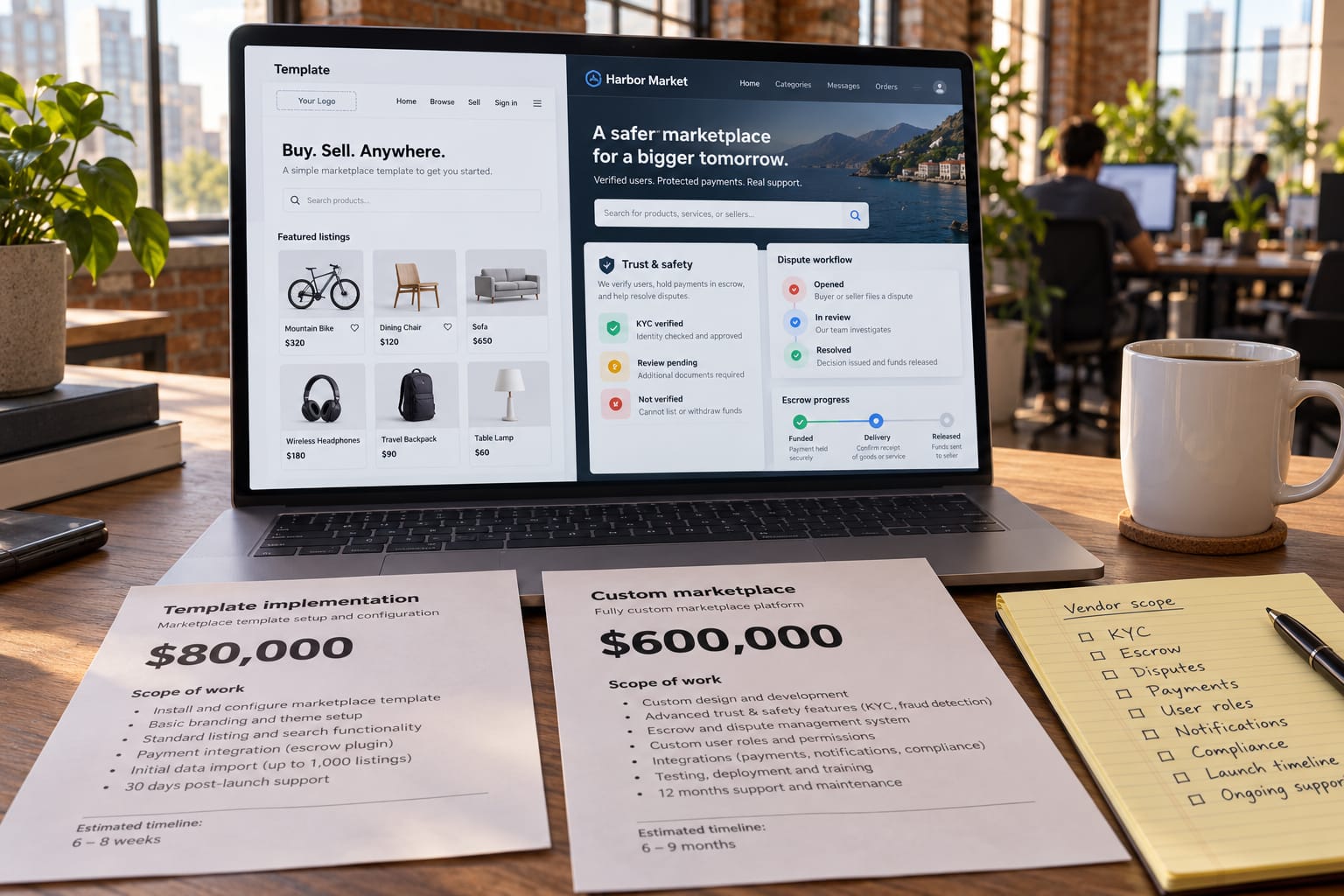
If you have one quote at $80,000 and another at $600,000 for the same two-sided marketplace, both vendors are probably being honest — they are just pricing two different products. The low quote is almost always a Sharetribe or Arcadier template with your logo and a Stripe Connect integration. The high quote is a custom build with real-time availability, identity verification, dispute workflows, escrow, and the operational tooling your ops team will need by month four. Industry benchmarks put custom two-sided marketplace MVPs from US agencies at $120,000–$400,000, with most production launches landing between $150,000 and $300,000, versus $15,000–$25,000 for a basic MVP on a pre-built platform. That is the gap you are seeing. This post explains what sits inside it, which pieces you can defer, and which ones become 40–60% change orders if you do.
The honest shape of the number
A production-grade two-sided marketplace in the US — one that can process payments to independent sellers, verify identities to the standard the INFORM Consumers Act now requires, handle disputes without burning your ops team, and survive a chargeback wave — is a six-figure build. The range is wide because the same “marketplace” label covers everything from a weekend-rental directory with manual payouts to a regulated services platform with instant payouts, KYC, and liability indemnification.
Three things decide where in the range you land:
- How much of the trust-and-safety layer you need on day one — identity verification, dispute resolution, chargeback handling, fraud scoring. This is the single largest driver and the one most commonly scoped out of the cheap quote.
- Whether your payment flow fits inside Stripe Connect's model or requires something custom. Cross-border payouts, split charges between two businesses, or escrow with milestone release all push you past the standard integration.
- Whether real-time matters — real-time availability, real-time pricing, real-time location. Each one adds a layer of backend complexity (websockets, event streams, cache invalidation) that batch-updated marketplaces avoid entirely.
Marketplace builds also carry a structural premium: two-sided apps cost 50–100% more than equivalent single-sided consumer apps, because you are essentially shipping two products — the supply-side onboarding, listing, and payout experience, and the demand-side discovery, booking, and payment experience — that happen to share a database.
The cost drivers, in order of impact
1. Trust and safety (the line item that is never in the first quote)
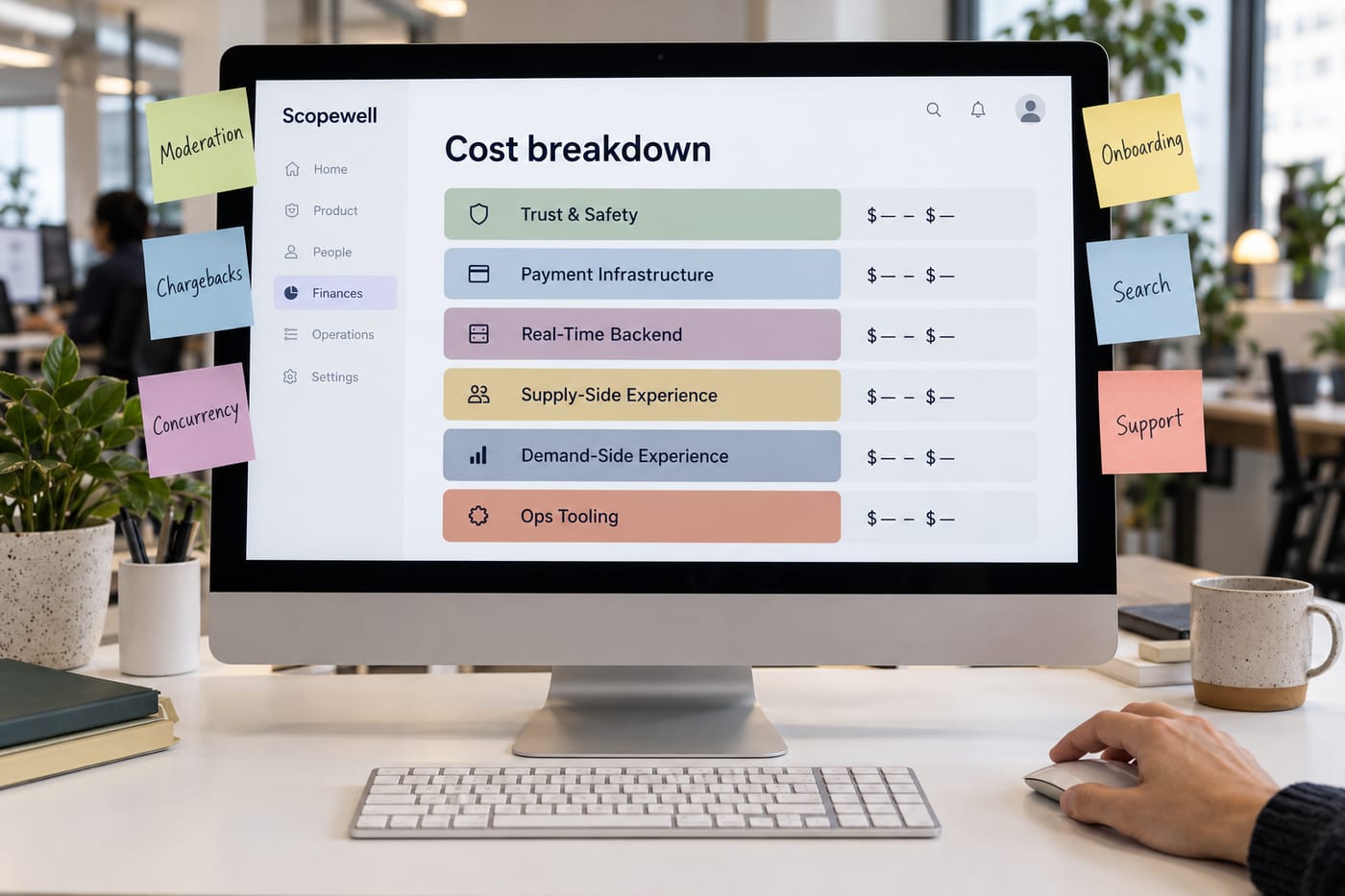
This is where $80K quotes become $200K six months after launch. The trust-and-safety layer has four parts, and they are not optional once you have real transaction volume:
- Identity verification for sellers. The INFORM Consumers Act, effective June 27, 2023, requires US online marketplaces to collect and verify identity and bank account information for any seller with 200+ transactions and $5,000+ in annual revenue, with civil penalties up to $53,088 per violation. This is not a “later” problem — it is a federal compliance obligation the day you cross the threshold, and it means an integration with Persona, Veriff, Jumio, or an equivalent, plus the workflows around re-verification and seller suspension.
- Dispute resolution tooling. Someone needs a console to see both sides of a transaction, read messages, refund partially, release escrow, and ban users. If you do not build this, your ops team will do it by SQL query at 11pm on a Saturday.
- Chargeback handling. Chargeback volume is projected to hit 337 million globally by 2026, up 41% from 2023, with 75–86% attributable to friendly fraud. Marketplaces absorb these in the gap between buyer refund and seller payout clawback, and the tooling to automate evidence submission is a real engineering effort.
- Fraud scoring. US merchants now lose $4.61 for every $1 of fraud, up 37% from 2020. Marketplace-specific fraud (collusion between buyer and seller, listing hijacks, payout redirection) needs its own detection logic beyond what Stripe Radar provides.
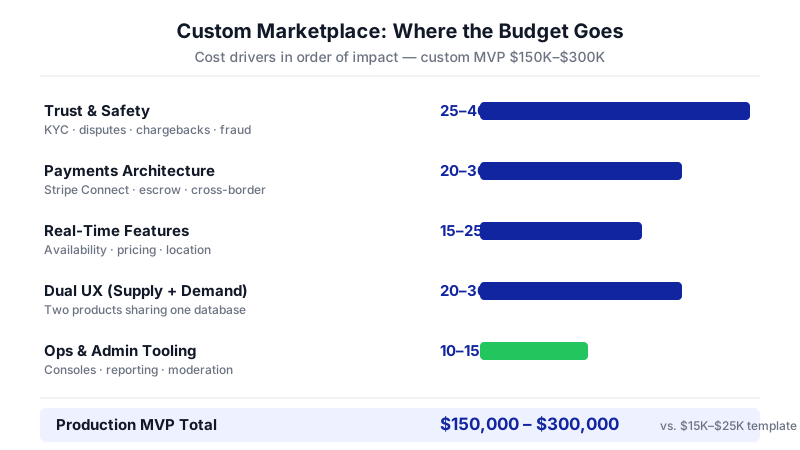
In practice, this layer alone can represent 25–40% of a serious marketplace build. Vendors who leave it out are not being dishonest — they are quoting what you asked for. But marketplace fraud is projected to cost businesses over $343 billion globally by 2026, and that number is the reason trust-and-safety eventually becomes a change order at 40–60% of the original contract value.
2. The payments architecture
Most US marketplaces default to Stripe Connect, and for a domestic services or goods marketplace with sellers in the US, that is usually correct. The problems start at the edges:
- Geography. Stripe Connect is available to marketplace operators in only 46 countries, compared to PayPal's 200+, and the platform and connected account typically have to be in the same region. If you are a US platform planning to onboard sellers in Southeast Asia or Latin America, Connect may not cover you and you are into a hybrid payout architecture.
- Split charges. Standard Stripe Payments legally cannot split a single charge between two businesses — only Connect can, and even then there are structural constraints around who holds funds and who owns the chargeback liability. Workarounds exist but create tax and compliance exposure that compounds fast.
- Escrow and payout timing. If your model requires holding funds until a milestone (job completion, delivery confirmation, dispute window close), you are building workflow logic on top of Connect's manual payouts, plus the reconciliation to match held balances against outstanding obligations.
- 1099 reporting. If you are the payment facilitator, you are responsible for 1099-K reporting to the IRS for US sellers. That is a background job, a reporting dashboard, and an annual process your bookkeeper has to sign off on. (Talk to a tax advisor about your specific reporting obligations — they shift depending on how your payment flow is structured.)
3. Real-time versus batch
“Real-time availability” sounds like a feature. It is a backend architecture decision. A marketplace where availability updates nightly is a CRUD app. A marketplace where two buyers cannot book the same slot at the same instant needs row-level locking, websocket channels, optimistic UI, and a conflict resolution strategy. The engineering difference is roughly 3x — not in lines of code, but in the testing, edge cases, and infrastructure (Redis, pub/sub, connection management) required to make it reliable.
Ask yourself honestly: does your category actually need real-time? Airbnb does not. DoorDash does. Most B2B services marketplaces do not. If your supply side can tolerate a 15-minute lag between booking and confirmation, you have just cut six figures of complexity.
4. Two apps, not one
The supply side and demand side of a marketplace are different products with different users, different jobs-to-be-done, and often different platforms. Buyers usually want mobile. Sellers often want web (easier to manage listings, upload photos, respond to inquiries from a desk). That means at minimum: one mobile app, one web dashboard for sellers, one admin console for you, and a shared backend. The $80K quote almost always assumes a single React Native app serving both roles. That works until your sellers start asking for a desktop experience.
5. The admin console nobody mentions
You will spend as much time inside the admin console as your users will inside the app. Suspending users, resolving disputes, manually releasing payouts, reviewing flagged listings, pulling reports — all of this needs an interface. If it is not budgeted, it gets built reactively, badly, and in the margins of other sprints. Figure 15–20% of the engineering budget for ops tooling that your customers will never see.
6. Data migration from the spreadsheet era
If you have been running the marketplace manually, you have historical data: sellers you have already vetted, buyer accounts, past transactions, reviews, cancellation history. Migrating this cleanly — matching records, de-duping, preserving reputation — is a project in itself. If the data is messy (and it is always messy), budget two to six weeks of someone's time just for the migration.
An illustrative worked example
This is illustrative, not a quote. Every number depends on specifics that a conversation would surface.
Scenario: A US-based services marketplace connecting independent professionals (think: specialised home services) with homeowners. 500 vetted providers already onboarded manually. Target: iOS and Android for buyers, web dashboard for providers, admin console for the ops team. Payments via Stripe Connect (US-only sellers), with 48-hour fund holding before payout. Identity verification required for all providers because the INFORM thresholds will be hit within a quarter. Real-time booking (two buyers cannot grab the same slot).
Where the money goes, as a share of total build (not dollars):
- Buyer mobile app (iOS + Android, React Native): ~20%
- Provider web dashboard: ~12%
- Backend API, booking engine, real-time availability: ~18%
- Payments integration (Stripe Connect, escrow logic, 1099 reporting): ~10%
- Trust and safety (identity verification, dispute console, chargeback workflows, fraud rules): ~18%
- Admin and ops console: ~10%
- Data migration from existing spreadsheets and vendor records: ~3%
- QA, security review, infrastructure setup, deployment: ~9%
For a build of this shape, from a US agency, the $150,000–$300,000 range Bolder Apps cites for production launches is a reasonable starting envelope. Blended US-India teams can land lower; pure US agencies land higher. Timeline for this scope: typically four to seven months of engineering, with another month of beta before you let real money flow.
What pushes it up, what pulls it down
| Pushes cost up | Pulls cost down |
|---|---|
| Cross-border sellers (Stripe Connect geography limits) | US-only sellers on Stripe Connect Express |
| Real-time availability and matching | Batch availability updates (hourly or daily) |
| Escrow with milestone release | Immediate payout after transaction |
| In-app messaging with media attachments | Email or SMS notifications only |
| Native iOS + Android separately | React Native or Flutter for both |
| Custom fraud scoring and ML risk models | Stripe Radar plus rule-based flags |
| SOC 2 or HIPAA scope on day one | Deferring compliance to post-PMF |
| Migrating historical data from messy spreadsheets | Starting fresh with new provider onboarding |
| White-label apps for enterprise partners | Single-brand consumer product |
| Multi-currency and multi-language from launch | US-only, English-only MVP |
Build versus buy: when the $25K template is actually right
There is a defensible case for starting on Sharetribe, Arcadier, or CS-Cart. If you are still validating demand, if your category tolerates generic UX, and if you can live with the platform's payment and payout model, a template saves you six months and six figures. The honest tradeoff: you will outgrow it the moment your category needs anything the template did not anticipate — a custom booking flow, a non-standard commission structure, integrations with industry-specific tools, or trust-and-safety workflows beyond what the template exposes.

A useful decision rule: if your core differentiation is the matching logic itself (a smarter algorithm, a vertical-specific workflow, a trust mechanism competitors do not have), build custom. If your differentiation is supply acquisition and brand, and the product can look like every other marketplace, buy and customise. Most founders know which they are honestly in; vendors will tell you whichever answer closes the deal.
How CodeNicely can help
We built Vahak, a logistics marketplace connecting truck owners and shippers, from zero through to one of India's largest trucking networks. That build hit every one of the problems above — two-sided onboarding with different needs on each side, identity verification for compliance, dispute resolution at scale, real-time location and availability, and payment flows that did not fit any off-the-shelf model. The reason it is the relevant case study for a US founder reading this: the trust-and-safety layer, the ops tooling, and the two-app architecture are structurally the same whether the sellers are truck owners in Maharashtra or home-service providers in Texas. The regulations differ; the engineering shape does not.
If you are a US-based founder weighing marketplace quotes, our US delivery team can walk through your scoped quotes and tell you honestly what is missing from each. We also publish our service model openly: you own the IP, you own the code, and there is no vendor lock-in on the infrastructure.
The three questions that turn a range into a quote
Before you ask any vendor for a revised number, be able to answer these three. The quote you get back will be an order of magnitude more useful.
- What is your trust-and-safety floor on day one? Specifically: are you willing to launch without identity verification, without a dispute console, and without automated chargeback handling? If no, those three alone are the difference between the $80K quote and the serious one.
- Where are your sellers, and how do they get paid? US-only on Stripe Connect Express is one answer. Cross-border with escrow release on milestones is another, and it is not the same product.
- Does your category require real-time, or can you tolerate a 15-minute lag? This single answer swings the backend architecture (and therefore the budget) more than any other scope decision.
A vendor who gives you a fixed number before you have answered these is pricing a product they have decided you need, not the one you actually need. Walk the next quote through these three and see which numbers move. That is where the real cost of your marketplace lives.
Frequently Asked Questions
Why is one quote $80K and another $600K for the same marketplace?
Because they are not the same product. The low quote is almost always a pre-built platform (Sharetribe, Arcadier) with light customisation and Stripe Connect dropped in; the high quote is a custom build with identity verification, dispute tooling, real-time features, and a proper admin console. Industry data puts custom US agency builds at $120K–$400K and pre-built platform MVPs at $15K–$25K — both ends are legitimate, they are just answering different questions.
Can I just use Stripe Connect and skip the rest of the trust-and-safety layer?
You can launch that way, but you will hit the ceiling fast. The INFORM Consumers Act legally requires US marketplaces to verify seller identities past 200 transactions and $5,000 in annual revenue, with penalties up to $53,088 per violation. On top of that, chargebacks and friendly fraud (now 75–86% of all chargebacks per Chargebacks911 data) will overwhelm a manual ops process within months of real volume.
How long does a two-sided marketplace actually take to build?
For a production-grade MVP with the trust-and-safety layer included, four to seven months of engineering is a realistic shape, with another month of controlled beta before you let real money flow at scale. What moves the timeline most: scope of the trust-and-safety layer, whether you need real-time features, and whether you are migrating historical data. Any vendor committing to a specific delivery date before scoping those three is guessing.
Should I build native iOS and Android, or use React Native?
For most marketplaces, React Native is the right default — it cuts mobile development cost roughly in half and the performance ceiling is high enough for booking, messaging, and payment flows. Go native only if you have specific requirements React Native handles poorly: heavy AR/camera work, deep hardware integration, or sustained background processing. For the buyer-side of a services or goods marketplace, this is almost never the case.
What is the single most common thing that gets scoped out of the first quote?
The admin and ops console. Vendors scope the two user-facing apps and the backend because those are what you asked about, but the internal tooling your ops team uses every day — dispute resolution, user suspension, payout holds, flagged-listing review — is often an afterthought that gets built reactively after launch. Budget 10–20% of the engineering effort for ops tooling you will never show a customer, or your team will build it in SQL at midnight.
Sources & further reading
- Marketplace App Development in 2026: Architecture, Cost, and Two-Sided Complexity — Bolder Apps
- Stripe Connect for Marketplaces: Features, Fees, and Payouts — Sharetribe Academy
- Stripe Fees Explained for Marketplace Operators (2026) — Drop Desk
- Marketplace Identity Verification: A Guide — Didit.me (citing Juniper Research)
- Chargeback Statistics 2026: Rates, Forecasts, and Costs — Chargeflow
- 52 Ecommerce Fraud Statistics You Need to Know in 2026 — Ringly.io (citing LexisNexis)
- State of Chargebacks 2026 — WinningChargebacks.com
- INFORM Consumers Act Imposes New Requirements for Online Marketplaces — DLA Piper
Get one practical guide a week
Costs, AI tools, partner selection — written for people who make the decision. No spam, unsubscribe anytime.
Thanks — you're on the list. One practical guide a week, nothing else.
That didn't work — please check the email address and try again.
Building something in Software & Technology?
CodeNicely partners with founders and tech teams to ship AI-native products that move metrics. Tell us about the problem you're solving.
Talk to our team Book a 30-min call