_1751731246795-BygAaJJK.png)

Build an Internal Tech Team or Keep Your Dev Partner?

 Published by CodeNicely, the product studio founded by Meghal Agrawal and Ujjwal Agrawal in 2017
For: COO or CTO at a 200–800-person Indian enterprise that has been running a core product on an external dev partner for 18–36 months and is now fielding board pressure to 'bring engineering in-house' before the next funding or IPO readiness review
In this guide
If your product has been running on an external partner for 18–36 months and the board is pushing to bring engineering in-house, the honest answer is: don't make this a binary. The total-cost-of-ownership break-even between a five-person internal team and a milestone-priced partner typically lands at month 22–28, not at hire date — and the deciding factor is almost never salary. It's the four to six months of ramp before new hires match partner velocity, the 4.81% gratuity accrual that starts on day one, and the institutional knowledge that walks out the door the moment you switch models without a transition plan. This post gives you the five axes that actually decide it, scores the three realistic options honestly, and tells you which situation calls for which move.
Reframe the decision the board is asking you to make
The board's instinct — "in-house means control" — is directionally reasonable and quantitatively wrong. Control is a function of IP ownership, code access, documentation quality, and the ability to change direction in a quarter. None of those require W-2 employment. Several of them get worse when you hire fast to hit a headcount number before an IPO readiness review.
The real decision in front of you is not in-house vs outsourced. It's a choice among four operating models:
- Full in-house — you hire, manage, and bench-fund the entire engineering function.
- Full external partner — milestone or retainer pricing, partner owns delivery, you own IP and roadmap.
- Hybrid with internal core — you hire 3–6 senior engineers who own architecture, security, and roadmap; partner handles delivery capacity.
- Staff augmentation — individual contractors sit inside your team under your management, billed hourly or monthly.
Gartner's 2025 CIO Survey found 48% of enterprises are moving from project-based outsourcing to dedicated-team and staff-augmentation models — a structural acknowledgement that pure versions of either extreme fail at scale. Keep that in mind before you let anyone frame this as a two-option choice.
The five axes that actually decide it
1. Fully-loaded cost, not CTC
The offer letter number is the smallest part of what a senior engineer costs you in India. Senior engineers in Bengaluru command a median total compensation of ₹30–60L, with the 75th percentile at ₹45L for product-company bands. Add to that:
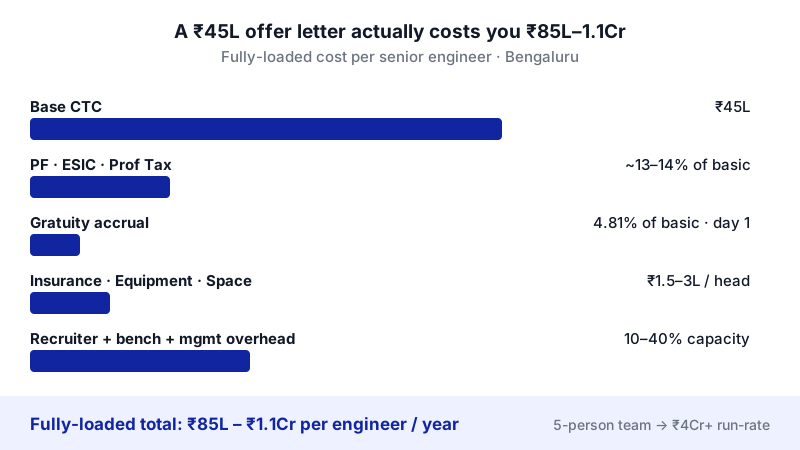
- Employer PF, ESIC, and professional tax (roughly 13–14% of basic)
- Gratuity provisioning — approximately 4.81% of annual basic pay, accruing from day one under the Code on Social Security 2020
- Health insurance, equipment, software licenses, workspace (even in a hybrid model, ₹1.5–3L per head per year)
- Recruiter fees (8–12% of first-year CTC for the roles you don't fill in-network)
- Bench time between sprints — typically 10–15% of annual capacity in a product with uneven roadmap pressure
- Management overhead — a first-time engineering manager typically absorbs 30–40% of a senior IC's output in the first year
Model it honestly and a ₹45L offer becomes ₹85L–1.1Cr of fully-loaded annual cost. For a five-person team with one lead, you're looking at a run-rate well north of ₹4Cr before the first production commit lands at partner-equivalent quality. None of this appears on the board deck that recommends "let's just hire."
2. Time to first production value
This is where most board-level decisions quietly implode. Average time-to-hire for a full-time IT role in India hit 78 days in 2026, up from 64 days in 2023. That number doesn't include the 60–90-day notice period a senior hire owes their current employer. So the realistic calendar from "approve the req" to "new engineer sitting in your standup" is five to six months.
Then add ramp. A senior hire joining a mature codebase typically needs 90–120 days before they're shipping production-quality work at partner-equivalent velocity. Call it eight to ten months, offer-letter to real throughput — per seat.
And it gets worse. 28% of accepted tech offers in India result in no-shows or candidate drops before joining. That means to fill five seats, you're likely running seven offer cycles. If the board is expecting internal engineering to be shipping at parity by the IPO readiness review in two quarters, the math simply does not work.
3. Key-person and institutional-knowledge risk
This is the axis nobody models and it's often the one that matters most. After 18–36 months on your product, your development partner's senior people know things that are not written down: the one legacy integration that breaks if you deploy on a Thursday, the customer whose data model doesn't fit the schema, the three business rules that live only in a product manager's head.
If you transition cold — fire the partner, hire a team — you lose all of that. McKinsey estimates 40% of enterprise technology balance sheets consist of technical debt, and clearing it costs $1.52 for every $1 of initial development spend. A badly-executed in-house transition is one of the fastest ways to materially grow that number.
Conversely, the risk of staying with a partner forever is concentration: if two senior partner engineers leave or the partner's priorities shift, you have no fallback. The honest answer is that both models have key-person risk; they're just differently distributed.
4. Optionality — what happens if you change your mind in month six
Internal teams are hard to unwind. Layoffs in India trigger notice-pay and severance obligations under the Industrial Disputes Act, management time, PR exposure if you're near a funding round, and gratuity payouts for anyone who crosses the five-year threshold (15 days' last-drawn wages per completed year, capped at ₹20L tax-free). A partner contract typically unwinds in 30–90 days with a clear exit clause.
If there's any realistic scenario — pivot, acquisition, funding delay — where you'd want to materially change engineering capacity in the next 12 months, that asymmetry matters a lot.
5. Strategic defensibility
Some things genuinely belong in-house: core IP, security architecture, data models that encode your competitive moat, anything that touches regulated flows you'll be audited on. Some things don't: delivery capacity for well-scoped features, platform modernization, mobile apps, admin tooling.
Gartner's 2024 data shows mature engineering organisations allocate on average 24% of R&D expenditure to outsourcing, and that share is expected to grow. The right question isn't "in-house or not" — it's "which 20–30% of our engineering work genuinely needs to be external, and which 70–80% must be ours?"
Scoring the three realistic options
| Axis | Full in-house (5 engineers) | Extend partner (status quo) | Hybrid: 3 internal + partner capacity |
|---|---|---|---|
| Year-1 fully-loaded cost | Highest — ramp cost with limited output | Lowest — known run-rate | Mid — internal cost offset by reduced partner scope |
| Time to parity throughput | 8–14 months | Immediate (already there) | 4–6 months for internal; partner holds the line |
| Key-person risk | Diversified across 5 hires, but ramp-stage fragile | Concentrated in partner's senior staff | Lowest — internal owns context, partner provides depth |
| Unwind cost at month 6 | Very high — severance, gratuity accruals, morale | Low — contract exit clause | Low to mid — partner scales down, core team stays |
| Board optics for IPO/funding | Strongest — "we own engineering" | Weakest — "you depend on a vendor" | Strong — "we own strategy, partner provides scale" |
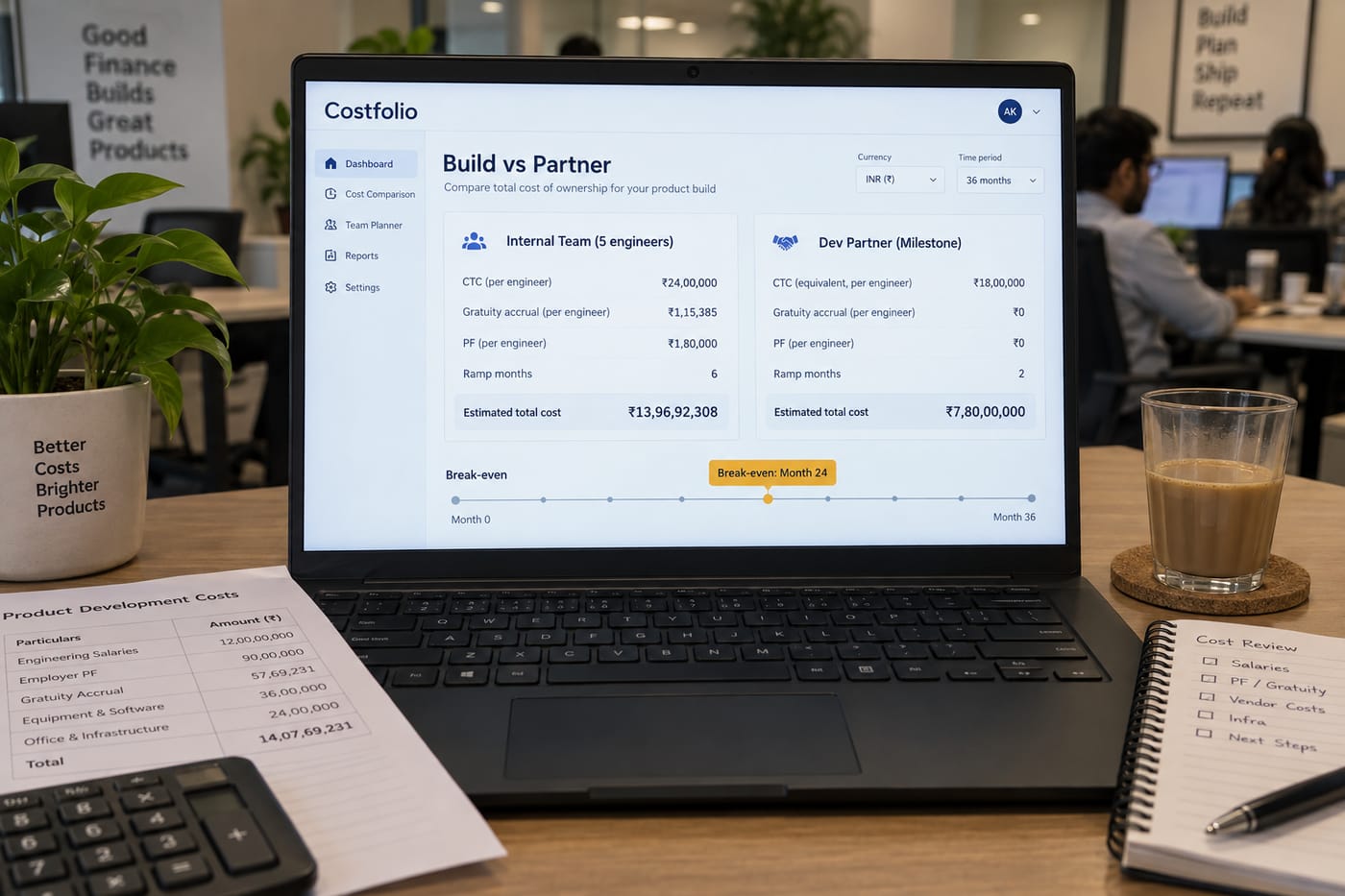
| Break-even vs partner on TCO | Month 22–28, if hiring goes well | N/A | Month 14–18 |
The honest case against hiring any external partner
Partners fail you in three specific ways and you should know them. First, incentive misalignment on milestone pricing — the partner optimises for scope sign-off, not product outcomes. Second, bench depth illusion — the senior engineer who built your platform may be on another client by Q3. Third, the roadmap drift tax — every quarter you don't own the architecture is a quarter you're one layer removed from the decisions that compound.

If your product is now your business, and your technical moat is the product, you need engineering ownership somewhere internal. The question is scope, not whether.
If you're in situation A, do X
Situation A: Product is stable, roadmap is predictable, next 12 months are feature delivery
Extend the partner. Hire one or two senior internal engineers for architecture and security ownership only. You don't need five hires. You need the right two. Spend the saved budget on better contractual terms with the partner — IP escrow, named-engineer continuity clauses, documentation SLAs. Revisit at month 12.
Situation B: You're 6–18 months from IPO or Series C, board wants engineering story
Go hybrid: hire 3 senior internal engineers over 6 months, keep partner for delivery capacity. This is the model that actually scores well on every axis. You get the board narrative ("engineering is owned in-house"), you keep velocity (partner carries the sprint load), and you de-risk the transition. Build an explicit 9–12 month knowledge transfer plan into the partner contract — paid, scheduled, documented.
Situation C: Product is core IP, roadmap requires deep domain expertise, you're funded for 24+ months
Build the full internal team, but phase it over 18 months, not 6. Keep the partner as overflow capacity for the first 12 months. Accept the cost. The strategic answer dominates the financial one here.
Situation D: Partner relationship has deteriorated, quality is slipping, cost is rising
Don't confuse "this partner isn't working" with "we need to go in-house." Those are different problems. Run a parallel evaluation of two alternative partners before you commit to a hiring plan that will take six months to even start producing output.
How CodeNicely can help
Most of our enterprise engagements don't start as pure outsourcing. They start as hybrid structures where our team provides delivery depth while the client's internal engineers own product strategy and architecture. GimBooks, the YC-backed accounting SaaS, is the clearest example — we worked alongside their internal team as they scaled, with explicit handoff checkpoints and shared code ownership from day one. The engagement was structured so that if they chose to bring more work in-house at any point, there was no cliff: documentation, context, and architectural decisions were already shared.
If you're deciding whether to extend a current partner, replace one, or build the hybrid model described above, we're happy to walk through the TCO math for your specific situation — including the knowledge-transfer plan that most proposals skip. Our enterprise practice and digital transformation work is built around this exact decision point. Full IP ownership, no vendor lock-in, and exit terms designed to make the transition reversible — which is the only honest way to structure a partnership that might end.
The bottom line
The board is right that engineering ownership matters. They're wrong that ownership requires full headcount. The decision isn't in-house vs partner — it's which 20–30% of your engineering work must be internal, how fast you can realistically ramp it, and what the transition plan looks like for the rest.
Before you approve a hiring plan, model three things the first draft always misses: the 8–10 month gap between offer letter and parity throughput, the 4.81% gratuity accrual and other employer costs that turn ₹45L offers into ₹85L–1.1Cr fully-loaded, and the institutional knowledge cost of a cold partner transition. If those three numbers change the recommendation — and they usually do — the hybrid model is the answer for most enterprises in the 200–800-person band.
Frequently Asked Questions
What is the fully-loaded annual cost of a senior engineer in Bengaluru or Pune in 2026?
The visible CTC is one input. For a senior engineer at a ₹40–50L offer, you should budget 70–100% on top for employer PF/ESIC, 4.81% gratuity accrual, insurance, equipment, recruiter fees, bench time, and management overhead — pushing fully-loaded cost to ₹80L–1.1Cr annually. The Glassdoor and Pathvio salary data captures the base; the loading comes from statutory and operational layers that vary by city, hybrid policy, and role seniority. What turns this into a real number for your case: the specific role mix, whether you have an in-house recruiter, and your office footprint.
How long does it realistically take to hire and ramp a five-person internal engineering team in India?
Plan for 10–14 months, offer-approval to full productivity. Average time-to-hire is 78 days, add 60–90 days of notice period, and 90–120 days of ramp before production parity. Factor in the 28% offer-drop rate — you'll likely run seven cycles to fill five seats. Any plan that promises faster is either leaning on in-network hires (fine, but doesn't scale past 2–3 roles) or is quietly budgeting for quality compromise.
Is a hybrid internal + partner model actually cheaper than full in-house?
Over a 12-month horizon, almost always yes — because you avoid ramp cost on seats you don't yet need. Over 36 months, it depends on how much delivery capacity you consume. The axis that usually decides it isn't cost; it's optionality and risk distribution. The hybrid model lets you scale the partner down as internal capacity grows, or scale it up if a hire doesn't work out, without triggering severance or morale costs.
What are the hidden costs of ending a long-running partner relationship?
The biggest is institutional knowledge loss — undocumented decisions, context on edge cases, customer-specific business rules. McKinsey's data on technical debt (clearing it costs $1.52 for every $1 of initial dev cost) is a reasonable proxy for what a bad transition compounds into. The second is velocity drop during handover — typically 40–60% for 2–4 months. Mitigate both by making a paid, scheduled, documented knowledge transfer a contractual obligation before termination, not a request after.
Will the board accept a hybrid model as a credible answer to "bring engineering in-house"?
In our experience with scaleup and pre-IPO clients, yes — provided it's framed as "we own strategy, architecture, and security; we scale delivery through partners." This is the model that mature engineering organisations run; Gartner's data on 24% average outsourcing allocation reflects it. The board narrative that fails is "we outsource everything." The narrative that works is "the architects, the security team, and the product-engineering leadership report to our CTO; our partner provides elastic delivery capacity under their direction." That's a defensible IPO story.
Sources & further reading
- Senior Software Engineer Salary in Bangalore 2026 — Glassdoor India
- Software Engineer Salary in Bangalore 2026: Median ₹26L — Pathvio
- India Tech Salary Report 2026: 25+ roles across 5 cities — Kaam.work
- Gratuity in India 2026: Rules, Formula & Tax Treatment — peorient.com
- Gratuity (India): Calculation, Eligibility & Tax Rules — Access Financial
- 2026 Indian IT Hiring Trends Report: Skills, Salaries & Stack Shifts — CompanyBench
- Tech Hiring Timelines India: How Long It Takes by Role — Supersourcing
- The India Tech Hiring Playbook 2026: What Works, What Doesn't — Teksands
Get one practical guide a week
Costs, AI tools, partner selection — written for people who make the decision. No spam, unsubscribe anytime.
Thanks — you're on the list. One practical guide a week, nothing else.
That didn't work — please check the email address and try again.
Building something in Enterprise Software?
CodeNicely partners with founders and tech teams to ship AI-native products that move metrics. Tell us about the problem you're solving.
Talk to our team Book a 30-min call