_1751731246795-BygAaJJK.png)

Hiring Your First In-House Engineer After a Failed Outsource

 Published by CodeNicely, the product studio founded by Meghal Agrawal and Ujjwal Agrawal in 2017
For: A UK enterprise COO or CTO at a 200–800-person company who has run two or three outsourced builds, now has a live product generating revenue, and is being pressured by the board to 'bring it in-house' — but has never managed an engineering team and does not know what that commitment actually costs or when the crossover is real
In this guide
- The real cost of a UK engineering hire in 2025
- The crossover: when does in-house actually win on cost?
- The IR35 trap: 'we'll just use a contractor' is not a free pass
- The five axes that actually decide it
- The case against hiring an agency at all — made honestly
- If you are in situation A, do X. If situation B, do Y.
- What would turn these ranges into a real number for you
- Frequently Asked Questions
If your current external build spend is below roughly £180,000 a year, hiring your first permanent engineer in the UK will almost certainly cost you more, not less — once you load employer NI at 15%, auto-enrolment pension at 3% minimum, 28 days of statutory paid leave, recruitment fees, and the management time a first technical hire absorbs from a non-technical COO or CTO. Above that threshold, and with a product that is genuinely load-bearing to the business, the calculus flips. This piece shows you the maths, the axes that actually decide it, and the shape of the two situations where each answer is right.
The context matters. You have run two or three outsourced builds. At least one disappointed you — missed milestones, a handover that read like a hostage note, a codebase nobody on your side fully understands. You have a live product earning revenue. The board, reading last quarter's invoices, has decided insourcing is the fix. That instinct is sometimes right. It is often expensively wrong, and the reason is that nobody at board level is pricing in what UK employment law actually costs an employer in 2025.
The real cost of a UK engineering hire in 2025
Start with the gross salary, then stop pretending that is the number. For a mid-senior backend or full-stack engineer, Ravio's October 2025 data puts the UK median at £70,000 and senior engineers at an average £110,200. ONS ASHE data via SalaryScout corroborates the shape: £52,500 national median, with senior London engineers reaching £85,000–£120,000 total comp.
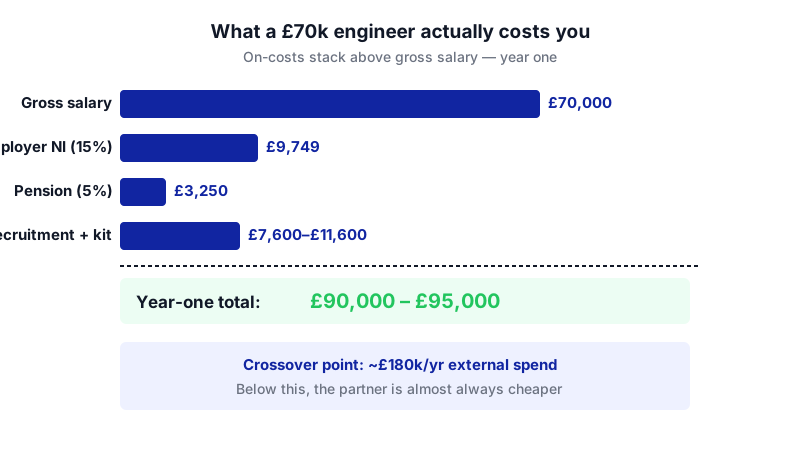

Then the on-costs stack up, and in April 2025 they got materially worse. The employer National Insurance rate rose from 13.8% to 15%, and the secondary threshold at which employers start paying NI dropped from £9,100 to £5,000. Deloitte modelled the combined effect and calls it a 'double hit' — a ~25% increase in employer NI contributions for a worker on average UK earnings. For a £70,000 engineer, the employer NI line alone is £9,749.40 a year before you have paid for anything else.
Pension is next. Auto-enrolment under the Pensions Act 2008 obliges you to contribute a statutory minimum of 3% of qualifying earnings, and 89% of eligible private-sector employees now participate — up from 40% in 2012 per IFS/DWP data. Treat it as a fixed on-cost. Most engineering employers in the UK match 5% or more to stay competitive.
Then paid leave. The Working Time Regulations 1998 guarantee a statutory minimum of 28 days — 5.6 weeks — of paid annual leave for full-time staff. That is roughly 10.7% of working days you pay for and get no output from. For a £70,000 engineer, that is about £7,500 of salary attributable to leave alone, before you count public holidays absorbed inside the 28, sick days, learning time, or statutory parental leave.
An illustrative load for a £70,000 mid-senior engineer, assumptions stated:
- Gross salary: £70,000
- Employer NI at 15% above £5,000 threshold: £9,749
- Pension at 5% employer contribution (above statutory minimum, competitive): £3,250
- Equipment, software licences, insurance, office allocation: £3,000–£6,000
- Recruitment fee (one-off, amortised): 20% of salary via agency = £14,000, or £4,600/year amortised over three
- Illustrative total year-one employer cost: £90,000–£95,000 for one engineer
That is one engineer. One engineer cannot run a product. You need, at minimum, two to avoid single-key-person risk, plus some fraction of a product manager, plus the management overhead that falls on you. A realistic first in-house team — two mid-senior engineers plus a part-time contractor or lead — is a £200,000–£260,000 annual commitment, structurally, before anyone writes a line of code.
The crossover: when does in-house actually win on cost?
Compare that to a milestone-priced external partner. A typical mid-market UK or offshore-blended development arrangement for a maintained live product sits somewhere between £8,000 and £20,000 a month depending on team size and seniority mix — call it £100,000 to £240,000 a year for continuous delivery, with the partner absorbing bench risk, holiday cover, sickness, attrition and recruitment.
The honest crossover looks like this:
- Below ~£180,000/year in external spend: the partner is almost always cheaper in total cost of ownership, because a single in-house engineer plus the management overhead you personally absorb exceeds what you were paying, and you lose the partner's bench depth.
- £180,000–£350,000/year: the maths is close enough that non-cost factors decide it — IP sensitivity, speed of iteration, how load-bearing the product is to revenue, whether the founding CTO/COO has the bandwidth to manage engineers.
- Above £350,000/year sustained for 18+ months: in-house wins on cost, and the strategic case (velocity, institutional knowledge, hiring brand) is usually also decisive.
These bands are directional, not quotes. What moves them is salary mix (London senior vs regional mid), whether you need SC/DV clearance, the pension and benefits package you need to be competitive against fintechs and FAANG, and the recruitment market in your specific stack.
The IR35 trap: 'we'll just use a contractor' is not a free pass
Many COOs reach for a UK contractor as a hedge — someone day-rated, no NI, no pension. That mental model has been illegal since April 2021 for medium and large private-sector firms. Under IR35 off-payroll rules, the hiring company — not the contractor — is responsible for determining employment status, and if HMRC decides the engagement is 'inside IR35', the fee-payer owes back PAYE, employer NICs, interest and penalties. IT contractors remain HMRC's most-targeted group for compliance checks.
Practically: a contractor working full-time on your product, using your systems, reporting to your line manager, is almost certainly inside IR35. The 'cheaper than a permie' assumption dissolves once you add the deemed employer NI, the apprenticeship levy if applicable, and the real risk of a retrospective determination. Treat any contractor engagement as a short-term bridge, not a sustainable staffing model, and get an employment lawyer to look at the SDS (Status Determination Statement) before you sign — this is not an area to improvise.
The five axes that actually decide it
1. Total cost of ownership, honestly loaded
Not salary. Salary + 15% NI + pension + leave idle-cost + equipment + recruitment amortised + your own management time (price it at your fully-loaded hourly cost, because the hours are real). Compare that against the partner's monthly invoice plus the hidden costs on their side too — your time spent in standups, your QA cycles, the handover tax if you ever switch.

2. Speed to first value after the decision
A development partner can usually be productive within two to four weeks of a signed SOW. A first in-house hire in the UK takes 8–16 weeks from job spec to first commit, longer for senior London talent, longer still if you need security clearance. If the board is demanding visible progress in Q1, hiring is not the answer; it is the answer for Q3 onward.
3. Key-person risk
One in-house engineer is one resignation away from total product paralysis. A partner carries a bench. If you hire, hire two, or accept that your single-engineer period is a risk you are consciously taking and buy appropriate insurance (documentation discipline, a retained partner on standby, a code escrow if the product is revenue-critical).
4. What happens if you change your mind in month six
Terminating a UK employee inside their first two years is relatively cheap and legally lower-risk, but it is still a human you hired, probably relocated, probably promised a career. The reputational cost in a small engineering community is real. Ending a partner engagement is a 30–90 day notice clause. Asymmetric reversibility matters when you are not sure of your demand curve.
5. The management-capability honesty check
This is the one COOs skip. Hiring your first engineer when nobody on the executive team has run engineers before is a specific failure mode. You will under-spec the role, mis-manage code review expectations, fail to set up the right CI/CD and on-call rotations, and burn the hire out within 12 months. If you do not have a technical hiring manager, either hire a fractional CTO first or stay with a partner who provides engineering leadership as part of the engagement. This is often the real reason the previous outsource 'failed' — the client-side ownership was never there, and insourcing will not fix that.
The case against hiring an agency at all — made honestly
A development partner, including the one publishing this piece, has real downsides a buyer should name out loud. Context lives partly in someone else's building. Priority competes with their other clients at crunch time. The incentive to document everything exhaustively for your team is weaker than it would be for a permanent hire who has to live with the code. Hourly or milestone rates on paper look higher than a salary because they include someone else's margin, benefits bill and bench cost — the fact that they are often cheaper in total is counter-intuitive, which is why boards keep making the wrong call.
Partners also create a specific lock-in risk if the contract does not spell out IP assignment, source access, and exit cooperation. Any partner worth engaging will give you full IP ownership, a monorepo you can clone today, and a documented runbook — if they will not, that is the deal-breaker, not the hourly rate.
If you are in situation A, do X. If situation B, do Y.
Situation A: Live product, <£180K/year external spend, non-technical executive team, revenue still proving itself
Do not hire yet. Fix the partner relationship or change partners. Insist on IP ownership, source control access, documented architecture, and a named technical lead who attends your exec reviews. Spend the next two to four quarters stabilising the product, growing revenue, and — critically — hiring a fractional CTO who can later become your first permanent technical leader. The board's instinct is premature.
Situation B: £180K–£350K spend, product is load-bearing, you have or can hire a credible head of engineering
Hybrid, deliberately. Hire a head of engineering first, then one or two senior engineers over 6–9 months, and keep the partner on a reducing retainer that covers surge capacity and specialist skills (ML, mobile, DevOps) you cannot justify full-time. This is the phase where enterprise buyers get the most value from a partner — as a capacity multiplier, not a sole provider.
Situation C: >£350K sustained, product is core IP, 18+ month roadmap visible
Insource the core, partner at the edges. Build a permanent team of 6–12 around the product core. Use partners for discrete, time-boxed initiatives — a new AI capability, a legacy modernisation stream, a market-specific build — where the shape of the work is wrong for permanent hires. This is the configuration most mature UK enterprise software teams end up at.
What would turn these ranges into a real number for you
Three specifics move the maths from directional to actionable: your current monthly external spend and what it buys (team size, seniority, hours), your product's revenue dependency (is a two-week outage a £10K problem or a £2M one), and your honest assessment of in-house management capacity. Any partner — or any good executive coach — should walk through those three with you before you commit either way. Nothing here is legal, tax or employment advice; before you make any hire, extend any contract, or restructure a contractor engagement under IR35, get a UK employment lawyer and your accountant to review the specifics of your situation.
Frequently Asked Questions
How much does it really cost to employ a software engineer in the UK in 2025?
For a £70,000 gross salary, you should budget roughly £90,000–£95,000 in year-one total employer cost once you add 15% employer NI (about £9,750 per Zelt's 2025/26 calculator), 3–5% pension, equipment, insurance and amortised recruitment fees. For a senior London hire at £110,000+ gross, year-one load typically exceeds £140,000. The April 2025 NI changes added roughly 25% to employer contributions versus the prior regime for average earners.
Is it cheaper to hire in-house or use a development partner?
Below roughly £180,000 a year in external spend, a partner is almost always cheaper on total cost of ownership once you load UK employer NI, pension, leave idle-cost, and the management time a first hire absorbs. Above £350,000 sustained for 18+ months, in-house usually wins on cost and on velocity. Between those bands, the decision is driven by IP sensitivity, product criticality and management bandwidth rather than headline cost.
Can I just use a contractor instead of a permanent employee to avoid NI and pension?
Not safely, if you are a medium or large private-sector firm. Since April 2021, IR35 places the burden of determining employment status on the hiring company, and a contractor working full-time on your product under your direction is almost certainly inside IR35 — meaning you owe PAYE, employer NICs and potentially penalties. Have an employment lawyer prepare the Status Determination Statement before engaging anyone on this basis.
How long does it take to hire a mid-senior engineer in the UK?
Realistically 8–16 weeks from job spec to first commit, assuming you have a technical hiring manager, a competitive package and a clean interview process. Senior London hires in competitive stacks (platform, ML, security) often stretch to 20 weeks. Roles requiring SC or DV security clearance can add another 10–16 weeks on top. If the board wants visible delivery progress in the current quarter, hiring is not the answer for that quarter.
What should I fix in my outsourced relationship before deciding to insource?
Three things, in order: confirm you have full IP assignment and direct source-control access on everything delivered to date; insist on a named technical lead who attends your executive reviews and owns documentation; and get a written architecture overview and runbook you could hand to any new team. If your current partner cannot or will not do all three, the problem is the partner, not the model — change partners before you change your operating model.
Sources & further reading
- Deloitte — Increase to Employer NIC rate and lowering of the secondary threshold (Autumn Budget 2024)
- GoFile — Employer NI Contributions (2025/26 rates and calculator)
- Zelt — Employer NI Calculator (2025/26 and 2026/27), with salary-band breakdowns
- SalaryScout — Software Engineer Salary UK 2024 (ONS ASHE data, percentile breakdown)
- Ravio — Software Engineer Salary Trends 2026 (UK median £70,000; senior £110,200)
- Davidson Morris — Minimum Employer Pension Contribution Guide (auto-enrolment 3% statutory minimum)
- IFS — Automatic enrolment: trends in employer pension contributions (89% participation in 2024)
- SprintLaw — IR35 Guidance: Off-Payroll Working Rules Explained (risk of back-tax, NICs, penalties)
Get one practical guide a week
Costs, AI tools, partner selection — written for people who make the decision. No spam, unsubscribe anytime.
Thanks — you're on the list. One practical guide a week, nothing else.
That didn't work — please check the email address and try again.
Building something in Enterprise Software?
CodeNicely partners with founders and tech teams to ship AI-native products that move metrics. Tell us about the problem you're solving.
Talk to our team Book a 30-min call