_1751731246795-BygAaJJK.png)
Where Warehouse Software Spend Actually Pays Off

 Published by CodeNicely, the product studio founded by Meghal Agrawal and Ujjwal Agrawal in 2017
For: Owner or COO of a US-based 3PL or regional distribution company with 2–5 warehouses, currently running a mix of a legacy WMS and spreadsheets, who needs to justify a six-figure software investment to a private-equity board or family-office owner before the next peak season
In this guide
- The three problems that actually cost you money
- Problem 1: Billing leakage is the biggest unlocked drawer in your business
- Problem 2: Carrier invoice audit at the dock
- Problem 3: Inventory accuracy that holds up to a client audit
- Custom WMS vs off-the-shelf: a straight answer
- The sequencing that defends the budget
- What this costs, honestly
- How CodeNicely can help
- The honest tradeoffs
- Frequently Asked Questions
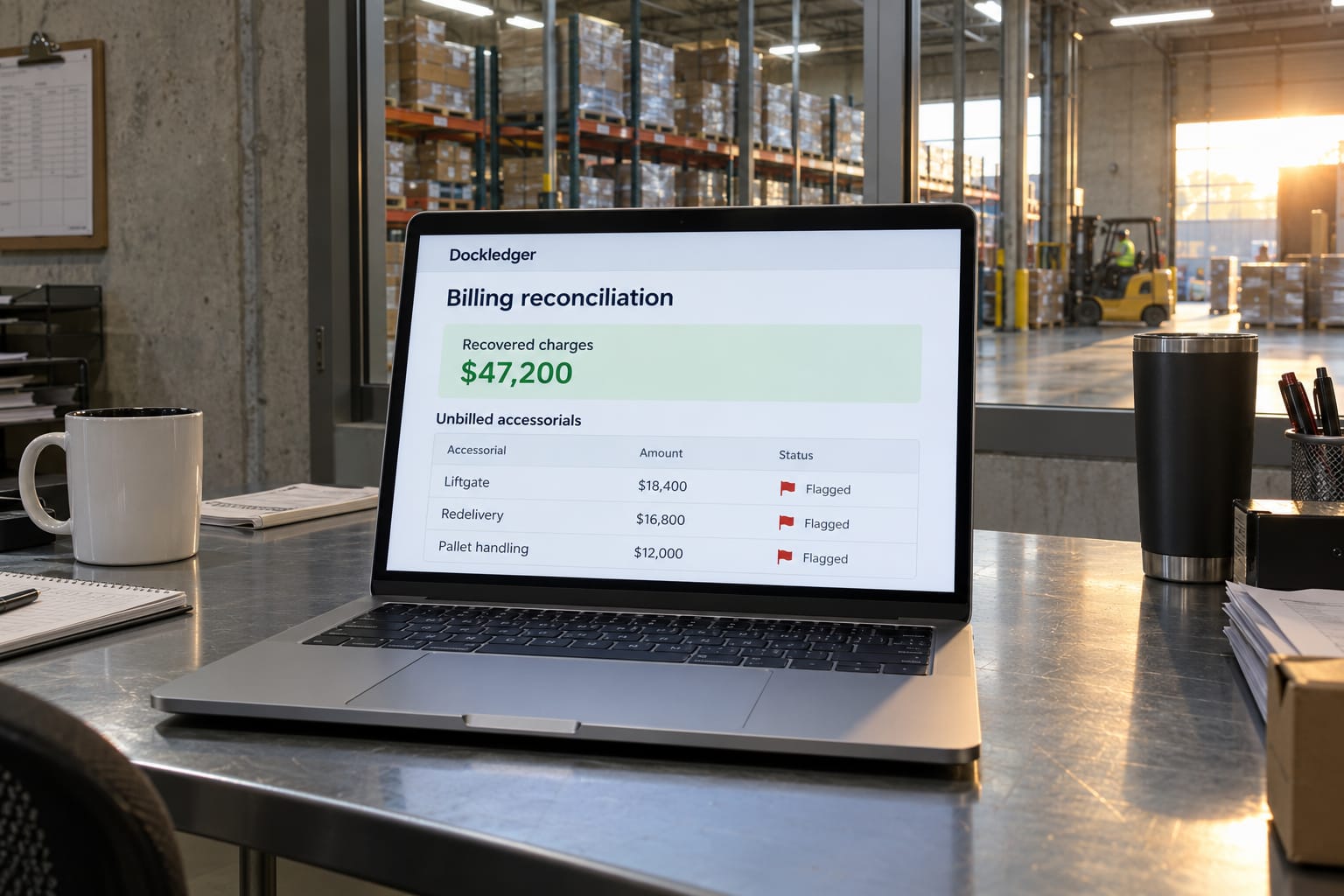
If you run a 2–5 warehouse 3PL or regional DC and you're trying to justify a six-figure software budget before peak, the single highest-ROI build is almost never a WMS replacement. It's a billing-reconciliation layer sitting between your existing WMS and your client invoices — because unbilled accessorials (liftgate, redelivery, address correction, pallet handling, after-hours receiving) are quietly bleeding 3–8% of your gross revenue every month, and no off-the-shelf WMS closes that gap without a services bill that eats the savings. Build the money-recovery layer first, fix inventory accuracy second, and only touch the WMS core when you've proven the ROI model to your board.
This post is the sequencing argument, with the numbers, for an owner or COO who has to walk into a PE or family-office review and defend the spend.
The three problems that actually cost you money
Every WMS vendor demo opens with a slide about labor productivity and slotting optimization. Those matter at Amazon scale. At 2–5 warehouses with mixed client books and a legacy WMS, three operational gaps cost more than everything else combined:
- Billing leakage on 3PL client invoices. You performed the work. You didn't capture the charge. Or you captured it, your account manager waived it in an email, and it never made it to the invoice.
- Carrier invoice overcharges and misrated freight. The LTL carrier billed a reclass, a reweigh, or an accessorial you don't owe — and your AP clerk paid it because the invoice matched the PRO number.
- Inventory that reconciles on paper but not in reality. Cycle counts look fine. Then a client pulls a report, you can't find 40 cases of their SKU, and you're writing a credit memo.
None of these are WMS problems in the strict sense. They are integration, workflow, and audit-trail problems. Which is exactly why ripping and replacing the WMS doesn't fix them.
Problem 1: Billing leakage is the biggest unlocked drawer in your business
The industry numbers on this are not subtle. Average 3PLs lose between 3–15% of gross revenue to billing leakage from unbilled value-added services, while best-in-class operations with automated billing keep that under 0.1%. Manual 3PL billing carries a 10–15% error rate.
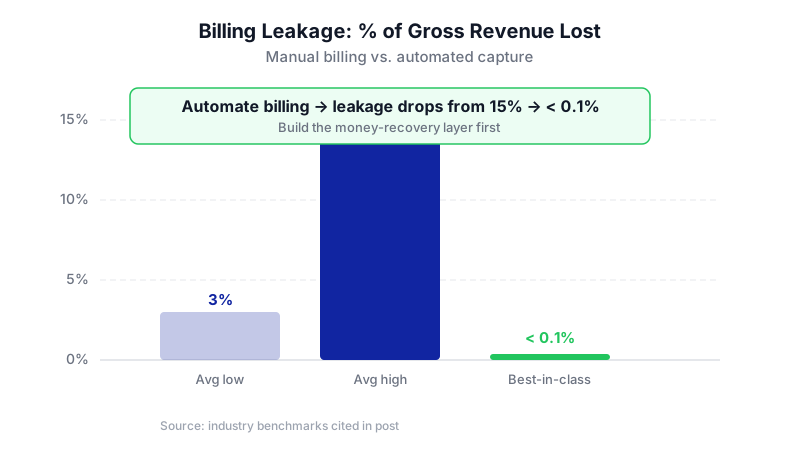

Extensiv's 2024 Benchmark Report of 200+ 3PL warehouses puts a sharper point on it: 56% of 3PLs name uncaptured charges as their #1 billing challenge, and over half spend more than 16 hours a month on billing tasks. The ones who got billing under 8 hours/month were 2.8× more likely to post high profitability growth.
What's actually happening operationally:
- A client requests a rush pick at 4pm. Floor supervisor approves it verbally. No ticket is created in the WMS. No charge hits the invoice.
- A pallet gets rewrapped because the inbound was damaged. Nobody logs it as a value-added service.
- Receiving holds 30 pallets for two extra days because the client's ASN was wrong. Storage overage goes uncharged because nobody flagged the aging.
- A kitting job runs 40% longer than quoted because the components came in wrong. The extra labor becomes margin erosion instead of a billable change order.
What to build: A billing-reconciliation layer that pulls event data from your WMS (receipts, picks, special handling flags, dock schedule, hold statuses), overlays each client's rate card, and generates a pre-invoice audit report that your account managers approve or dispute before billing goes out. Pair it with a lightweight mobile app or SMS workflow so floor supervisors can log off-cycle services in 15 seconds.
What changes: You stop losing 3–15% of revenue. The audit trail also ends 70%+ of client billing disputes, because every charge has a timestamped event behind it. Account managers stop writing goodwill waivers to protect relationships they're already protecting with service quality.
What it takes: This is a 3–5 month custom build for most mid-size 3PLs if your WMS has a usable API or exportable event log. The cost drivers are: how many clients and rate-card variations you have, how clean your WMS event data is, and whether you want full invoice generation or just a reconciliation checkpoint feeding your existing accounting system. If your WMS is a 15-year-old on-prem system with no API, add an integration layer and a few more weeks.
Problem 2: Carrier invoice audit at the dock
The other side of the billing coin is what you're paying out. C.H. Robinson's August 2024 market update noted accessorial charges on LTL invoices have grown from appearing on ~10% of invoices in 2014 to nearly 40% today, with their cost impact going from 3% on top of linehaul to 14%. Goshippo's analysis pegs billing errors at 3–8% of total transportation spend, with roughly 15% of parcels invoiced incorrectly. Gartner's estimate is 1–5% of transportation spend lost to freight payment errors — for a mid-size 3PL handling $50M in freight, that's up to $2.5M.
What to build: A freight audit workflow that ingests carrier EDI 210 invoices, matches them against the rated BOL and the actual accessorials captured at the dock (dimensioner data, dock schedule, driver sign-in), and flags discrepancies before AP cuts a check. Most mid-market TMS products do a weak version of this; the gap is usually in matching to your operational truth, not the carrier's.
What changes: You recover 2–5% of freight spend on average. You also get a data trail that lets you renegotiate carrier contracts annually with actual accessorial frequency rather than the carrier's claim.
What it takes: If you already have a TMS with an audit module, this is a configuration and integration project, not a build. If you don't, buy before you build — Trax, Loadsmart, nVision Global, and others do this reasonably well. Build only the piece that connects dock-door reality to the audit.
Problem 3: Inventory accuracy that holds up to a client audit
Paper-accurate inventory is the one that quietly kills renewals. A client runs their own count, finds a 2% variance, and suddenly you're on probation. The root cause is almost always one of three things: receiving mis-scans, putaway without confirmation, or returns that get restocked without proper inspection.
What to build (or buy): If your WMS already supports directed putaway and RF-scanned confirmations and your team just isn't using them, this is a process and enablement problem, not a software problem. Fix it with training and supervisor dashboards before you spend a dollar on new tech. If your WMS genuinely can't do directed putaway with mandatory scan confirmation, you have a WMS problem — and that's when buying a modern tier-2 WMS (Extensiv, Da Vinci, Infoplus, Softeon) beats building. Custom WMS cores almost never pencil out at your scale.
Where custom helps: The client-facing inventory portal. Off-the-shelf WMS client portals are universally mediocre. A custom portal that gives each client real-time inventory, aging, exception alerts, and self-service reporting is a 2–3 month build and often becomes a renewal and upsell lever.
Custom WMS vs off-the-shelf: a straight answer
Do not build a custom WMS core. The global WMS market was ~$4.5B in 2025 heading to $10–15B by 2030, with 80% of 2024 revenue coming from services — implementation, consulting, support. That 80% figure is the honest tell: WMS deployments are expensive because they're hard, and that hardness doesn't go away because you're building instead of buying. The difference is you absorb all of it.
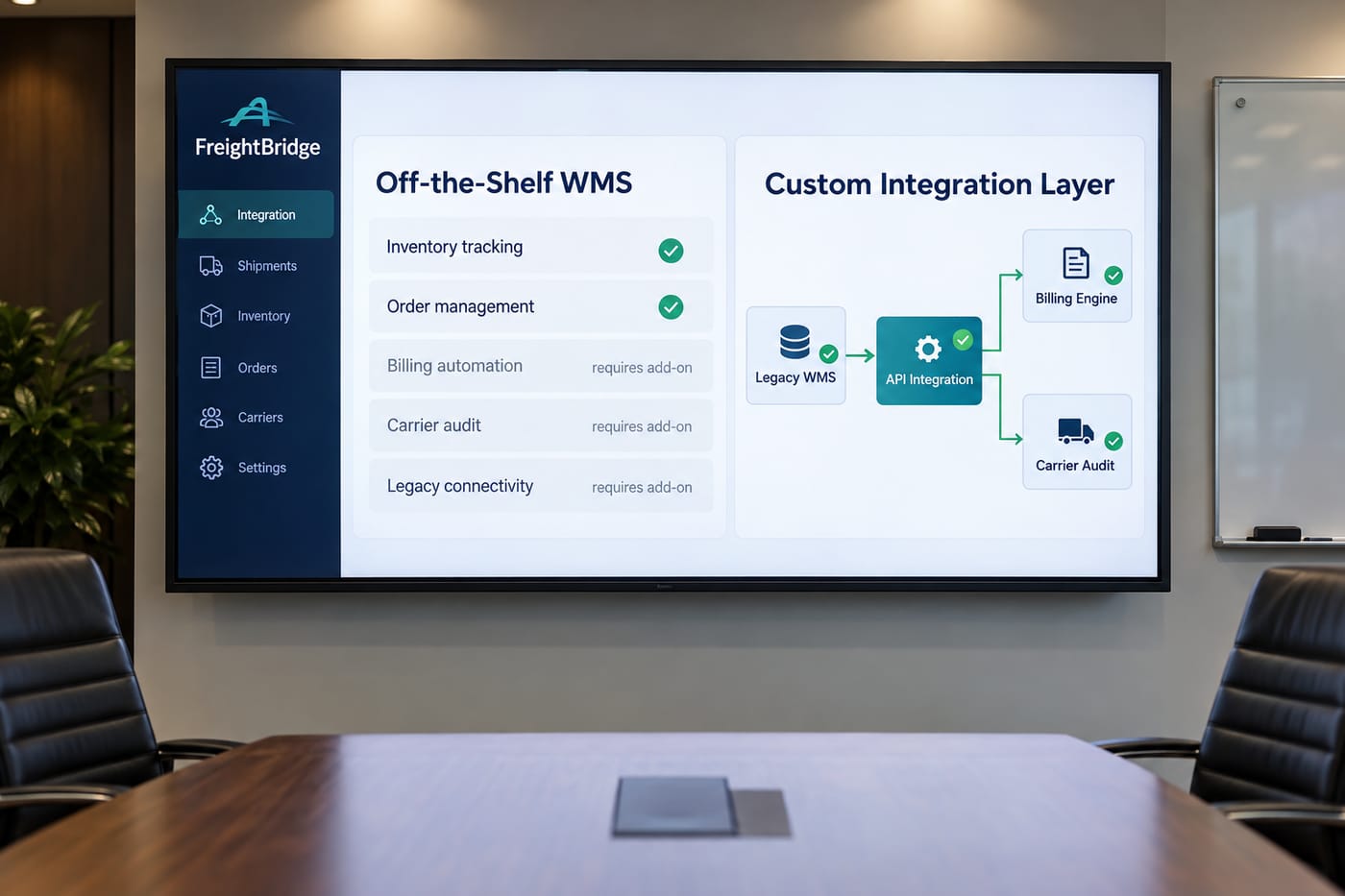
Build custom where the off-the-shelf market is weak and the business logic is yours:
- Billing reconciliation and client invoicing (weak in every WMS)
- Client-facing portals (universally mediocre)
- Dock-door workflow apps that connect operational reality to billing and audit
- Integration middleware between WMS, TMS, accounting, and client ERPs
- Specific automation around your most frequent accessorials and value-added services
Buy where the market is mature and the logic is commodity:
- WMS core (receiving, putaway, picking, shipping)
- TMS and freight audit
- Labor management
- Yard management (if you need it at all)
The sequencing that defends the budget
Here's the order that holds up in a board room:
Months 0–2: Measure the leak. Before any build, instrument what you have. Pull 90 days of invoices against 90 days of WMS event data. Quantify unbilled services per client. This becomes your ROI baseline and the number you'll report against. Also audit 60 days of carrier invoices manually against BOLs. These two exercises cost you a part-time analyst and buy you the business case.
Months 2–6: Build the billing-reconciliation layer. This is the highest-ROI build. If the measurement phase surfaced 4–8% leakage on a $20M book, you're recovering $800K–$1.6M annually against a mid-six-figure build. That's the number the board wants.
Months 4–8 (parallel): Buy or configure freight audit. This is mostly a vendor selection and integration project, not a build. Run it alongside the billing layer with a different workstream owner.
Months 6–10: Build the client portal. Once billing reconciliation is live, the portal is a natural extension — same data model, same event stream. It becomes a sales and retention asset.
Months 10–18: Evaluate WMS replacement, honestly. With a year of clean operational data and a working reconciliation layer, you can finally judge whether the WMS core is holding you back or just unloved. Most of the time, the answer surprises people: the old WMS is adequate once you've surrounded it with the right custom layers.
What this costs, honestly
Nobody can give you a real number without scoping, and anyone who does on a first call is quoting the wrong project. What drives the number for your situation:
- WMS integration surface. A modern WMS with REST APIs and webhooks is a different project from a 2008 on-prem system where you're reading from a mirrored SQL database.
- Client and rate-card complexity. 15 clients on 3 rate-card templates is a different build from 60 clients each with bespoke pricing.
- Scope of invoice generation. Reconciliation only (feeding your existing accounting flow) is roughly half the cost of full invoice generation with payment tracking.
- Mobile and floor workflow. If supervisors need a tablet or mobile app to capture off-cycle services, add design and device-management work.
Illustrative only: a 3PL with 3 warehouses, 25 clients, a WMS with a usable API, and a reconciliation-only scope (no full invoicing) is a mid-six-figure build over roughly 4–6 months, with the leakage-recovery business case typically paying it back inside 12 months of go-live. Every assumption in that sentence moves the number — change any one and it's a different project. The two or three things that would turn that range into an actual quote are: a half-day scoping session on your WMS and data model, a rate-card inventory from your account management team, and a sample of 30 days of invoices with their underlying WMS events. That's a conversation, not a form.
How CodeNicely can help
We build the integration, workflow, and reconciliation layers that sit on top of systems you already own. The closest analog in our work is Vahak, India's largest logistics marketplace, where we built the pricing, matching, and settlement infrastructure that reconciles thousands of daily load-truck transactions across a fragmented carrier base — the same shape of problem as reconciling thousands of warehouse events against client rate cards and carrier invoices.
For a US-based 3PL or regional distributor, the engagement model matters as much as the technical fit: you keep full IP ownership, we don't lock you into a platform, and we design the reconciliation layer to be WMS-agnostic so a future WMS swap doesn't throw the investment away. More on how we work with US operators and our broader legacy-modernization approach.
The honest tradeoffs
A few things this approach is bad at, so you can argue them in advance:
- It doesn't fix a genuinely broken WMS. If your WMS can't support directed putaway, RF scanning, or basic lot/serial tracking, a reconciliation layer on top is lipstick. You need the WMS replacement, and you need it first.
- It depends on your account managers. The reconciliation layer surfaces disputes; humans still have to resolve them with clients. If your account team is understaffed, the tool creates work before it creates revenue.
- Custom code is yours to maintain. Budget 15–20% of build cost annually for enhancements and support, or hire the engineer to own it in-house. There is no third option.
Frequently Asked Questions
Should we replace our WMS before peak season?
Almost never. A WMS replacement 90 days before peak is how operators end up running two systems through peak and recovering from both in Q1. If the current WMS is functional, surround it with the custom layers that close your real revenue gaps and schedule any core replacement for the post-peak window (February–May for most US distributors).
How much revenue leakage should we actually expect to find?
Industry benchmarks put average 3PL billing leakage at 3–15% of gross revenue, with the median closer to 5–8%. Your actual number depends on how disciplined your floor-to-invoice workflow is today, how many accessorials your clients contractually owe but don't get charged, and how often account managers waive charges informally. A 90-day measurement exercise against your WMS event data will give you the real figure before you commit to any build.
What does a custom billing-reconciliation layer cost, and how long does it take?
It's a mid-six-figure range for most mid-size 3PLs over 4–6 months, but the drivers that move the number most are your WMS's integration surface, how many client rate-card variations you have, and whether you need full invoice generation or just reconciliation feeding your existing accounting flow. A scoping session on your WMS, a rate-card inventory, and 30 days of sample invoice/event data are what turn the range into an actual quote.
Is it cheaper to buy a 3PL billing module from our WMS vendor?
Sometimes, if your WMS vendor's billing module genuinely supports your client rate-card complexity and accessorial variety. In practice, 3PL billing modules bundled with WMS products tend to handle simple storage-and-handling pricing well and fall apart on bespoke client agreements, project-based pricing, or event-driven accessorials. Get a demo using your three most complex clients' real rate cards before you decide.
What's the first thing we should do if we can only fund one project this year?
Instrument and measure before you build. Spend 6–8 weeks pulling WMS event data against 90 days of client invoices and quantifying leakage by client and service type. That artifact alone — leakage by client, by service, by month — reframes the entire board conversation and tells you whether the reconciliation layer, a WMS replacement, or something else should be the first dollar spent.
Sources & further reading
- Rethinking 3PL Billing — Logistics Reply (2025)
- Why 3PL Billing Errors Are Costing You More Than You Think — Datex Corp
- 3PL Fulfillment Statistics and Benchmarks for 2026 — KSP 3PL (cites Extensiv 2024 Benchmark)
- 3PL Invoice Reconciliation: A Buyer's Guide — invoicedataextraction.com (cites Extensiv 2024 Benchmark)
- North America Freight Market Update: August 2024 — C.H. Robinson
- What Are Accessorial Charges? A 2026 Guide for Shippers — Goshippo
- Why Freight Billing Errors Still Drain 3PL Profits — Debales AI (cites Gartner estimate)
- Warehouse Management System Market Size, Share & Trends 2025–2030 — MarketsandMarkets
Get one practical guide a week
Costs, AI tools, partner selection — written for people who make the decision. No spam, unsubscribe anytime.
Thanks — you're on the list. One practical guide a week, nothing else.
That didn't work — please check the email address and try again.
Building something in Warehousing and Distribution?
CodeNicely partners with founders and tech teams to ship AI-native products that move metrics. Tell us about the problem you're solving.
Talk to our team Book a 30-min call