_1751731246795-BygAaJJK.png)
What to Build for Non-Profits and Foundations in the UAE

 Published by CodeNicely, the product studio founded by Meghal Agrawal and Ujjwal Agrawal in 2017
For: A Secretary-General or COO of a licensed UAE foundation or charity — registered under the Ministry of Community Development or a free-zone authority — who is managing donor reporting, grant disbursements, and MOHRE volunteer compliance across spreadsheets and WhatsApp threads, and has been told by the board to 'get the systems right' before the next funding cycle
In this guide
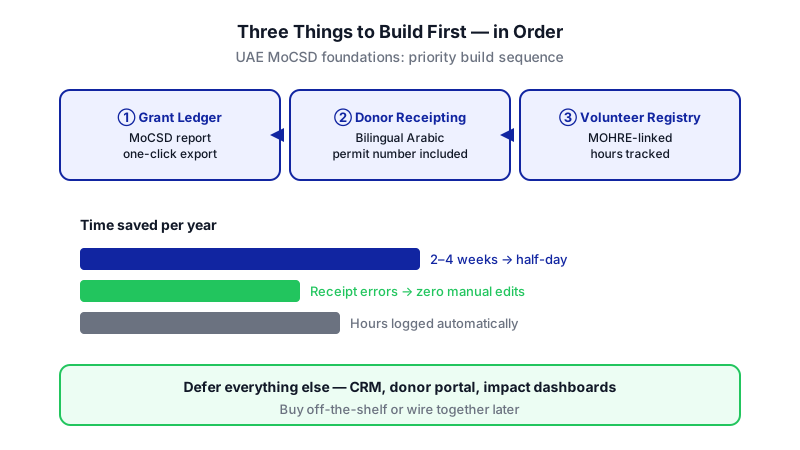
If you run a MoCSD-licensed foundation in the UAE, build three things in this order: a grant disbursement ledger with a one-click MoCSD annual-report export, a bilingual donor receipting system that issues Arabic-compliant acknowledgements, and a MOHRE-linked volunteer registry that tracks hours against the national volunteering system. Everything else — the CRM, the donor portal, the impact dashboards the board keeps asking for — is cheaper to defer, buy off-the-shelf, or wire together later. The reason global platforms keep failing you is simple: they were designed for US 501(c)(3) filings, and the UAE's regulatory stack doesn't translate.
This post is the build-vs-buy decision laid out for someone sitting with a renewal deadline, a board memo about 'getting the systems right', and quotes from three vendors who have never heard of Cabinet Resolution No. 17.
Why the global nonprofit stack doesn't fit
The global nonprofit software market reached $5.5 billion in 2024, led by Blackbaud at 11.9% market share. The entire top-10 vendor list is architected around IRS Form 990, US donor tax receipting, and Gift Aid-style structures. North America alone accounts for 42%+ of global nonprofit software revenue, while the Middle East & Africa nonprofit CRM market was valued at only $0.2 billion in 2024. That gap is why your Salesforce NPSP consultant kept quoting custom objects for everything that touched MoCSD or MOHRE — because none of it ships out of the box.
The regulatory load got heavier, not lighter. Federal Decree-Law No. 50 of 2023 on the Regulation of Public Welfare Activities unified licensing and added oversight mechanisms that compliance tools now have to track in near-real-time. Fundraising campaigns need prior approval. Cross-border disbursements need documentation trails. And annual financial statements must be audited by a Ministry-approved auditor and filed with MoCSD within four months of fiscal year-end — three to four for DCD-licensed entities in Abu Dhabi. Miss it, and licence revocation is on the table.
So the question isn't 'which platform'. It's 'which three jobs cost us the most hours and the most risk, and what is the smallest thing we can build to kill them'.
The three operations that actually cost real money
1. Re-keying grant data into the MoCSD annual report
This is the single most expensive manual operation in most UAE foundations and nobody puts it on the board deck. Your finance lead exports Excel from the accounting system, your programs lead maintains a separate beneficiary tracker, your field teams send WhatsApp PDFs of disbursement receipts, and somebody — usually a senior person who shouldn't be doing it — spends two to four weeks each year hand-assembling the MoCSD submission in the prescribed Arabic template. Cross-reference errors show up in the audit. The auditor flags them. You fix them. You refile.

Given the scale involved — Dubai's public charitable sector spending reached Dh4 billion in 2023 across 53,900 initiatives, and the UAE's foreign aid alone totalled Dh11.7 billion in 2023 — the per-foundation volume of disbursements and beneficiaries can run into the thousands annually. Reconciling that manually is how errors creep in.
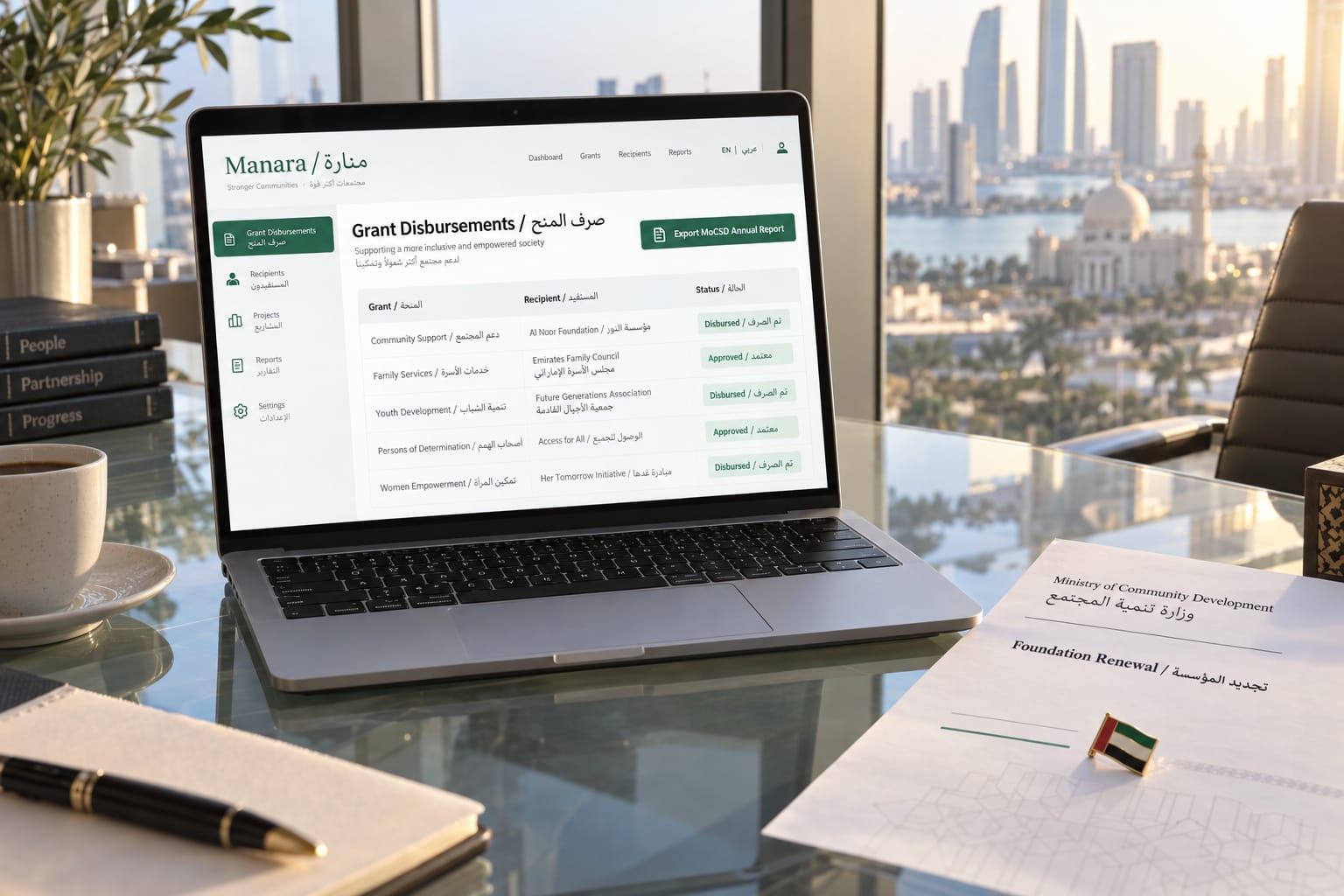
What to build: A disbursement ledger with four non-negotiable features — (1) every disbursement row carries beneficiary ID, programme code, approval chain, and supporting-document link; (2) accounting entries are posted automatically to your GL (Xero, Zoho Books, Odoo, SAP — pick one and commit); (3) a one-click export generates the MoCSD annual report in the prescribed Arabic format, filled with the current year's numbers; (4) the same engine produces the auditor's working papers.
What changes: The annual report compilation drops from weeks to a half-day review. Audit queries stop being archaeology. Your Secretary-General stops personally proofreading Arabic spreadsheets at 11pm in March.
What this is bad at: It will not fix bad underlying data. If your field teams are not capturing beneficiary IDs today, the ledger will surface the gap, not close it. Expect a six-to-ten-week data-cleanup project before the system is trustworthy.
2. Donor receipting and acknowledgement in Arabic
UAE donors — individuals and corporates — expect Arabic-language receipts with the correct licensing references, the fundraising permit number for the campaign, and in many corporate CSR cases a format acceptable to the donor's own auditor. Global donor CRMs issue English PDFs with a US-centric tax-deductibility paragraph. You end up with staff manually editing receipts in Word, which breaks the moment donation volume ticks up during Ramadan or the National Day campaign.
What to build (or more often, extend): A thin donor-receipting layer sitting on top of whatever payment stack you already use (Telr, Network International, Stripe, bank transfer reconciliation). It generates bilingual receipts tied to the active fundraising permit, logs the donor against campaign and programme, and feeds the donations ledger that eventually rolls into the MoCSD report. If you have under ~15,000 donors a year, you don't need a 'donor CRM' — you need a receipting engine plus a clean donor table. The CRM comes later, if ever.
What changes: Receipts go out in minutes, not days. Corporate CSR donors stop chasing. Your campaign reconciliation at month-end becomes a filter query instead of a spreadsheet merge.
3. Volunteer registration and MOHRE compliance
The UAE mobilised over 600,000 volunteers in 2024, with AED 239 million in donations tracked through the national volunteering and welfare system. If your foundation runs programmes that use volunteers — and most do — you are expected to register volunteer hours and participants through the national system. Most organisations are tracking this in a shared spreadsheet, which means it is wrong by Tuesday.
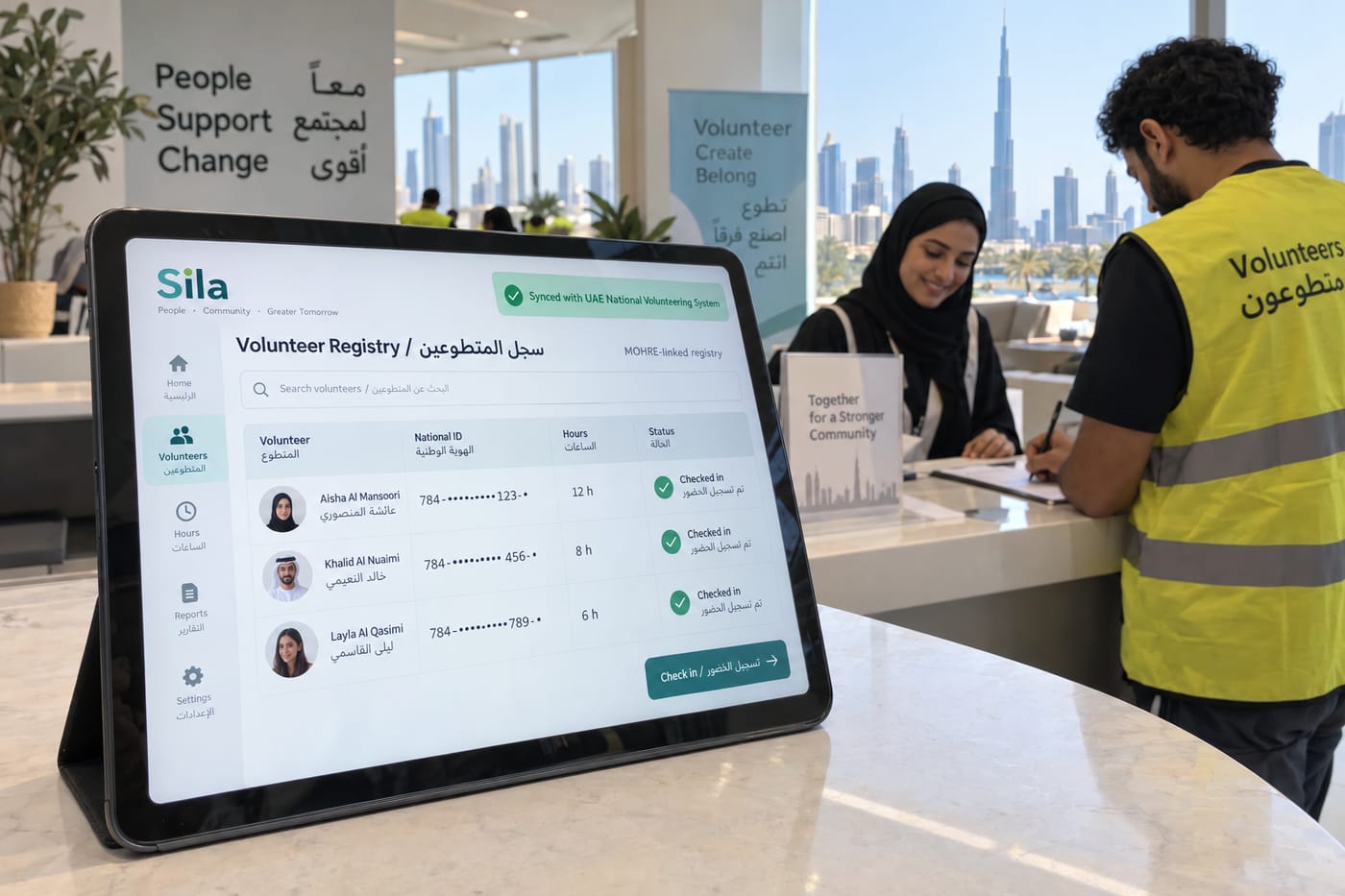
What to build: A lightweight volunteer registry with a mobile sign-in flow (QR at the event, Emirates ID scan or manual entry fallback), automatic hour-logging, and an export that matches the national volunteering platform's intake format. Add a simple consent and waiver capture while you're there — it costs nothing extra and makes legal happy.
What changes: You can answer 'how many volunteer hours did we deliver last quarter, by programme' in 10 seconds instead of 10 days. That number is also what the board and your government stakeholders ask for first.
What NOT to build (yet)
- A custom donor-facing portal. Unless you have 50,000+ recurring donors, a well-configured payment page plus email receipts covers 90% of the value. Portals are maintenance debt.
- An AI impact-measurement dashboard. You cannot measure impact well until the disbursement ledger is clean. Build the ledger first; the dashboard is a two-week job on top of it later.
- A bespoke accounting system. Don't. Use Xero, Zoho Books, Odoo, or SAP depending on size. Integrate — do not replace.
- A chatbot for donor queries. Donors want a human during a Ramadan campaign. Fund a shared inbox with templated replies before you fund an LLM.
- Blockchain for donation transparency. It will come up in a board meeting. It is not a 2025 problem for a MoCSD-licensed foundation. Say no politely.
Build, buy, or wire together — a decision frame
| Capability | Recommendation | Why |
|---|---|---|
| Accounting / GL | Buy | Xero / Zoho / Odoo / SAP all work; Ministry-approved auditors know them |
| Payment processing | Buy | Telr, Network International, Stripe — commodity |
| Disbursement ledger with MoCSD export | Build | No vendor ships this; it is the highest-ROI custom build |
| Bilingual donor receipting | Build (thin layer) | Needs licence/permit awareness no CRM has |
| Volunteer registry + MOHRE sync | Build (lightweight) | Compliance-specific; off-the-shelf tools don't integrate |
| Donor CRM | Defer or buy small | HubSpot Nonprofit tier covers most until you cross ~15k donors |
| Programme / case management | Depends | Buy if generic (CommCare, Salesforce NPSP); build only if programme is unusual |
| Impact dashboard | Build later | Metabase or Power BI on top of the ledger; cheap once data is clean |
What this costs and how long it takes — the honest shape
No one can quote a UAE foundation a real number without seeing three things: how many disbursement transactions you process a year, how many systems the ledger has to read from (accounting, payment gateway, field-collection app, bank statements), and whether your beneficiary data is already structured or lives in PDFs and WhatsApp exports. Those three variables move the budget by a factor of three or four.
The shape of a build is this: the disbursement ledger with MoCSD export is the largest piece — it carries data modelling for programmes, beneficiaries, approvals, and the Arabic report generator. Receipting and volunteer registry are each roughly a quarter of that effort. Integration work scales with how many existing systems you keep. Data migration is almost always underestimated — if your historical records are messy, cleaning them often costs more than the software itself.
Illustrative example, with every assumption on the table: a mid-sized MoCSD-licensed foundation processing ~3,000 disbursements a year, with Zoho Books already in place, one payment gateway, three years of historical beneficiary data in reasonable shape, and no need for a donor portal — would typically phase the three builds over roughly two to three quarters, going live with the ledger first (so one audit cycle runs on the new system before the next MoCSD filing), then receipting ahead of Ramadan, then the volunteer registry. This is a shape, not a quote; add or remove an integration, add or remove the data-cleanup project, and the picture changes materially.
To turn any of this into a real number for your foundation, three specifics do most of the work: (1) a transaction-volume audit of the last 12 months of disbursements and donations, (2) a system inventory of what you'd keep versus replace, and (3) a sample of 50 historical beneficiary records so a data lead can judge the cleanup load. Those three artefacts turn a range into a scope. A conversation with a team that has built this stack before — ours or anyone else's working on custom software in Dubai and the wider UAE — should start there, not with a demo.
Sequencing: what to do in the next 90 days
- Weeks 1–2: Pull the last MoCSD filing and reverse-engineer every field. For each field, write down which system (or spreadsheet, or inbox) the data came from. This document is your real requirements doc.
- Weeks 2–4: Decide the accounting system you are committing to for the next five years. Stop evaluating. If you have one that works, keep it.
- Weeks 4–8: Scope and begin the disbursement ledger. Insist that the MoCSD export is in sprint one, not sprint six — if the output doesn't work, nothing else matters.
- Weeks 8–12: In parallel, start the data cleanup on historical beneficiaries and disbursements. This is a people problem, not a software problem; assign a named owner.
- After the ledger is live: Receipting, then volunteer registry, then — only then — talk about dashboards, portals, and AI.
One last thing. The Ministry of Community Empowerment's requirements and Federal Decree-Law No. 50 of 2023 create a compliance surface that will keep shifting over the next three to five years. Build systems that let your finance and compliance team change report formats without a developer in the loop. Hard-coding a template is how you end up back on spreadsheets in 2027. And on anything touching audit submissions, licence conditions, or fundraising permits — have your Ministry-approved auditor and your legal counsel review the specifics; this post is a build plan, not legal or audit advice.
Frequently Asked Questions
Can we just use Salesforce NPSP or Blackbaud with heavy customisation?
You can, and some larger UAE foundations do. The honest tradeoff: you pay annual platform licensing plus a specialist implementation partner, and you still write custom code or objects for MoCSD exports, bilingual receipting, and MOHRE volunteer sync — because none of it ships natively. For foundations with complex multi-country donor bases it can be worth it; for a UAE-focused foundation under ~15,000 donors, a lighter custom stack on top of your existing accounting system is usually cheaper to own over five years.
What drives the budget for a custom foundation management system in the UAE?
Four things, in order: transaction volume (disbursements and donations per year), number of upstream and downstream systems the platform must integrate with, the state of your historical data, and whether Arabic-language outputs are needed for government filings and donor receipts (they almost always are). A transaction-volume audit and a system inventory are the two artefacts that convert a range into a real scope — your delivery partner should ask for both before quoting.
How long before we can file an MoCSD report from the new system?
The limiting factor is usually not the software — it is getting one clean fiscal year of data flowing through the new ledger before the auditor signs off on it. Most foundations plan to go live on the ledger at least one full quarter before the fiscal year starts, so the first MoCSD filing from the new system is based on a complete year of native data rather than a mid-year migration. Any delivery timeline that promises a filing from the new system in the same quarter it goes live should be treated with scepticism.
Do we need separate systems for MoCSD-licensed activities and free-zone-licensed activities?
No, but you need a licence dimension in the data model from day one. If your foundation operates under multiple licences — MoCSD for domestic charitable activity, a free-zone authority for a research or convening arm — every disbursement, donation, and volunteer record should be tagged with the licence under which it was conducted. One ledger, multiple report templates. Retrofitting this later is painful; it is cheap at the start.
Should we build Arabic-first or English-first?
Bilingual from the first screen. Admin users may prefer English; donors, beneficiaries, and every government-facing output need Arabic. Treat Arabic as a first-class language in the data model — field lengths, right-to-left rendering, name formats, and PDF generation — not as a translation layer bolted on in month six. Fixing it later means rebuilding half the UI and most of the document templates.
Sources & further reading
- Apply to Establish Non-Profit Organization — Ministry of Community Empowerment (UAE Government)
- UAE Sustainability Journey Annual Report 2024 — Federal Competitiveness and Statistics Centre
- Public spending on Dubai's charitable sector reached Dh4 billion in 2023 — Gulf News
- UAE's strategic humanitarian efforts highlighted on International Charity Day — Gulf News
- Top 10 Non-Profit Software Vendors, Market Size and Forecast 2024–2029 — AppsRunTheWorld
- Global Non-profit CRM Software Market Size, Share, Growth Trends — Verified Market Reports
- What Financial Statements Must NPOs Prepare in UAE? — One Desk Solution
- UAE Non-Profit Fundraising Regulations — Nour Attorneys
Get one practical guide a week
Costs, AI tools, partner selection — written for people who make the decision. No spam, unsubscribe anytime.
Thanks — you're on the list. One practical guide a week, nothing else.
That didn't work — please check the email address and try again.
Building something in Non-Profit?
CodeNicely partners with founders and tech teams to ship AI-native products that move metrics. Tell us about the problem you're solving.
Talk to our team Book a 30-min call