_1751731246795-BygAaJJK.png)
What to Build If You Own a Factory in the UAE

 Published by CodeNicely, the product studio founded by Meghal Agrawal and Ujjwal Agrawal in 2017
For: An owner or COO of a mid-size UAE manufacturer — plastics, food processing, steel fabrication, or building materials — running 50–500 people across one or two facilities in Dubai, Sharjah, or Abu Dhabi, who has outgrown spreadsheets and WhatsApp but cannot justify a full SAP implementation, and is now deciding whether to buy a generic ERP or build something that actually fits their shop floor
In this guide
If you own a mid-size factory in the UAE and have outgrown spreadsheets, the honest answer is this: do not buy a full ERP, and do not try to build one. Build three narrow systems in sequence — real-time material yield tracking, a shared production schedule that survives your foreman taking leave, and a compliance document system that assembles ESMA and halal audit packs automatically. Everything else can wait, and most of what SAP or Odoo resellers will pitch you is solving a problem you do not have yet.
The reasoning takes a few minutes to explain, so here it is.
Why the ERP pitch keeps missing
UAE manufacturing is in a strange moment. The sector contributed Dh190 billion to GDP in 2024, up 62% from 2020, and Operation 300bn is pushing that number to AED 300 billion by 2031. There are now more than 13,500 industrial companies employing around 700,000 people, with 40% of them in Abu Dhabi and 20% in Dubai. Manufacturing is already 16% of Sharjah's GDP and 27% of Ras Al Khaimah's, per Emirates NBD research.
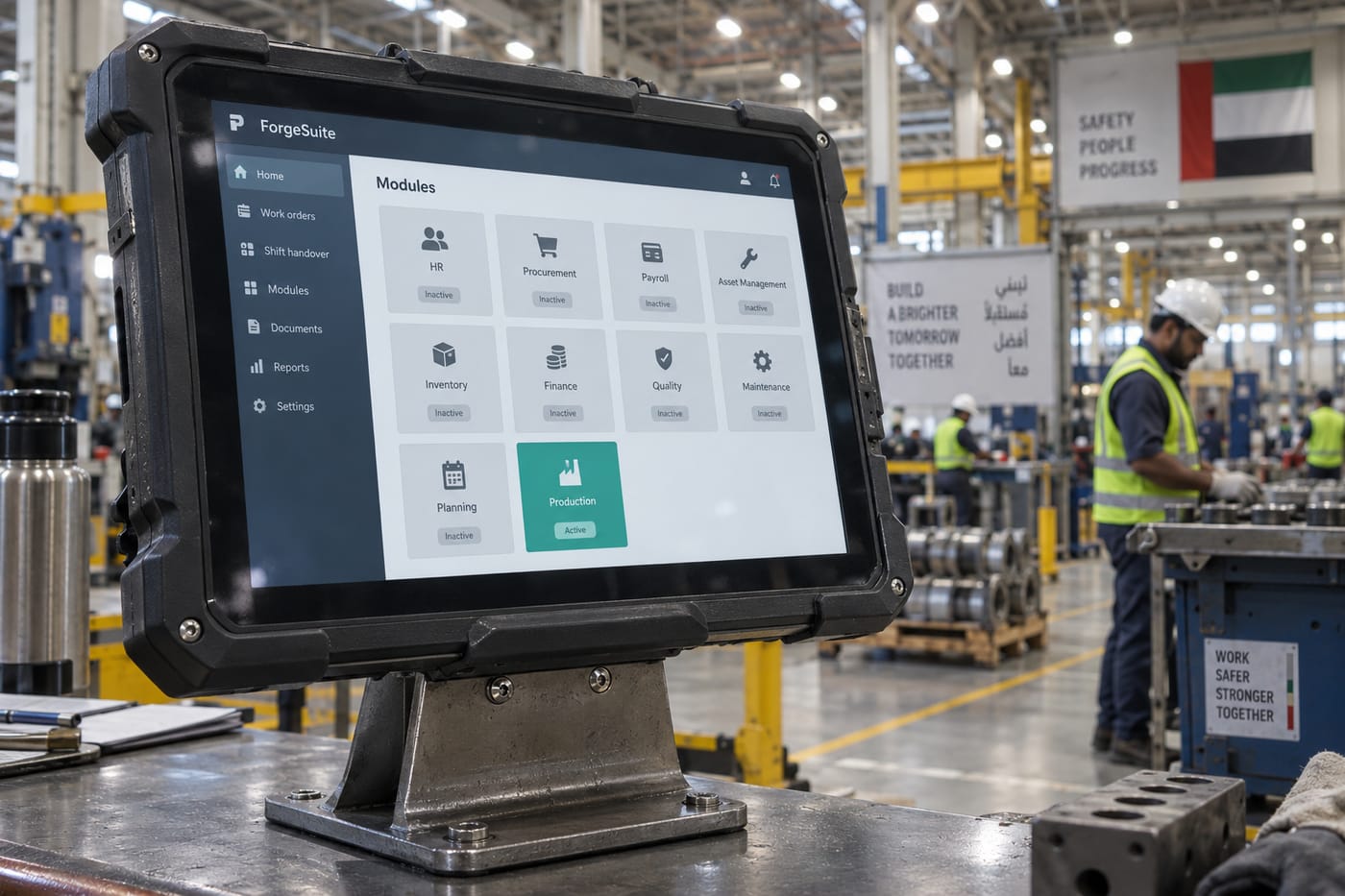
What this means on the ground: your business is probably bigger and more complicated than it was in 2020, and the tooling has not kept up. Every reseller who walks into your office has one answer — a six-figure ERP license, a twelve-to-eighteen month rollout, and a promise that it will fix everything. It will not. Gartner data shows more than 70% of ERP implementations fail to meet their original business case, with discrete manufacturing recording a 73% failure rate — the highest of any industry — and average budget overruns of 215%. These are not implementation failures by small shops. These are mid-market manufacturers much like yours.
The reason is simple. A generic ERP models a factory the way an accountant does — purchase orders in, finished goods out, variance at month-end. It does not model your factory the way your foreman does, which is where the money actually lives or dies.
The three problems worth solving
Before deciding what to build, be specific about what is actually hurting you. In most mid-size UAE manufacturers running plastics, food processing, steel fabrication, or building materials, three problems account for most of the recoverable margin.
1. The yield gap between goods-in and finished goods
You buy a tonne of raw material. You ship 920 kilos of finished product. Where did the other 80 kilos go? Your ERP says "variance." Your foreman says "normal." Neither answer is useful.
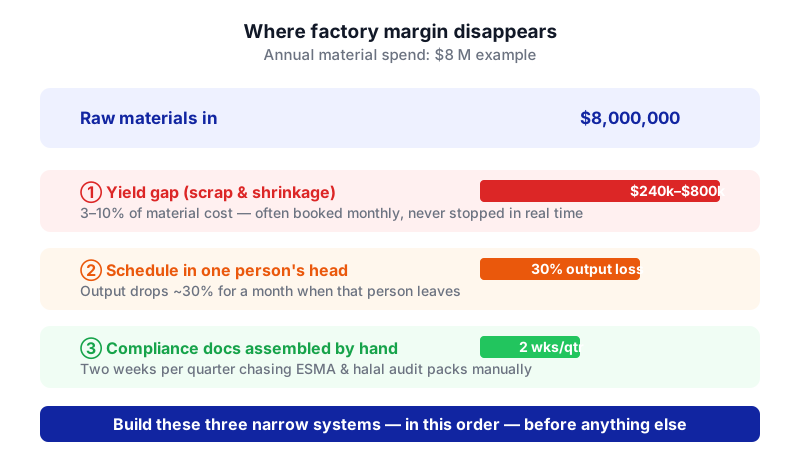
Scrap and shrinkage are the single most under-measured cost in mid-market manufacturing. Scrap typically accounts for 3–10% of total material costs depending on the process, and metal stamping operations routinely lose 10–25% of raw material. For a factory spending $8M a year on materials, a 6% scrap rate is roughly $480,000 vanishing annually — most of which is bookable as a journal entry but not recoverable, because by the time finance sees it the shift has gone home.
The non-obvious part: the ERP is not wrong, it is just late. The loss is real, but it gets booked at month-end as a variance, not flagged in real time at the station where it happened and could have been stopped. A worker over-pouring resin, a cutting program with the wrong offset, a mixer running two minutes too long — these are shift-level problems that need shift-level feedback.
2. The schedule that lives in one person's head
Walk into most UAE factories at 7am and ask who decides what runs today. The answer is a production manager with a notebook, a WhatsApp group, and twenty years of memory about which die goes on which press and which customer will scream loudest if their order slips. This works. Until he takes two weeks of leave, or quits, or gets sick. Then output drops 30% for a month while someone else figures it out.
This is not a software problem that an off-the-shelf APS (advanced planning and scheduling) module solves well, because the real logic is not in constraints and capacities — it is in the fifty exceptions the manager carries in his head. The job is to extract that logic into a tool that a less-experienced person can run, not to replace him with an algorithm.
3. Compliance documentation assembled by hand
If you sell construction materials, food products, electrical goods, or automotive parts in the UAE, ESMA certification is legally mandatory, and it requires accredited lab test reports, ISO 9001 QMS documentation, bilingual Arabic/English labeling, and batch-level traceability. Halal certification adds another layer. ADQCC, Dubai Municipality, and sector-specific regulators each want their own evidence packs.
Most mid-size factories pull these together manually before every audit. Someone spends two weeks a quarter chasing lab reports, matching them to batch numbers, and screenshotting WhatsApp messages from suppliers. This is not a strategic problem but it is an expensive one — and it is the easiest of the three to fix with software, because the inputs are structured and the outputs are templates.
What to actually build, and in what order
Build first: a real-time material yield tracker
Not an ERP module. A focused system that sits between goods-in and finished-goods and tracks what happens in between, at the station level, in near real time.
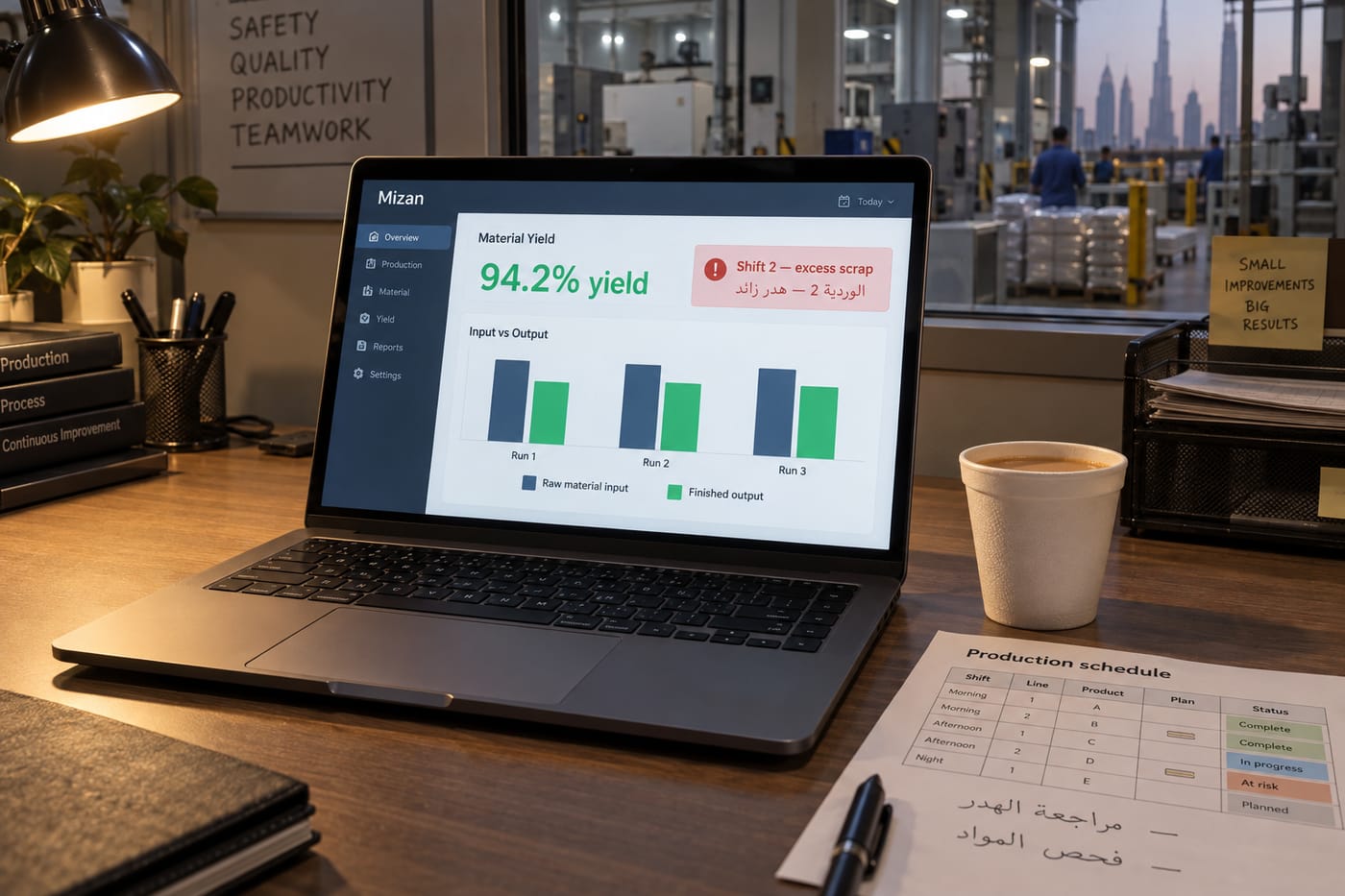
What it looks like: barcode or RFID tagging at goods receipt, weighing stations or counters at each major process step, a tablet or kiosk at each line where operators log actual consumption against planned, and a dashboard that flags variance above a threshold within the shift — not at month-end. The tablet UI needs to work in Arabic, English, Hindi, and Urdu because that is who is on your floor. It needs to work offline because factory wifi fails.
What changes once it exists: you stop discovering scrap problems in the monthly variance report and start catching them within hours. More than 60% of manufacturers report inaccurate inventory data and over 50% have operational inefficiencies tied to it — this is the system that fixes both for your floor, without needing to replace anything financial.
What drives the build cost and timeline: the number of production lines you instrument, whether you add hardware (scales, scanners, RFID gates) or just use tablets, and how clean your existing BOM data is. A pilot on one line in one facility is a different scope from a full rollout across two sites. The parts that balloon budgets are hardware procurement, floor wifi coverage, and the time it takes to clean up BOMs that have never been audited. The parts you control: how narrow you keep the first version, and whether you resist the temptation to add scheduling and quality in the same release.
Build second: a shared production schedule
Once you have real yield data flowing, build the scheduling layer. The goal is not to automate the foreman — it is to externalise his logic so the business survives his absence and so you can see three weeks ahead instead of three days.
What it looks like: a drag-and-drop schedule board showing lines, shifts, jobs, and material availability, with the foreman's rules encoded as soft constraints (die changeover times, operator skills, customer priority tiers). Integrates with the yield tracker so if a line is running at 85% of planned throughput, the schedule reflects reality by lunchtime, not next week. Mobile-first for shift leads.
What changes once it exists: new production managers can be productive in weeks instead of months. You can commit to delivery dates with more confidence. You can see the impact of a rush order before you accept it.
The honest tradeoff: this is harder than it looks because the real work is interviewing your foreman for a week, documenting every exception, and getting him to admit the rules he does not know he follows. If he will not engage, do not build this. Build it later, when the next operations hire comes in and you have leverage to systematise.
Build third: compliance pack automation
Build this last, not because it is unimportant, but because the first two generate most of the data this one needs. Once you have batch-level traceability from the yield tracker, assembling an ESMA pack becomes templating rather than archaeology.
What it looks like: a document system that pulls batch records, lab test reports (from your accredited lab's portal or email), supplier certificates, and QMS records, matches them to the right product-batch combination, and generates a bilingual Arabic/English audit pack in a day instead of two weeks. Alerts when a certificate is about to expire. Keeps an audit log of who approved what.
What changes: audit prep stops being a two-week fire drill. Export documentation stops being the bottleneck when a customer in Saudi or Oman wants faster shipping.
One caveat: do not treat this as legal advice. Every ESMA, ADQCC, halal, or sector-specific submission needs to be reviewed by someone qualified before you file it. The software reduces the clerical cost. It does not reduce your legal responsibility.
What is honestly not worth building yet
A few things vendors will push that you should push back on:
- A custom finance and accounting module. Keep using Tally, Zoho Books, or whatever you have. Integrate when the yield tracker needs to post to it. Rebuilding finance is where ERP projects die.
- Predictive maintenance. Beautiful idea, almost never justified at mid-size UAE scale. The sensor investment and the data history required to make useful predictions take years. Run a planned preventive maintenance schedule in a spreadsheet first.
- A customer portal. Unless you have more than a hundred active B2B customers placing frequent repeat orders, email and WhatsApp are fine. Build this when the pain is real.
- Full IoT instrumentation of every machine. Instrument the two or three machines where throughput determines your bottleneck. The rest can wait.
- An AI copilot for the shop floor. Not yet. The data to train anything useful comes from the first system you build. Revisit in year two.
Sequencing and what it takes
A sensible sequence for a 50–500 person factory running one or two UAE sites looks roughly like this, though every situation is different:
- Weeks 1–3: diagnostic. Walk the floor, map actual material flow, identify the two or three stations where yield is leaking, interview the foreman, review the last four audits. Decide what is worth building and what is not.
- Months 1–3: yield tracker pilot on one line. Measure the baseline, deploy, measure again. If scrap does not visibly move, stop and figure out why before expanding.
- Months 3–6: rollout across remaining lines and integrate with existing inventory and finance.
- Months 6–9: scheduling layer, built on top of real yield data.
- Months 9–12: compliance automation, using the batch traceability the first system produced.
This is illustrative. A single-site plastics shop with clean BOMs and one production manager moves faster. A three-site steel fabricator with twenty years of undocumented tribal knowledge moves slower. The variables that actually drive the timeline and the number: how many lines and sites you instrument, whether hardware is involved, how clean your existing data is, how much time your operations team can give the project, and how disciplined you are about keeping each phase narrow. The variables you do not control: lead times on industrial hardware, availability of your foreman for interviews, and how your lab reports arrive today.
Turning any of this into a real quote requires three specifics: the number of production lines and sites in scope, whether you want hardware instrumentation or tablet-only input, and the state of your existing BOM and inventory data. Without those, any number is theatre. If you want to pressure-test which of the three systems is actually worth building first in your operation, that is a conversation worth having with a team that builds custom software for UAE businesses rather than a reseller trying to move licenses.
Frequently Asked Questions
Should a UAE manufacturer build custom software or buy an ERP like SAP or Odoo?
Neither, as a first move. Buy a basic finance and inventory system off the shelf if you do not have one, and build custom only for the two or three operational problems where you lose real money — typically yield tracking, scheduling, and compliance. Full ERP replacement is the most expensive and most failure-prone option; 73% of discrete manufacturing ERP projects miss their business case.
What drives the cost of building production tracking software in the UAE?
Four things, in rough order of impact: the number of production lines and sites you instrument, whether you add hardware like scales, barcode scanners, or RFID (versus tablet-only input), the state of your existing BOM and inventory data, and how many languages the operator UI needs to support. A single-line pilot in one facility is a very different scope from a full multi-site rollout. The best way to narrow the range is to scope one pilot line first and extrapolate from measured results.
How long does it take to see results from a yield tracking system?
Pilots on a single line typically start producing usable variance data within weeks of go-live, but the operational change — operators and shift leads actually using the data to adjust in real time — takes months of consistent management attention. The software is the easy part. The behavioural change on the floor is what determines whether scrap actually drops.
Does custom software help with ESMA, halal, or ADQCC compliance?
Yes, in the sense that it dramatically reduces the clerical work of assembling audit packs, matching batch records to lab reports, and generating bilingual documentation. It does not replace legal and regulatory review — every submission still needs a qualified compliance officer or external consultant to sign off. The software makes their job faster, not optional.
Can we start with just one of the three systems?
Yes, and you should. Starting with yield tracking is almost always the right first step because it produces the data the other two systems need and because the ROI is the most measurable. Build scheduling or compliance first only if you have a specific trigger — a key production manager leaving, or an imminent audit failure risk — that makes it urgent.
Sources & further reading
- UAE industrial sector posts Dh190 billion GDP contribution in 2024 — Gulf News
- UAE's $11bn manufacturing investment aims to cut oil reliance — AGBI
- Make it in the Emirates: UAE manufacturing focused on future with 'sunrise industries' — The National
- Operation 300bn, the UAE's industrial strategy — UAE Government Portal
- Shrinkage, Scrap and Sunk Costs: Finding the Hidden Numbers in Your Floor Operations — JMCO
- 95+ Manufacturing Waste Statistics 2026 — Manufacturing Lead Generation
- ERP Failure Rate: 2026 Research — Godlan
- 85+ Manufacturing ERP Statistics 2026 — Manufacturing Lead Generation
Get one practical guide a week
Costs, AI tools, partner selection — written for people who make the decision. No spam, unsubscribe anytime.
Thanks — you're on the list. One practical guide a week, nothing else.
That didn't work — please check the email address and try again.
Building something in Manufacturing and Industrial?
CodeNicely partners with founders and tech teams to ship AI-native products that move metrics. Tell us about the problem you're solving.
Talk to our team Book a 30-min call