

What to Build for Retail Chains in the UAE

 Published by CodeNicely, the product studio founded by Meghal Agrawal and Ujjwal Agrawal in 2017
For: A founder or COO running a 10–40-location UAE retail chain — fashion, electronics, or F&B — whose ops team is drowning in WhatsApp approvals, manual stock transfers between branches, and end-of-month reports they can't fully trust
In this guide
- The three profit leaks a UAE chain already recognises
- Build #1: Inter-branch stock transfer and markdown-approval workflow
- Build #2: VAT-clean POS-to-ERP integration, ahead of 2027 e-invoicing
- Build #3: Unified real-time inventory across branches and e-commerce
- Build #4: Loyalty — but Arabic-first and tied to behaviour, not points
- What is probably not worth building yet
- How to think about cost and timeline
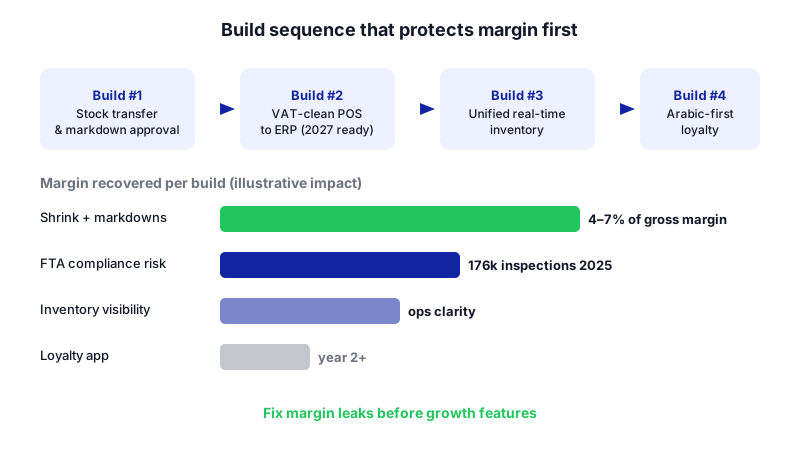
- The sequence, in one view
- How CodeNicely can help
- Frequently Asked Questions
If you run a 10–40-store chain in the UAE and you're trying to decide what software to build next, build the inter-branch stock transfer and markdown-approval workflow first — then a VAT-clean POS-to-ERP integration ahead of the 2027 e-invoicing mandate, then unified inventory visibility, and only then the loyalty app your marketing team keeps asking for. Shrinkage and untracked discounting typically erode more margin than any customer-facing feature can recover in year one, and the FTA's enforcement activity nearly doubled from 93,000 inspections in 2024 to 176,000 in 2025, so the compliance clock is louder than the growth clock right now.
This post walks through the operational problems that cost UAE retail chains real money, what to build for each, and the sequence that actually works. It is written for founders and COOs — not for a procurement committee.
The three profit leaks a UAE chain already recognises
Before anything gets built, be honest about where the money actually goes. For a mid-size UAE retail chain, three problems do most of the damage:
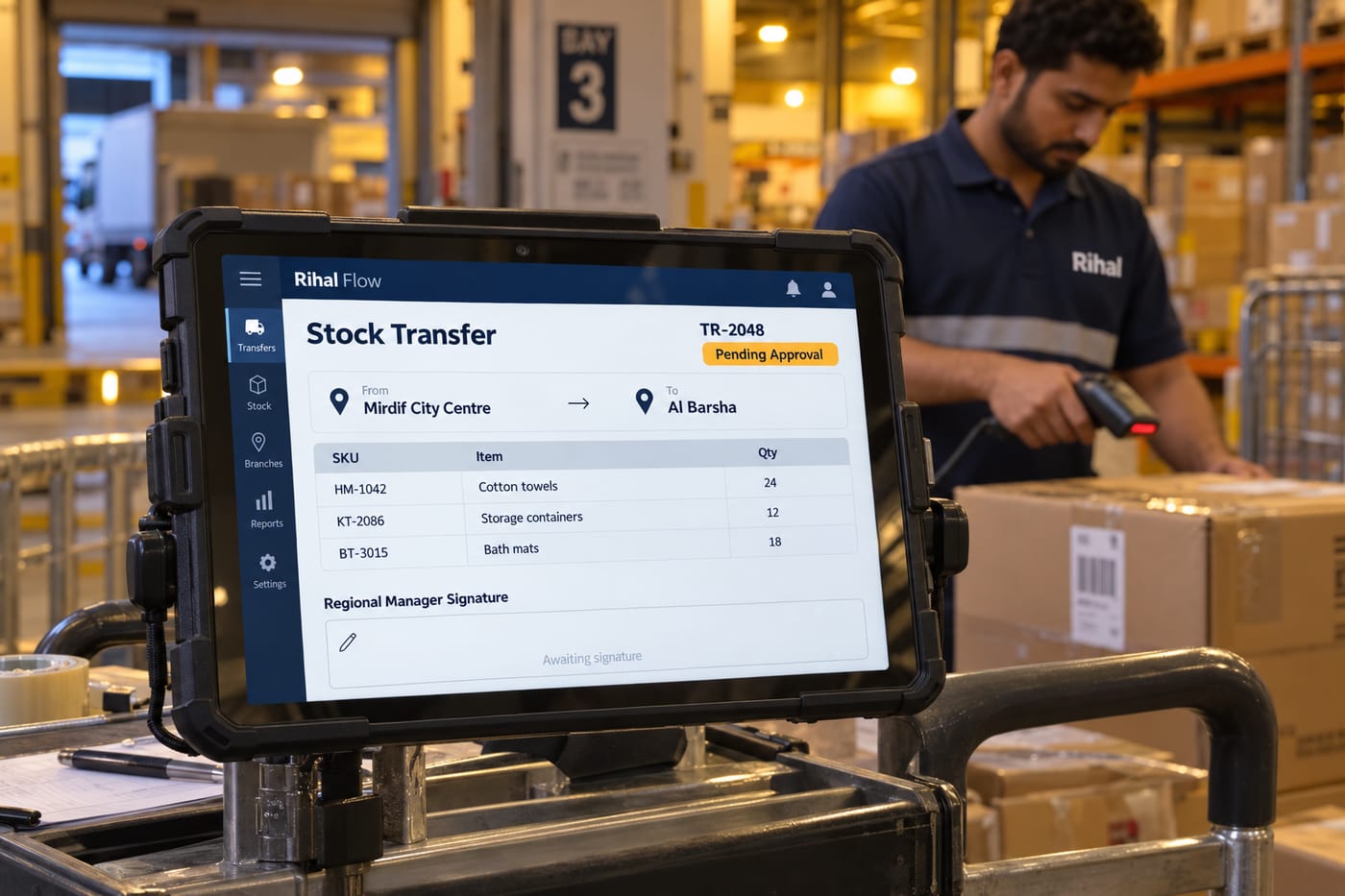
- Stock moves between branches on WhatsApp. A manager in Mirdif messages a manager in Al Barsha, a driver picks up cartons, and the ERP learns about it two days later — or never. The physical count and the system count diverge every week.
- Markdowns and returns have no paper trail. A branch manager approves a 30% markdown on slow-moving SKUs because a regional manager verbally okayed it. Nobody can tell at month-end whether that was policy, favour, or shrinkage dressed up as a discount.
- Month-end numbers don't reconcile across POS, e-commerce, and the accounting system. VAT-inclusive pricing is set in the POS, the Shopify or Salla storefront calculates it differently, and finance spends five days a month in spreadsheets closing the gap.
These are not sexy problems. They are the ones that compound. ECR Retail Loss research cited by Yoobic shows that halving shrink would raise average retail profit by 29%, and global retail shrinkage ran to roughly 1.6% of total sales in 2022. In a UAE chain, our observation across engagements is that the combination of physical shrink plus unaudited markdowns typically sits at 4–7% of gross margin — because the markdowns rarely show up in standard shrink reporting at all.
Build #1: Inter-branch stock transfer and markdown-approval workflow
This is the one almost nobody pitches you and the one that pays back fastest.
What it does
- Every stock transfer between branches is initiated as a request in the system — on a tablet, phone, or the POS back-office — not on WhatsApp.
- The receiving manager confirms receipt by scanning. Discrepancies auto-flag.
- Every markdown above a configurable threshold (say, 15%) requires a second approver — regional manager or ops head — and the approval, the SKU, the branch, the manager, and the reason code are logged.
- Returns above a threshold follow the same two-step approval.
- A weekly report shows per-branch markdown rate, transfer discrepancy rate, and return rate, ranked.
What changes once it exists
Within a quarter, the branches with the highest discrepancy rates become obvious. The markdowns stop being a verbal culture and become a number on a dashboard. In our experience with similar workflow builds, the observation effect alone — the fact that managers know every approval is logged — tightens discretionary discounting materially before any policy change is made.
What it's bad at
It will not stop a determined insider. It will not fix a bad planogram or a buyer who over-orders. And in the first month, your branch managers will complain that it slows them down. That complaint is the point.
What it takes
The shape of the build: a mobile-friendly approval layer plus a transfer module that talks to your existing POS/ERP via its API. The cost drivers are (a) how many systems it needs to read from and write to, (b) whether your current POS has a usable API or needs middleware, and (c) how many role types and approval thresholds you want. A single-POS, single-ERP chain with a modern API is a very different project from a chain running three POS systems across acquired brands.
Build #2: VAT-clean POS-to-ERP integration, ahead of 2027 e-invoicing
This one has a hard deadline. The UAE's mandatory e-invoicing rollout begins 1 January 2027 for businesses with revenue of AED 50 million or more, which covers most mid-size chains. Invoices will need to be structured XML, exchanged via an FTA-Accredited Service Provider. If your POS exports a PDF receipt and your accountant retypes totals into Zoho or Tally, that model dies.
What to build
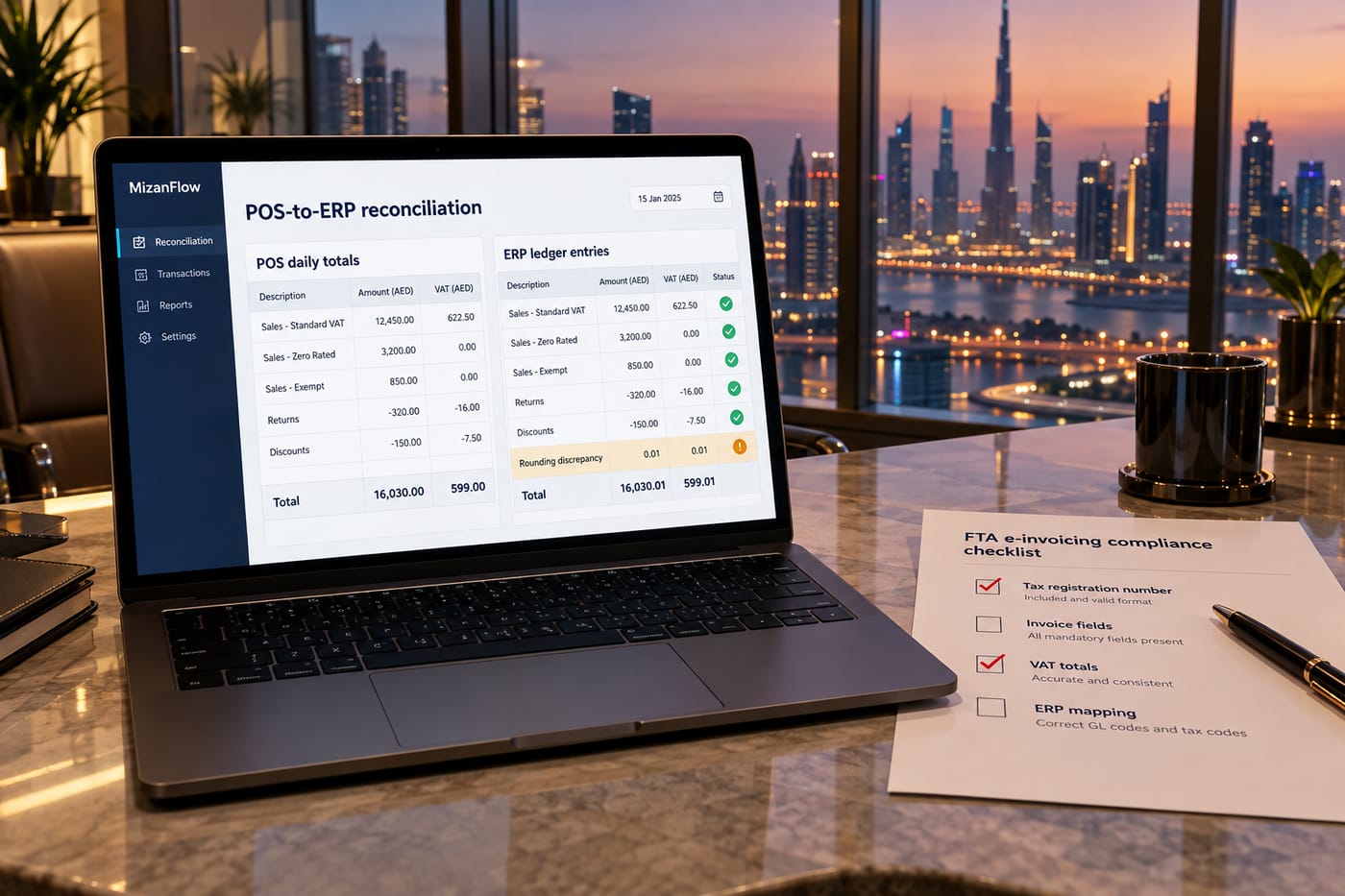
- A clean integration layer between every POS terminal and your ERP, with VAT calculated once — at the POS — and carried through unchanged.
- Branch-level and SKU-level tax categorisation that matches your FTA filings.
- A single reconciliation report that proves POS daily sales = ERP revenue = VAT return line, with any gap itemised.
- Readiness to connect to an FTA-Accredited Service Provider for the e-invoicing exchange.
Why do it now, not in late 2026
Because the integration itself exposes dirty data — duplicated SKUs, mismatched tax codes, branches running outdated price lists — and cleaning that data is 60% of the work. Chains that start in Q4 2026 will be cleaning data under deadline pressure. The voluntary phase is already live, which is a useful testing window.
None of this is legal advice. Your tax advisor and an FTA-accredited provider should sign off on the specifics of your filing structure.
Build #3: Unified real-time inventory across branches and e-commerce
Only now does it make sense to go after a single stock view. If you build this before #1, you are plumbing a leaking tank.
What it does
- One source of truth for stock, synced from every branch POS and the warehouse to your e-commerce site in near real time (seconds to a few minutes, not overnight).
- Click-and-collect and ship-from-store, routed to the branch with the best combination of stock and proximity.
- A buyer dashboard that shows sell-through by SKU by branch, with days-of-cover.
Why third, not first
Real-time inventory is only as truthful as the data flowing into it. If your transfers are untracked and your markdowns are informal, the "single view" is a confident lie. Fix the inputs first.
What it's bad at
It will not fix demand forecasting on its own. It will reduce stockouts and overstocks visibly, but the forecasting layer on top is a separate build and should wait until you have at least two clean quarters of unified data.
Build #4: Loyalty — but Arabic-first and tied to behaviour, not points
The UAE loyalty market is expected to grow 16.1% to around US$490.8 million in 2025. But only 33% of consumers globally say they feel genuinely connected to the programmes they belong to, and Landmark Group's Shukran Rewards — Arabic for 'thank you' — has 10 million+ members across 9 countries. The lesson is not "launch a points app." It is that cultural framing and specific moments (Ramadan, back-to-school, National Day) move the needle more than generic tiers.
What to build
- A bilingual (Arabic-first, English-second) loyalty mechanic integrated with the POS and e-commerce, not a bolted-on app.
- Ramadan and seasonal campaign hooks the marketing team can configure without a developer.
- WhatsApp-based enrolment and receipts — not a mandatory app download. Download gating kills enrolment in this market.
- Segment-level analytics the buying team can actually act on.
Why last
Loyalty amplifies whatever your operation already is. If stockouts and inconsistent pricing frustrate your best customers, a loyalty programme accelerates their exit — and GCC consumers move between brands faster than global averages when perceived value declines. Fix the operation, then reward the customer.
What is probably not worth building yet
- A custom demand-forecasting engine. You need 12–18 months of unified, clean data first. Until then, a well-configured off-the-shelf tool plus your buyers' intuition will outperform a custom model built on dirty inputs.
- A branded mobile app as the primary channel. WhatsApp Business plus a fast mobile web storefront usually outperforms a native app for mid-size chains, until you have a loyalty mechanic worth downloading an app for.
- Computer-vision shelf monitoring. Interesting, but the ROI shows up at hundreds of stores, not forty.
- A full ERP replacement. Almost always more expensive and more disruptive than integrating cleanly with what you have. Replace only when the existing ERP cannot handle VAT structuring or multi-entity consolidation.
How to think about cost and timeline
Every founder asks what this costs and how long it takes. The honest answer is a range driven by four things:
- How many systems need to be touched. One POS and one ERP is a different project from three POS systems across acquired brands and a separate e-commerce stack.
- How clean your current data is. SKU duplication, inconsistent tax codes, and branches running outdated price lists are the single biggest timeline risk — often 30–50% of total effort.
- How many approval roles and exception flows you need. A two-role approval chain is weeks of work. A five-role chain with regional overrides, category-specific thresholds, and audit exports is months.
- Whether the regulatory layer is in scope. E-invoicing readiness adds integration work with an FTA-Accredited Service Provider and a certification cycle you don't control the timing of.
Illustrative only: a chain with 20 stores, one modern POS with a usable API, one ERP, and reasonably clean master data — building just the transfer and markdown-approval workflow in phase one — is a materially smaller project than a chain with 35 stores across three acquired brands running two POS systems and needing e-invoicing readiness at the same time. The second scenario is a programme, not a project.
To turn any of this into a real number, three things need scoping: (1) the exact POS/ERP/e-commerce stack and API maturity, (2) the state of SKU and tax master data, and (3) the approval and audit requirements the finance and ops teams actually need. That's the conversation to have with us or any serious partner before anyone quotes you anything.
The sequence, in one view
| Order | Build | Pays back by | Why this slot |
|---|---|---|---|
| 1 | Inter-branch transfer + markdown approval workflow | Reducing shrink and unaudited discounting | Highest-ROI, lowest regulatory risk, enables everything else |
| 2 | POS–ERP VAT integration, e-invoicing ready | Avoiding audit penalties and a 2027 scramble | Hard deadline, forces data cleanup you need anyway |
| 3 | Unified real-time inventory + click-and-collect | Fewer stockouts, higher online conversion | Only truthful once #1 is in place |
| 4 | Arabic-first loyalty tied to POS and seasons | Repeat rate and basket size | Amplifies a working operation; destroys a broken one |
How CodeNicely can help
Most of our relevant work for a chain in your position is not from another fashion or F&B brand — it's from Vahak, India's largest logistics marketplace, where the core problem was the same shape: thousands of distributed transactions (loads, trucks, drivers) happening in WhatsApp and phone calls, with no system of record, no approval trail, and no way for operations to see which nodes in the network were leaking money. We built the workflow, approval, and real-time visibility layer that moved those transactions onto a system without slowing the operators down — which is the harder half of the problem. The parallel to a 10–40-store UAE chain running on branch-manager WhatsApp groups is close enough to be useful.
For the VAT-and-finance-integration piece, our work on GimBooks — a YC-backed accounting SaaS — is where the relevant muscle sits: tax-structured invoicing, reconciliation across sources, and keeping finance data clean enough to pass audit. If you'd rather start with a scoped conversation about your specific stack, our Dubai software development team is the right entry point.
Frequently Asked Questions
What software does a retail chain in the UAE actually need before 2027?
At minimum: a POS that calculates VAT correctly and consistently across every branch, an ERP or accounting system that receives those transactions without manual re-entry, and the ability to issue structured XML invoices via an FTA-Accredited Service Provider when the mandate takes effect. Everything else — loyalty, forecasting, apps — is strategic choice. The VAT and e-invoicing readiness is not.
Should we replace our POS or integrate with it?
Integrate, unless the POS literally cannot handle UAE VAT structuring, has no usable API, or is unsupported by its vendor. POS replacement in a live multi-branch chain is a 9–18 month disruption that rarely pays back versus a well-built integration layer. Replace only when the integration cost approaches the replacement cost, or when the vendor is a dead end.
How long does inter-branch transfer and markdown-approval software take to build?
The shape of the timeline is driven by three things: how many POS and ERP systems it has to talk to, how clean your SKU and branch master data is, and how many approval roles and thresholds the finance team requires. A single-POS, single-ERP chain with clean data is a materially shorter project than a multi-brand chain with inconsistent masters. The way to turn that into a real number is a two-week scoping conversation that audits your current stack and data.
Is a custom loyalty app worth building, or should we use an off-the-shelf platform?
For most 10–40-store chains, start with an off-the-shelf platform integrated properly with your POS and WhatsApp, in Arabic-first UX. Custom becomes worth it when you have a specific mechanic — a Ramadan-tied family-pooling model, a cross-brand points structure, a tiered VIP experience — that off-the-shelf platforms can't configure. Build the mechanic, not the app.
What's the single biggest risk in building retail chain software in the UAE?
Dirty master data. Duplicated SKUs across branches, inconsistent tax categorisation, and outdated price lists are what turn a six-month build into an eighteen-month build. Any serious partner will spend the first two weeks auditing data quality before quoting the project — if they don't, that's the warning sign.
Sources & further reading
- UAE Retail Market Size, Share & Trends Forecast 2033 — IMARC Group
- UAE Retail Platform Market Size, Share, Trends, Growth Analysis Report, 2030 — MarketsandMarkets
- What is shrink in retail? Causes, types and the real cost — Yoobic (citing NRF & ECR Retail Loss)
- Guide to UAE VAT Compliance for Businesses — VJM Global
- UAE to launch pilot phase of electronic invoicing system in July 2026 — Gulf News
- UAE E-Invoicing Mandate 2026: Voluntary Phase Live — Tradeshift
- Ramadan Drives Loyalty Adoption Across the GCC — Loylogic
- Middle East Loyalty Trends 2026: Six Forces Shaping Customer Engagement — Loylogic
Get one practical guide a week
Costs, AI tools, partner selection — written for people who make the decision. No spam, unsubscribe anytime.
Thanks — you're on the list. One practical guide a week, nothing else.
That didn't work — please check the email address and try again.
Building something in Retail?
CodeNicely partners with founders and tech teams to ship AI-native products that move metrics. Tell us about the problem you're solving.
Talk to our team Book a 30-min call