_1751731246795-BygAaJJK.png)
What to Build for Marketing and Creative Agencies in the UAE

 Published by CodeNicely, the product studio founded by Meghal Agrawal and Ujjwal Agrawal in 2017
For: Founder or MD of a 15–60-person integrated marketing or creative agency in Dubai, running AED 8–25M in annual billings, who suspects their margin is being eaten by scope creep and manual reporting but has never been shown exactly which systems are responsible
In this guide
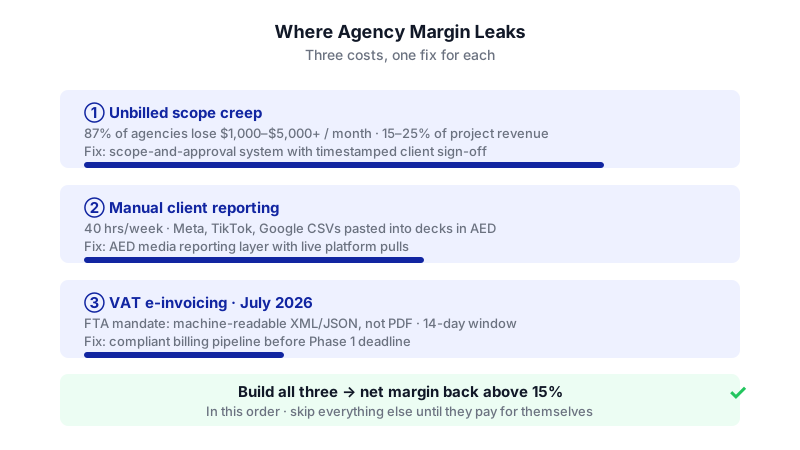
If you run a 15–60-person agency in Dubai and your net margin is drifting below 15%, the fix is almost never a new project-management tool. It's three pieces of custom software that no off-the-shelf vendor sells together: a scope-and-approval system that timestamps client sign-off against a specific deliverable version, an AED-denominated media reporting layer that pulls Meta, TikTok, and Google without a Monday-morning export ritual, and a VAT e-invoicing pipeline ready for the FTA's July 2026 Phase 1 mandate. Build those three, in that order, and skip the rest until they're paying for themselves.
This post is for the founder or MD who already suspects where the money is going but has been pitched the same generic agency OS five times this year. Below is what to build, what changes once it exists, and what it realistically takes.
The three problems that actually cost you money
Before the build order, name the leaks honestly. Agencies in the UAE lose margin in the same three places, in roughly this ranking:
1. Unbilled scope creep that your MSA already entitles you to invoice
Ignition's 2025 Agency Pricing & Cashflow Report surveyed 273 agency managers and executives and found that 57% of agencies lose between $1,000 and $5,000 every month to unbilled scope creep, another 30% lose more than $5,000 a month, and only 1% successfully bill for everything that falls outside scope. The Agency Management Institute's 2024 benchmark data puts the revenue impact for agencies without formal scope management at 15–25% of project revenue. PMI's Pulse of the Profession has scope creep affecting 52% of all projects, with budget overruns averaging 27% once it starts.
Your MSA almost certainly already has a change-order clause. The problem is operational: when the client WhatsApps a tweak at 11 PM, nobody creates a change order because there is no system that makes it the path of least resistance. The approved scope lives in a signed PDF. The actual work lives in Figma, Slack, and a dozen email threads. Nothing timestamps the moment a client approved v3 of a deliverable, so when v7 ships with an extra ad set, extra language, and an extra round of revisions, nobody can prove what was scoped.
2. Monday-morning client reporting that eats 40 hours a week across the agency
UAE digital ad spend was USD 2.29 billion in 2025 and is forecast to hit USD 2.64 billion in 2026, with TikTok now the largest ad platform in the country at 12.5 million adult users — ahead of LinkedIn, Facebook, YouTube, and Instagram. Your clients are spending on all five, often in different currencies, and expecting one weekly deck in AED with VAT reconciled. If your account managers are still exporting CSVs from each platform and pasting them into a template, you're paying senior salaries for data janitor work.
3. VAT invoicing that's about to get much harder
The UAE introduced mandatory e-invoicing via Federal Decree-Law No. 16 of 2024, effective 30 October 2024, with Phase 1 mandatory implementation set for July 2026. Invoices must be machine-readable XML or JSON — not PDFs — and transmitted to the FTA within 14 days of the transaction via an accredited service provider. Deloitte's guidance is clear that this applies to B2B and B2G transactions first. If your billing today is a Xero or Zoho invoice emailed as a PDF, that stops being compliant. For agencies running separate ADGM and mainland entities with retainers invoiced across both, this is not a plug-in — it's a billing-architecture problem. A tax advisor should sign off on your specific setup.
What to build, in order
Build 1: A scope-and-approval system that enforces your MSA
This is the single highest-ROI piece of software a UAE agency can build, and almost nobody builds it because the big agency-ops vendors treat approvals as a checkbox feature instead of a billing event.
What it actually does:
- Every deliverable is versioned and tied to a specific line item in the signed scope document
- Client approvals happen in-system — via a branded link, not Slack or WhatsApp — and get timestamped with the approver's name, the deliverable version, and the scope line
- When a change request comes in, the system compares it to the approved scope and auto-generates a change-order draft with an estimate, which the AM reviews and sends in two clicks
- Arabic-English dual-language deliverables are tracked as separate approval chains (because they are — your Arabic copy lead approves copy; the client's Arabic-speaking stakeholder approves it separately from the English)
- Monthly, it produces a scope utilisation report per retainer: hours delivered vs. hours scoped, change orders issued vs. accepted vs. absorbed
What changes once it exists: the change-order conversation stops being awkward because the system, not the account manager, raises it. Agencies that implement this well typically recover a meaningful share of the 15–25% revenue that AMI's benchmark says is leaking. The number depends entirely on how disciplined your AMs become about actually sending the change orders the system drafts for them — the software removes the friction, but it does not remove the client-relationship conversation.
What it's bad at: it will not fix a scope document that was vague to begin with. If your SOWs say "social media content" instead of "12 static posts, 4 reels, 2 rounds of revisions per asset," no software can enforce what was never defined.
Build 2: AED-denominated media reporting that reconciles across platforms
Once scope is under control, the next leak is the manual reporting. The build:
- API connections to Meta Ads, TikTok Ads, Google Ads, LinkedIn Ads, and Snapchat (still meaningful in the GCC)
- Nightly pull of spend, impressions, CTR, CPM, conversions — stored in your warehouse, not inside the vendor's dashboard
- Currency conversion to AED at the day's rate, with VAT handled per platform (Meta and Google invoice differently to UAE entities than they do globally)
- Client-branded reporting layer where each client sees only their accounts, in their language, with the metrics they care about
- Anomaly alerts — when a campaign's CPM jumps 40% overnight, the strategist knows before the client does
What changes: the Monday report goes from a four-hour exercise to a review-and-send. Senior account time redirects to strategy. Clients get a live dashboard between reports, which is itself a retention argument.
You can increasingly layer AI on top — summary generation, performance commentary, budget pacing recommendations. The UAE marketing automation market was valued at USD 270.1 million in 2025 and is projected to reach USD 535 million by 2030 at a 14.7% CAGR, well above global growth. Clients are starting to expect AI-assisted insights in reports; being early here is a defensible pitch advantage. See how we think about this in our AI studio work.
What it's bad at: it will not replace a good strategist's judgment on why performance dropped. It will tell you that CPMs rose; it will not tell you that Ramadan started on Tuesday.
Build 3: VAT-compliant e-invoicing tied to your billing entities
This one you cannot avoid. Phase 1 is July 2026. The build is less exciting than the first two but it is non-negotiable, and if you run both an ADGM free-zone entity and a mainland entity (common for agencies serving government and regulated clients), the architecture matters.
- Integration with an FTA-accredited service provider (ASP) — this is not a build decision; the FTA publishes the list
- Invoice generation in the required XML/JSON format, routed through the correct entity based on the client contract
- Retainer logic: monthly recurring invoices that correctly apportion VAT, handle advance billing, and reconcile against actual delivered scope from Build 1
- Credit note workflows for scope reductions and refunds
- Audit trail that satisfies the 14-day transmission requirement
What changes: you stop worrying about July 2026. Your finance team gets back the two days a month they currently spend chasing invoice PDFs. Reconciliation between delivered scope and billed amount becomes automatic because Build 1 feeds Build 3.
What it's bad at: it will not advise you on which entity should bill which client — that's a tax and legal structuring question your auditor and lawyer have to answer for your specific setup.
What to not build yet (or ever)
A few things sound appealing and are usually a mistake for an agency your size:
- A custom CRM. HubSpot or Pipedrive will do what you need for years. Build on top of them if you must — don't replace them.
- A custom time-tracking tool. Harvest, Toggl, and Everhour exist. The problem is not the tool; it's that your team doesn't log hours. Software won't fix that.
- A proprietary AI content generator. You will spend AED 400K building something inferior to what a USD 20/month ChatGPT Team seat gives your copywriters. Build AI into your reporting and scope systems — not your creative output.
- A full-stack "agency OS." Resist the temptation to build one platform that does everything. Three focused tools that integrate are faster, cheaper, and less fragile than one monolith.
Sequencing and what shapes the investment
Build in the order above. Scope first because it recovers revenue immediately and funds the next two builds. Reporting second because it buys back senior time. E-invoicing third because the deadline is fixed and you have until mid-2026.
What drives the cost and timeline of each piece, honestly:
- How many ad platforms and billing entities you need to support. Two platforms and one entity is a different build from five platforms and three entities
- Whether you already have clean data on existing retainers. If your SOWs live in Google Drive with inconsistent structure, data migration dominates the first phase
- How much AI you want in the first version. A reporting layer with templated commentary is faster to build than one that writes nuanced performance narratives per client
- Your appetite for change management. Software goes live in weeks; account managers changing habits takes months. Budget for training, not just the build
A realistic shape: each of the three builds is a focused engagement, not a two-year platform project. The scope-and-approval system is typically the smallest. The reporting layer is the largest because of the platform integrations. The e-invoicing piece sits in between and is bounded by the ASP integration pattern. Any firm quote requires knowing your platform mix, your entity structure, and whether you want AI commentary in v1 — have that conversation before anyone gives you a number.
How CodeNicely can help
We build custom software for operators who already know where their margin is leaking and need something fitted to their workflow, not a generic SaaS. The closest parallel in our work is GimBooks — a YC-backed accounting and invoicing platform for Indian SMBs where we built the invoicing engine, GST compliance, and the recurring-billing logic. The patterns transfer directly to UAE VAT e-invoicing and retainer billing: machine-readable invoice formats, multi-entity routing, credit note workflows, and audit trails that satisfy a tax authority. For the scope-and-approval and AI-reporting pieces, our AI studio team has shipped similar workflow and data-pipeline builds. If you're a Dubai agency sizing this out, our UAE team is the right first conversation — we scope, we price against the scope, and you own the IP outright with no vendor lock-in.
The bottom line
Your margin is not being eaten by bad project management. It's being eaten by the gap between what you scoped, what you delivered, and what you billed — and by the hours your senior people spend doing data entry that software should do. Fix those three things in order. Skip the rest. Revisit in eighteen months when the first three are generating returns.
Frequently Asked Questions
How much does custom agency software typically cost for a Dubai agency?
The honest answer is that it depends on three things: how many ad platforms and billing entities you need to integrate, whether your existing scope and retainer data is clean enough to migrate, and how much AI you want in version one. A single-entity agency with three ad platforms and templated reporting is a very different engagement from a multi-entity agency with five platforms and AI-generated performance commentary. To turn a range into a real quote, you need a scoping conversation that maps your current systems, platforms, and entity structure.
Can off-the-shelf tools like Monday, Asana, or ClickUp solve the scope creep problem?
Partially. They handle task tracking well. What they do not do well is tie each deliverable version to a specific scope line in your signed MSA, timestamp client approvals as billable events, and auto-draft change orders when work exceeds scope. If you have the operational discipline to layer those workflows on top manually, generic tools can work. Most agencies don't, which is why the custom build pays back.
Do we really need to prepare for UAE e-invoicing now if Phase 1 is July 2026?
Yes, if your billing architecture is complex — multiple entities, mixed retainer and project billing, or clients in regulated sectors. The PwC and Deloitte guidance both suggest nine to twelve months of lead time for non-trivial setups because of the ASP integration, format compliance, and testing cycles. A tax advisor should confirm what applies to your specific entities.
How long before we see margin recovery from a scope-enforcement system?
The system itself can be live in a focused build cycle. The margin recovery depends on how quickly your account managers adopt the change-order workflow — software removes the friction but doesn't remove the client conversation. Agencies with disciplined AM leadership see measurable change-order revenue in the first full quarter; agencies that treat it as optional see nothing. Build in training and management reporting from day one.
Should we build or buy the ad-reporting layer?
Buy if your needs are standard — Supermetrics, Funnel.io, and Whatagraph handle most of the plumbing. Build if you have UAE-specific requirements that off-the-shelf tools handle poorly: AED currency reconciliation with per-platform VAT treatment, Arabic-language client dashboards, deep integration with your scope and billing systems, or AI commentary trained on your clients' performance patterns. Many agencies start with a bought tool and build a thin custom layer on top — that's often the fastest path.
Sources & further reading
- UAE Advertising Market Size, Share & Trends Forecast 2033 — IMARC Group
- Marketing Agencies Market Industry Insights, Forecast 2035 — Market Research Future
- Digital Marketing Statistics UAE 2026: 20+ Key Facts (citing DataReportal Digital 2026: UAE and Research and Markets)
- 2025 Agency Pricing & Cashflow Report — Ignition (primary source)
- Why Do Agency Projects Go Over Scope in 2026? (citing Agency Management Institute 2024 benchmark)
- 52% of Projects Now Experience Scope Creep — TRCR (citing PMI Pulse of the Profession)
- UAE's E-invoicing launch in 2026: What you need to know — PwC Middle East
- E-invoicing – Amendments to the UAE VAT legislation — Deloitte Middle East
Get one practical guide a week
Costs, AI tools, partner selection — written for people who make the decision. No spam, unsubscribe anytime.
Thanks — you're on the list. One practical guide a week, nothing else.
That didn't work — please check the email address and try again.
Building something in Marketing and Creative Agencies?
CodeNicely partners with founders and tech teams to ship AI-native products that move metrics. Tell us about the problem you're solving.
Talk to our team Book a 30-min call