
What Software a UAE Pet Business Should Build First

 Published by CodeNicely, the product studio founded by Meghal Agrawal and Ujjwal Agrawal in 2017
For: Owner or COO of a Dubai-based pet services group — grooming, boarding, vet, or retail — running 2–5 locations and losing margin to no-shows, untracked repeat customers, and a WhatsApp-driven booking process that doesn't scale
In this guide
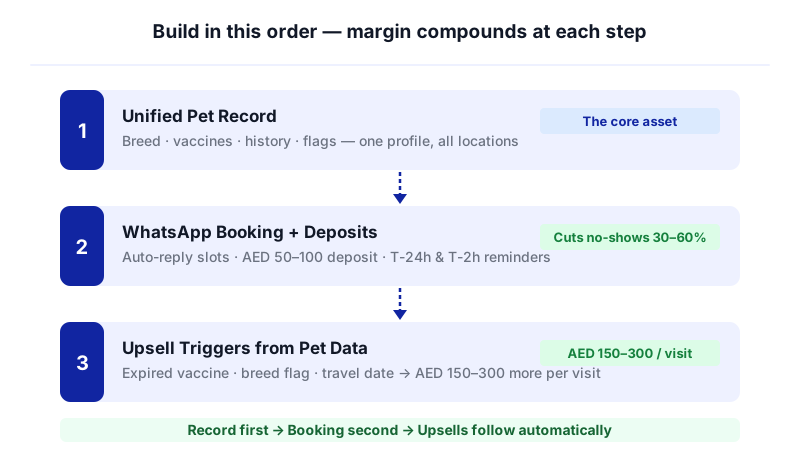
If you run a Dubai pet services group across 2–5 locations, the first piece of software worth commissioning is not a booking system. It is a unified pet record — vaccination status, breed flags, grooming history, boarding notes — that your booking flow, your WhatsApp replies, and your upsell prompts all read from. Build that first, bolt deposit-enforced booking onto it second, and only then worry about loyalty, retail POS, or an owner-facing app. The reason is margin: a pet with an expired rabies vaccine or an overdue dental is worth AED 150–300 more per visit, and WhatsApp bookings cannot see that.
This post walks through the three operational problems that actually cost a UAE pet business money, what to build for each, and in what order. It assumes you already have 2–5 locations across grooming, boarding, vet, or retail — if you are still at one shop, most of this is premature.
The three problems that are actually bleeding margin
1. WhatsApp bookings do not scale, and you already know this
The symptom is familiar: one staff member fields 200+ WhatsApp messages a day across locations, bookings get double-entered or lost, and after-hours enquiries sit until morning. The data backs up what you feel. Over 70% of WhatsApp users abandon a booking conversation if they don't get a reply within 5 minutes, and the average small business takes 2+ hours to respond — losing roughly 40% of potential leads before first contact.
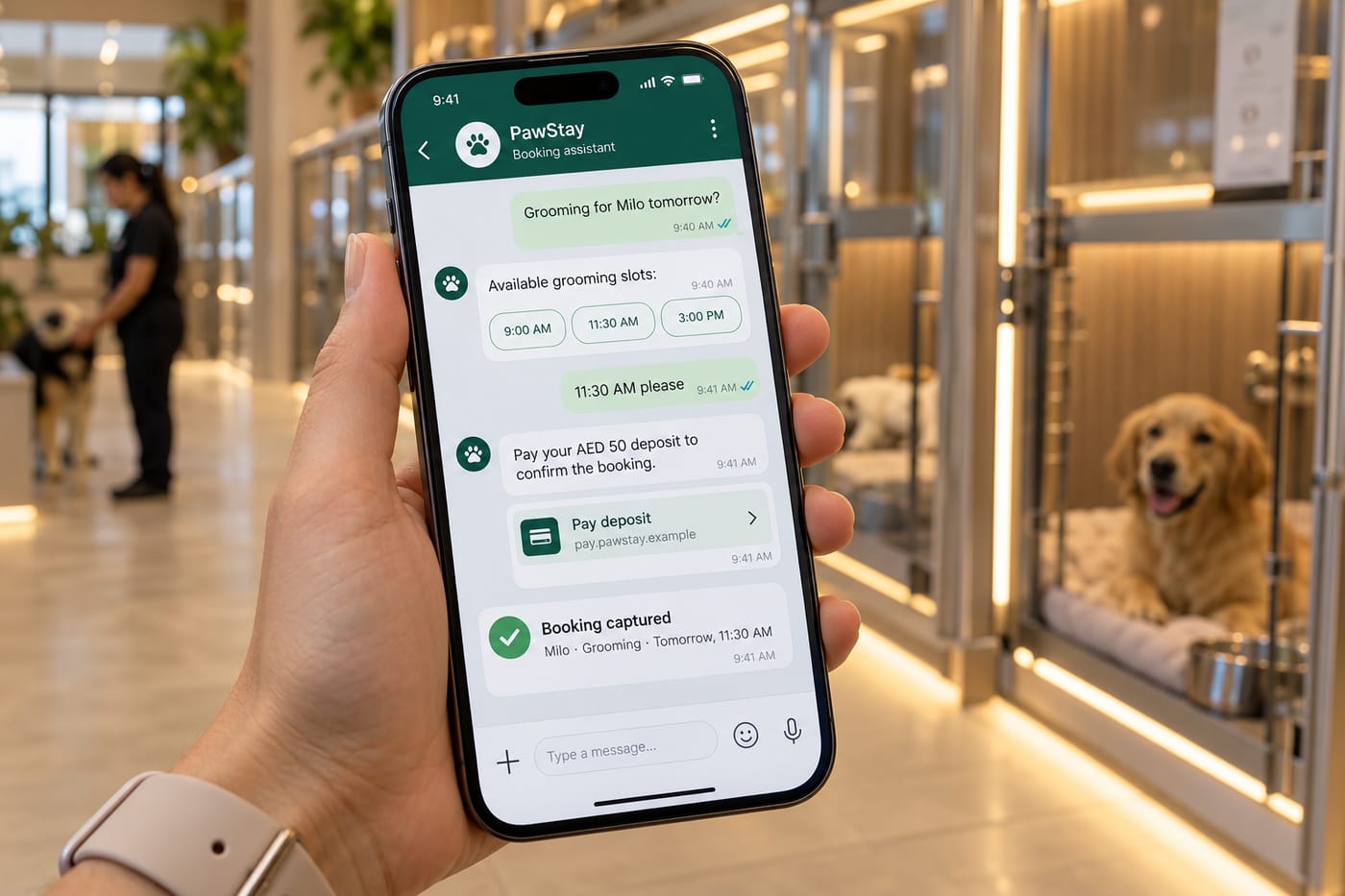
But here is what the booking SaaS vendors will not tell you: switching to a generic online booking widget does not fix this. UAE pet owners prefer WhatsApp. They are not going to install your app or bookmark your booking page. The fix is a WhatsApp Business API integration that routes messages into a single inbox, auto-replies with available slots pulled from a real calendar, and captures the booking without a human in the loop for the standard cases. The human handles the exceptions.
2. No-shows without deposits are a tax you are paying voluntarily
No-show rates across appointment service businesses run 20–25%, and salon-type businesses without reminders see up to 30%. For a grooming location doing 25 appointments a week at an average AED 180 ticket, a 15% no-show rate is roughly AED 42,000 of lost revenue per year per location. Across five locations, that is a six-figure AED problem.
Automated reminders cut no-shows by 30–60%, and deposit requirements cut them further. The true cost of a no-show is estimated at up to 4× the face value once you factor in idle groomer time and the slot a paying customer could have taken.
The fix is not complicated: a deposit-enforced booking flow (AED 50–100 held on card or via a payment link), a 24-hour and 2-hour reminder, and a one-tap reschedule link. The hard part is making it work inside WhatsApp without forcing the customer onto a web portal — which is why this is custom work, not a Fresha subscription.
3. The pet record gap — the one nobody is pitching you
This is the real one. Veterinarian recommendations drive roughly 44% of pet owner spending, and among dog owners who visited a vet in 2024, nearly half visited twice and 27% visited three or more times. Diagnostics revenue per practice grew 6% in 2025 — three times faster than overall practice revenue — while visit counts fell. Translation: the money is in what you sell per visit, which is triggered by what you know about the pet.
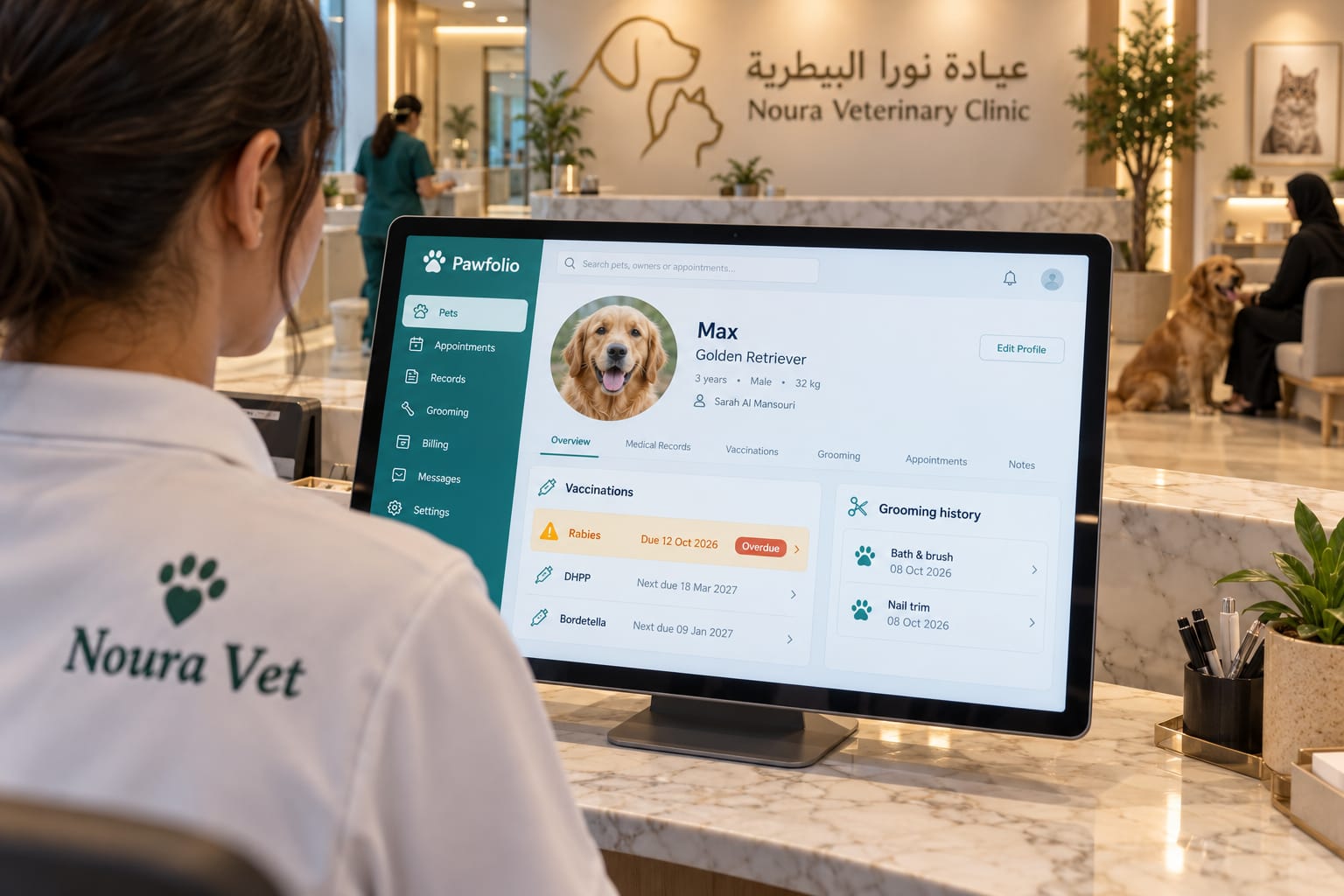
Your groomer books a Golden Retriever for a bath. Your system should flag: last rabies vaccine 11 months ago (upsell booster at the attached vet), breed-prone to ear infections (upsell ear cleaning), owner travels in July (prompt boarding booking in May). None of this happens with a WhatsApp calendar. All of it happens with a shared pet profile that your groomer, vet, boarding staff, and retail cashier all read and write to.
This is the asset. Everything else is plumbing around it.
What to build, in order
Phase 1: The pet record + WhatsApp booking layer
Start with a single pet profile schema — owner, pet, breed, DOB, microchip ID (ISO 11784/11785, which you need for anything import-related anyway), vaccination record with expiry dates, allergy and behaviour flags, service history across all your locations. This is your core database. Keep it boring, keep it clean, and make sure every staff-facing screen in every location writes to it.
On top of that, build:
- A WhatsApp Business API bot that handles booking, rescheduling, and reminders for the 70% of enquiries that are standard
- A staff dashboard showing today's appointments across locations, with the pet profile one click away
- Deposit capture via Stripe, Telr, or Network International — whichever your acquiring bank prefers in the UAE
- Automated reminders at T-24h and T-2h, with a reschedule link that respects your deposit policy
What changes once it exists: you stop losing the 40% of WhatsApp leads, no-shows drop meaningfully (realistically to 8–12% from 20–25%, based on the reminder+deposit combination), and your groomers walk into every appointment knowing the pet.
What this is bad at: it does not solve retail POS, it does not handle vet clinical records to the depth a dedicated PIMS like ezyVet does, and it will not do accounting. Do not try to make it do those things in Phase 1.
Phase 2: Upsell triggers and the vet/grooming/boarding handoff
Once the record exists, add the logic that monetises it. Rules engine, not AI — at least not yet. Examples:
- Vaccination expiring in <60 days → automated WhatsApp with a one-tap booking at the vet arm
- Grooming customer whose pet has not had a dental in 12 months → prompt at checkout
- Boarding enquiry for a pet with expired kennel cough vaccine → required vet visit flagged before booking is confirmed (this also protects you legally)
- Breed-specific prompts (brachycephalic breeds for summer boarding, double-coated breeds for de-shedding)
If you run boarding, this phase is also where you build the MOCCAE and import documentation workflow. Every cat and dog entering the UAE needs a MOCCAE import permit (AED 200, 30-day validity), an ISO microchip, current rabies vaccination, and a government-endorsed health certificate issued within 10 days of travel — with 90-day waiting periods for pets from high-risk countries. If you are handling relocations or international boarding clients, having this as a tracked workflow with document expiry alerts is a differentiator and a liability shield. (Do not take this as legal or regulatory advice — your compliance officer or a UAE-licensed vet should sign off on your actual workflow.)
Phase 3: Retail POS, loyalty, and the owner app
Only after Phases 1 and 2 are running. The reason is sequencing: a loyalty programme is worthless without a unified customer view, a retail POS integration is noise until you have the pet record to attach purchases to, and an owner-facing app is a maintenance burden that most UAE pet owners will not install anyway (WhatsApp has already won that battle).
When you do build retail integration, the goal is a single customer ledger — the AED 400 of monthly dog food, the quarterly groom, the annual vet visit, all on one profile. That is the view that lets you build real retention offers and justify the premiumisation that is driving the UAE pet food market from USD 107M in 2024 toward USD 171M by 2033.
What this costs and how long it takes — the honest version
Every buyer wants a number. Here is the shape of it instead, because anyone who gives you a figure before scoping is guessing.
What drives the cost and timeline:
- Number of integrations. WhatsApp Business API is one. A UAE payment gateway (Telr, Network, Stripe) is another. If you have an existing POS (Vend, Loyverse) or accounting system (Zoho, Xero) that needs two-way sync, each adds real work.
- Data migration. If you have 5,000 existing customers in spreadsheets and WhatsApp chat history, cleaning and importing that is a project in itself. Starting with a blank database is faster but you lose history.
- Multi-location complexity. Shared inventory, cross-location booking, inter-location transfers — each is a design decision that adds weeks.
- Compliance scope. If MOCCAE import workflows and vet clinical records are in Phase 1, you are building a lot more schema and audit logging than a pure grooming app needs.
Illustrative only: a Phase 1 build — unified pet record, WhatsApp booking bot, deposit flow, reminders, staff dashboard, three locations, no POS integration, no legacy data migration, one UAE payment gateway — is in the range of a mid-sized custom build. Think months, not weeks, and not years. Phase 2 adds roughly half that again. Phase 3 depends entirely on what retail and loyalty systems you are integrating with.
To turn this into an actual quote you would need to answer three things: how many locations and which services (grooming only vs grooming+vet+boarding+retail), what systems you already run that the new build has to talk to, and whether you are migrating historical customer data. Have those three answers ready for any conversation — with us or anyone else — and the scoping gets honest fast.
How CodeNicely can help
The pattern above — a shared domain record that multiple workflows read from, plus a messaging layer that handles the long tail — is what we built for HealthPotli, an e-pharmacy where the core asset was a unified patient and prescription record that drove refill prompts, drug interaction checks, and repeat purchase. The parallels to a pet services group are close: regulated records, repeat-visit economics, multiple service lines sharing one customer, and a messaging-first customer base. We handled the clinical data model, the ordering workflow, and the pharmacist-facing dashboard as one system, not three.
If you are evaluating this build, our Dubai software development team can scope Phase 1 against your actual location count, systems, and compliance scope. We work with full IP transfer — the code and the pet record database are yours — and no vendor lock-in on the hosting or payment side.
Sequencing: the one-line version
Build the pet record first. Wrap it in a WhatsApp booking layer with deposits and reminders. Add upsell rules and compliance workflows once that is live and clean. Touch retail POS and loyalty last. Do not let a booking SaaS vendor convince you the calendar is the product — the record is the product.
The UAE pet market is at the right scale for this. Pet ownership jumped 30% post-pandemic to about 1.5 million owners, pet sitting alone is growing at 14.7% CAGR toward USD 44M by 2030, and grooming is the fastest-growing MEA regional market at 9.2% CAGR. The operators who will capture that growth across 10, 15, 20 locations are the ones whose software can tell them what each pet needs next. The ones still running on WhatsApp will cap out at four or five.
Frequently Asked Questions
Should I just use Fresha, Vagaro, or ezyVet instead of building custom?
If you run one location of one service type, yes — off-the-shelf is almost always right at that scale. The case for custom starts at 2–3 locations spanning multiple service types (grooming + vet, or grooming + boarding + retail), because no single SaaS handles that combined pet record well, and the margin you lose to disconnected systems quickly exceeds the build cost. A hybrid is also valid: ezyVet for the vet arm's clinical records, custom for the shared customer and booking layer that sits above it.
How much does a custom pet services platform cost in the UAE?
The honest answer is that the range is wide and driven by three things: how many locations, how many integrations (WhatsApp API, payment gateway, existing POS, accounting), and whether you need to migrate historical customer data. A Phase 1 build for a 3-location grooming+boarding group with no legacy migration sits in a very different bracket than a 5-location group that also wants vet clinical records and retail POS sync. Have your location count, current systems list, and data migration decision ready, and any serious software partner can give you a scoped number within a week.
How long before we see no-shows actually drop?
Based on the industry data, reminder-plus-deposit flows typically cut no-shows from the 20–25% baseline into the 8–12% range within the first 60–90 days of go-live, once customers adjust to the deposit expectation. The first month will see some pushback from regulars who are not used to paying upfront — that is normal and worth absorbing. The 24-hour reminder does most of the work; the deposit does the rest.
Can we handle MOCCAE import permits and health certificates inside the same system?
Yes, as a document-tracking and alerting workflow — expiry dates, required vaccinations, microchip verification, waiting-period calculations. What you should not do is treat the software as a substitute for an actual MOCCAE-licensed vet reviewing each case. Build it as a workflow that prepares and tracks the paperwork, flags what is missing, and alerts on expiry; have a licensed professional sign off on each actual submission.
Do UAE pet owners actually want to book through WhatsApp instead of an app?
Overwhelmingly yes. WhatsApp penetration in the UAE is near-universal and the installed-app fatigue is real — asking a customer to download a pet services app to book a groom is friction most will not accept. The right pattern is WhatsApp-first for booking and reminders, with a lightweight web portal (not an app) for customers who want to see full pet history. Save the native app for Phase 3, if ever.
Sources & further reading
- UAE Pet Grooming Services Market Size & Outlook, 2025–2030 — Grand View Research
- Pet Sitting Market Size in UAE 2026: Growth & Trends — PetWatch App
- UAE Pet Food Market Size, Share & Trends Forecast 2033 — IMARC Group
- No-Show Rates by Industry: 2026 Benchmarks and Costs — Etisia
- How Much Do No-Shows Really Cost? A Data Breakdown by Industry — SimplyBook.me
- Why Small Businesses Are Losing 40% of Leads on WhatsApp — Clarivo
- Effective Metrics for WhatsApp Bookings — Kuba Labs
- UAE Pet Import Requirements (Dogs & Cats) — Official 2026 Guide — ZooVetTravel / MOCCAE
Get one practical guide a week
Costs, AI tools, partner selection — written for people who make the decision. No spam, unsubscribe anytime.
Thanks — you're on the list. One practical guide a week, nothing else.
That didn't work — please check the email address and try again.
Building something in Pet Services?
CodeNicely partners with founders and tech teams to ship AI-native products that move metrics. Tell us about the problem you're solving.
Talk to our team Book a 30-min call