
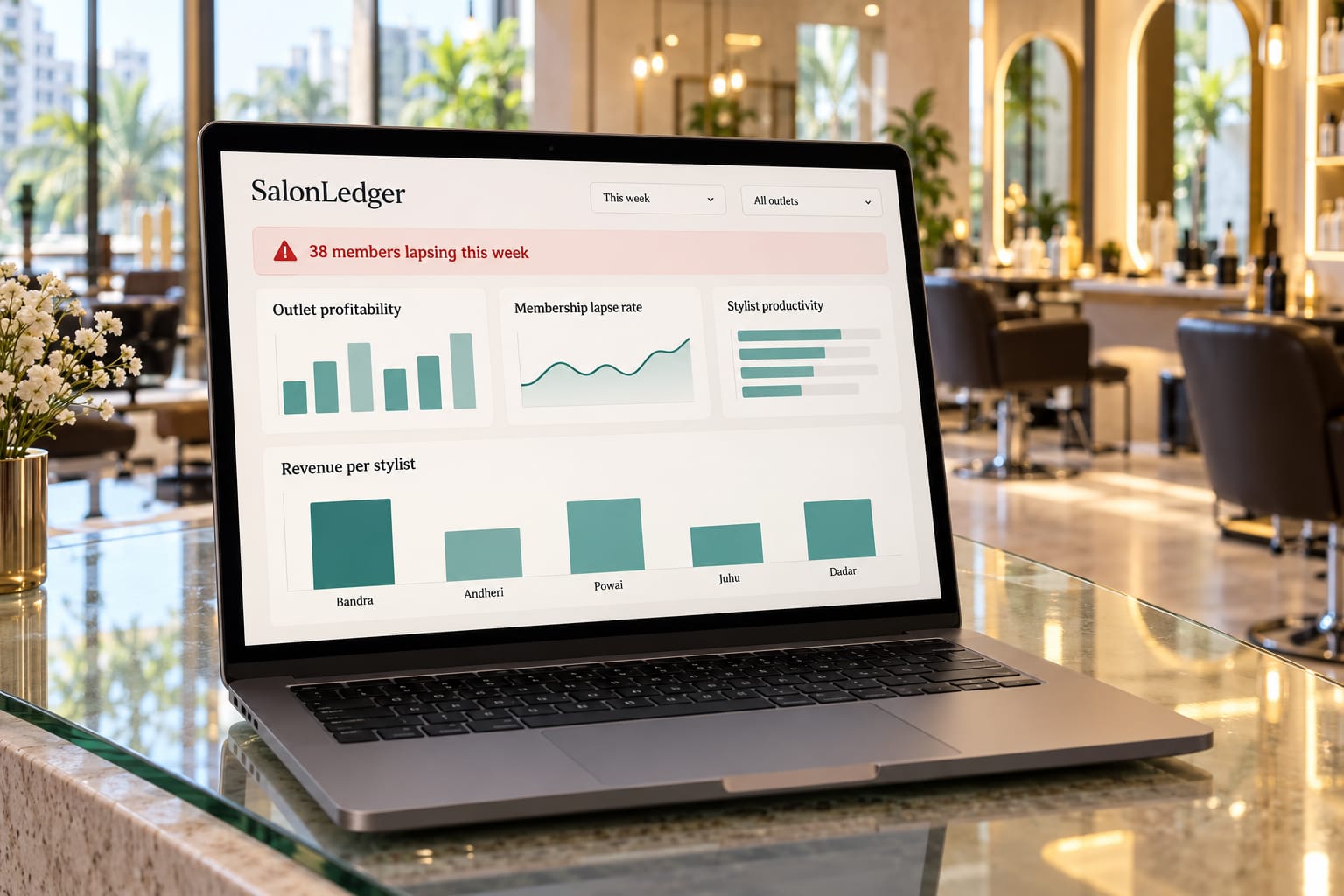
What to Build for Salons and Personal Care Chains in India

 Published by CodeNicely, the product studio founded by Meghal Agrawal and Ujjwal Agrawal in 2017
For: Owner or COO of a 5–30 location salon or personal care chain in India who is losing repeat customers to app-first competitors and cannot see which outlet is actually profitable
In this guide
If you run a 5-30 outlet salon or personal care chain in India, the software worth building first is not another booking app — it is a membership redemption and auto-renewal engine, a stylist-level productivity dashboard, and a real-time retail inventory system. Booking is a solved problem. The revenue leaks that actually matter — lapsed packages, invisible per-stylist variance, and shrinkage hidden in a paper stock register — are not addressed by any of the SaaS tools being pitched to you, and they are where the P&L is bleeding.
This post is for owners and COOs who already have a POS, already take bookings online, and still cannot answer two questions on a Monday morning: which outlet is actually profitable, and why last quarter's membership revenue did not repeat this quarter. Here is what to build for your business, in what order, and what to not bother with yet.
The three leaks that cost you real money
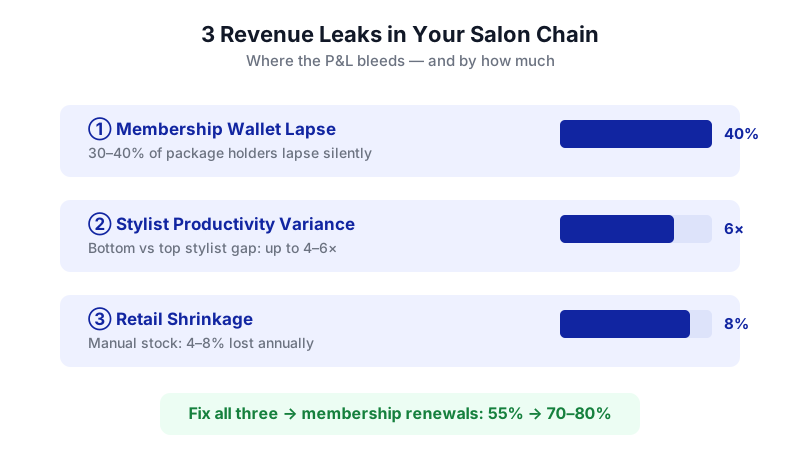
Before the build order, be honest about where the money is going. In an Indian salon chain doing ₹8-40 crore in annual revenue, three operational problems consistently outrank everything else owners worry about.
1. Membership wallet lapse
The pre-paid package sold at the desk — ₹10,000 for ten services, ₹25,000 annual grooming membership, bridal packages — is almost always the single largest line on your P&L, and the one with the worst visibility. Zenoti's 2026 benchmark found salons with active membership programmes grew revenue at 8% versus 2% for non-membership salons, a 4x difference, and member clients visited 10-12 times a year versus 6-8 for non-members. FranchiseBazar data on Indian salons shows prepaid programmes can drive 30% revenue growth in mid-sized chains, with members visiting six-plus times annually against four for walk-ins.
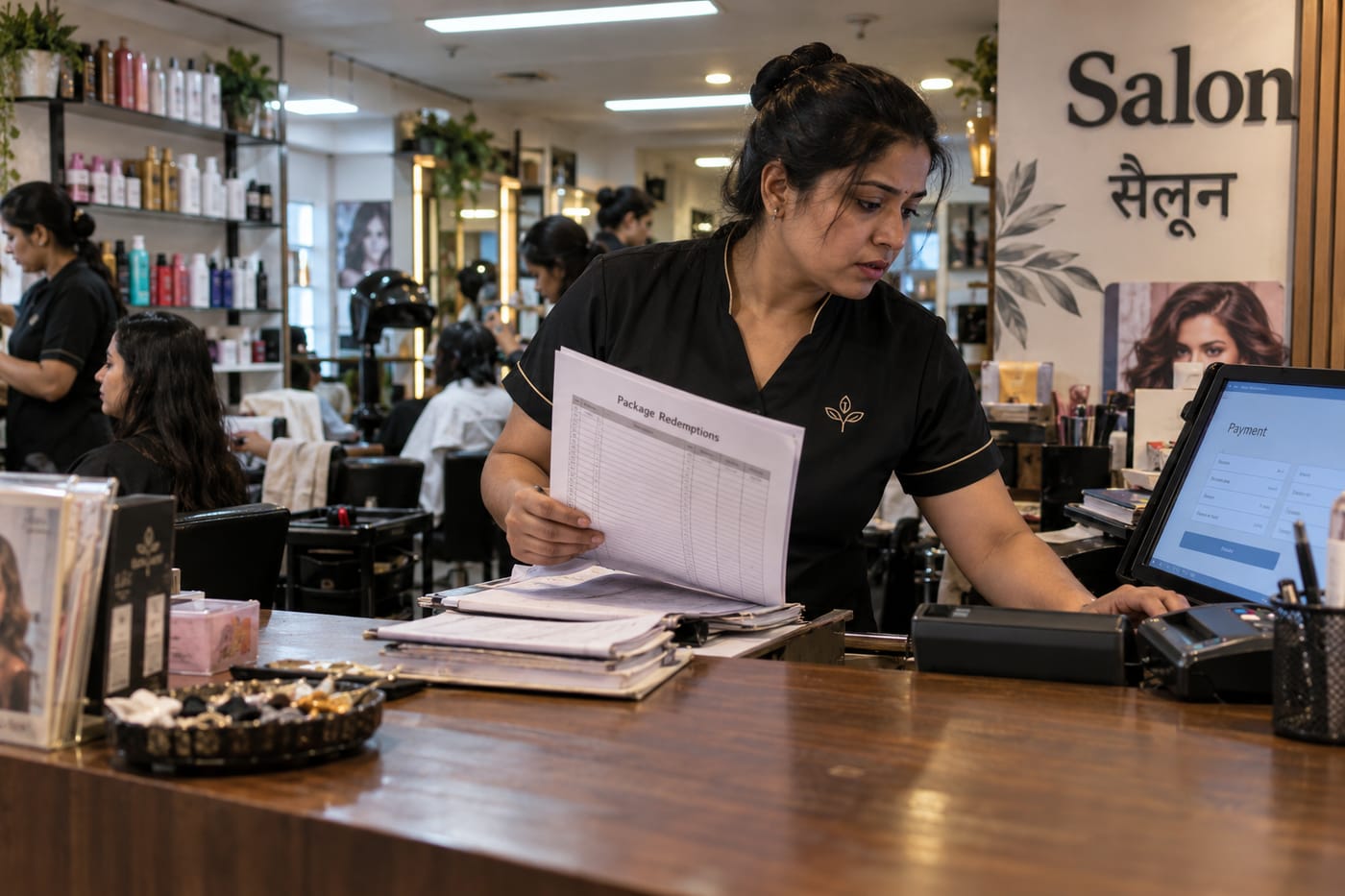
The leak: most off-the-shelf POS systems record the ₹10,000 package as a liability entry, decrement a counter as services are redeemed, and go silent. No one knows which member has three sessions left and has not visited in 90 days. No one gets a renewal call at session eight. Packages expire. Clients forget. You eat the breakage once but lose the renewal forever. In most chains we have looked at, 30-40% of package holders lapse rather than cancel, and the owner has no dashboard to see it happening.
2. Stylist-level productivity variance
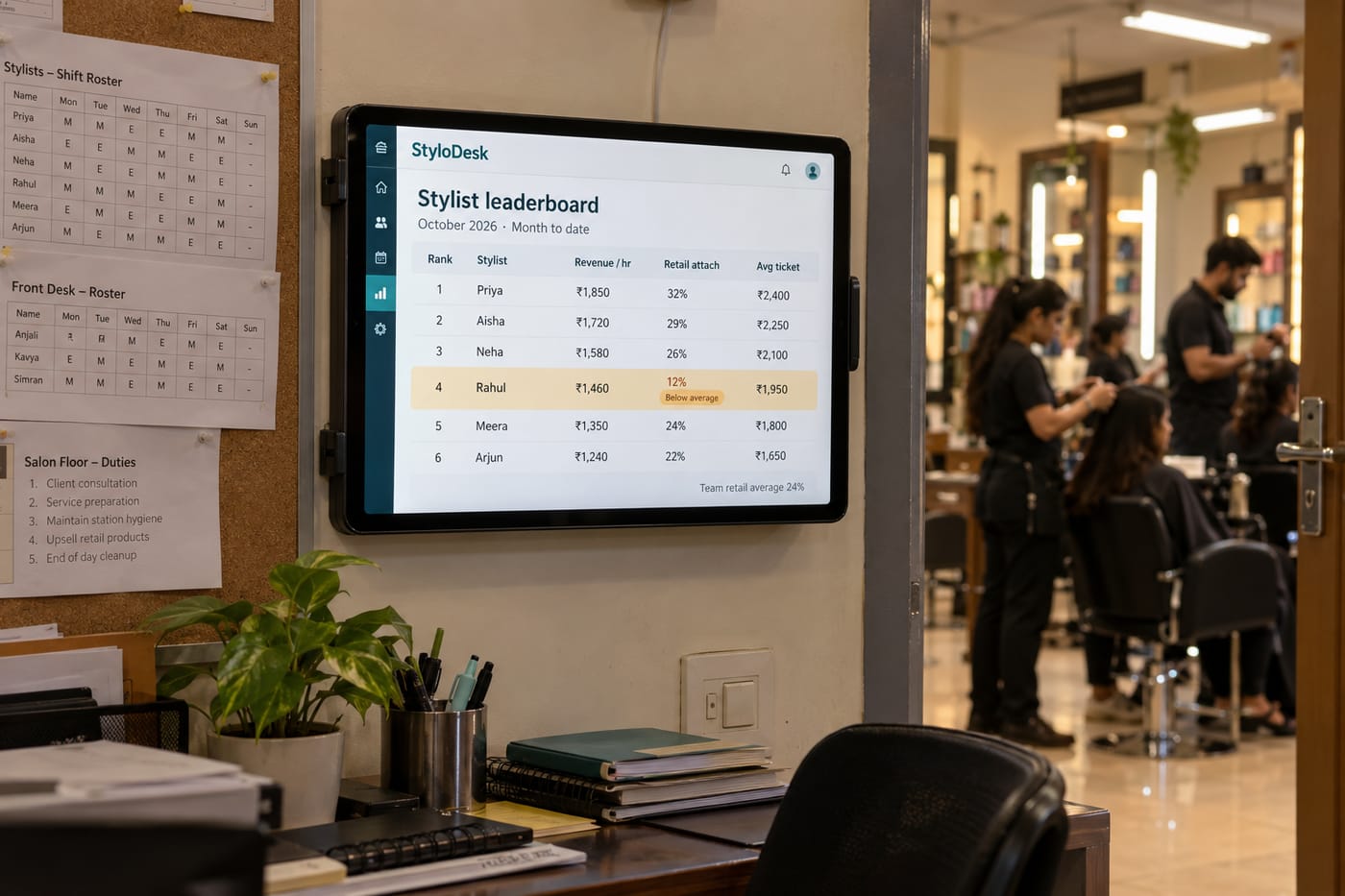
You know your top stylist is better than your bottom stylist. You do not know by how much, on which service, and at which outlet. The Dall'Italia 2026 retail attach rate benchmarks show the gap between top and bottom stylists in a median salon runs 4-6x, and top-quartile salons compress this to roughly 1.5x. Closing this internal variance is identified as the single highest-leverage P&L move for most salons — ahead of pricing, marketing, or new outlets.
No booking-first SaaS reports this. Your current system knows who performed the service. It does not know what the client paid, what retail was attached, whether a rebook happened, and whether the service upsold into a membership. All five numbers have to live in one row per stylist per day.
3. Retail shrinkage
Shampoo, serum, treatment product — the retail counter and the backbar inventory. RetailPOS India estimates Indian retail chains relying on manual stock counts lose 4-8% of inventory annually to shrinkage, and chains with real-time controls bring this down to 1.5-2.5%. For a chain doing ₹1 crore a year in product, that is ₹4-6 lakh of pure margin walking out. In salons it is worse, because backbar consumption gets rolled into service cost and no one audits the per-service dosage.
What to build, in order
Build 1: Membership redemption and auto-renewal engine
This is the first thing. It sits on top of your existing POS or replaces it, depending on how open the current system's API is.
What it does:
- Tracks every package sold with service-level balance, expiry, and member-level visit frequency
- Triggers staff-side prompts: "Priya has two sessions left and expires in 21 days" at the point of billing, not three months later
- Automates WhatsApp renewal flows at session N-2, at 60 days of inactivity, and at expiry-minus-30
- Offers in-flow renewal with pre-populated upgrade paths (₹10k package → ₹15k with 20% more services), payable via UPI link
- Reports lapse rate by outlet, by package type, by acquisition channel
What changes once it exists: a chain that was renewing 55% of expiring packages typically moves to 70-80% within two quarters. The incremental revenue is almost pure margin because the client is already in the system.
What it is bad at: it will not fix the underlying problem that your front desk is selling the wrong packages to the wrong clients. That takes training. The engine makes the pipeline visible — someone still has to work it.
Build 2: Stylist-level P&L dashboard
One screen per stylist per day showing: services performed, revenue generated, retail attached, rebook rate, membership conversion, and no-show rate. One screen per outlet rolling the same up. One screen for you rolling all outlets.
This is a data engineering problem more than a UI problem. The data exists — in your POS, in your appointment system, in your inventory ledger — but it does not join. Building this means wiring those sources into a single warehouse (Postgres is fine, nothing exotic needed) with a nightly or hourly pipeline, and a dashboard layer on top.
What changes once it exists: you can run a monthly review where every outlet manager sees the variance between their top and bottom stylist on retail attach. Just making it visible, with no other intervention, closes the gap. Chains that go from 5x variance to 2x on a product line doing ₹30 lakh a year recover ₹8-10 lakh of margin that was already paid for.
What it is bad at: it will create friction. Stylists who have been coasting will be unhappy. Managers who did not know their numbers will push back on the methodology. Budget three months of change management, not two weeks.
Build 3: Real-time inventory with per-service consumption
Barcode or QR on every retail SKU and every backbar bottle. Dispense events logged against the service and the stylist. Variance reports between expected and actual consumption, flagged weekly. Automated reorder when stock crosses threshold, outlet by outlet.
This is the least glamorous build and the one with the fastest payback. Bringing shrinkage from 6% to 2% on a ₹1 crore product line returns ₹4 lakh a year, every year, against a one-time build that is a fraction of that.
What it is bad at: it depends on floor discipline. If the stylist does not scan the bottle, the system does not know. Pair it with a per-service dispensing SOP or do not bother.
Build 4 (optional, later): Client-side app
Only after the first three are live and working. A booking app for your clients is table stakes but it is not where the money is. Build it when retention is already improving and you need a channel to push personalised offers and membership upgrades. Build it earlier and you have shipped a shinier version of what Urban Company already does better than you can.
What not to build yet
- AI-powered style recommendations. The data you have on client preferences is too thin for a model to beat your senior stylist. Revisit after two years of structured consultation notes.
- Dynamic pricing by time slot. Indian salon clients are price-sensitive in ways that make surge pricing a brand risk. Fill off-peak with membership-only offers instead.
- In-house loyalty points on top of memberships. You already have a prepaid wallet. A second currency confuses the front desk and dilutes the first.
- Franchise-partner-facing portal, if you are not actually franchising yet. Build the single-owner tooling well before you expose it to a third party.
What this costs and how long it takes
The honest answer is that cost and timeline are driven by three things, in roughly this order of impact: how open your current POS is (does it have a documented API, or are we scraping reports?), how many of your outlets are already on the same system versus a patchwork, and how clean your historical membership data is. A chain with one POS across all outlets and an API is a very different project from a chain where three outlets run Zenoti, two run a local tool, and the oldest outlet still uses Excel.
Illustrative, not a quote: for a chain of 10 outlets on a single POS with a working API, building the membership engine as the first module — redemption tracking, WhatsApp renewal flows, lapse reporting, UPI payment links — is a focused engagement in the range of 10-14 weeks of build plus a pilot at two outlets before full rollout. Add the stylist dashboard and inventory module and you are looking at a staged programme across two to three quarters, with each module going live independently so revenue impact starts in month three, not month nine.
The global spa and salon software market is growing at 10.68% CAGR, with Asia-Pacific leading at 11.69% — and notably, business intelligence and reporting is the fastest-growing module at 11.64%, while booking and CRM still dominate installed base. Translation: the market is moving where the money is, and reporting is where you should spend first.
To turn any of this into a real estimate for your chain, three specifics have to be scoped: the current POS and its integration surface, the outlet count and consistency, and whether you want to replace the POS or build alongside it. Those three answers move the number by 3-5x. A scoping conversation is the right next step before anyone, including us, quotes a figure.
How CodeNicely can help
We build the kind of operational software described above — not generic SaaS, but custom systems that fit your existing POS, your WhatsApp Business account, your UPI stack, and the way your outlet managers actually work. You keep the IP. There is no per-seat license that scales with headcount.
The engagement that maps most closely to a salon chain's situation is GimBooks, where we built accounting and billing software for Indian SMBs with the same core challenge you have: existing manual workflows, a non-technical operator base, and the need for the product to work on a modest Android phone at the counter without training. The membership wallet, the stylist dashboard, and the inventory ledger are all variations of the same problem — structured data capture from a non-technical user, with reporting that an owner can read on a phone. For the AI-driven renewal prompts and churn prediction layer, our AI studio work on HealthPotli is directly relevant: we built the model that scores customer re-order likelihood from prescription history, which is structurally the same problem as scoring membership renewal likelihood from visit history.
We work with chains across SMB and multi-outlet retail in India. If you want to see the membership engine mocked up against your actual lapse data before committing to a build, that is a two-week paid discovery, not a sales pitch.
How to sequence the next six months
- Weeks 1-2: Audit. Pull 18 months of membership sales and redemption data. Calculate your actual lapse rate. Pull per-stylist revenue and retail attach for one quarter. You now have the baseline.
- Weeks 3-14: Build and pilot the membership engine at two outlets. Measure renewal rate against the baseline before rolling to the rest.
- Weeks 10-20: In parallel with pilot rollout, build the stylist dashboard. Launch it with a mandatory monthly outlet review built around it.
- Weeks 18-28: Inventory and backbar consumption module. Launch with a per-service dispensing SOP, not as a software-only rollout.
- Month 9 onwards: Revisit the client-facing app question with the retention data from the first three modules. The answer may be different than you think today.
The chains that will own the next five years of Indian personal care are not the ones with the slickest booking flow. They are the ones that know, outlet by outlet and stylist by stylist, where every rupee of revenue and margin is coming from — and have an auto-renewal engine quietly working the membership base while the front desk is busy with walk-ins. Build in that order.
Frequently Asked Questions
Should I replace my existing salon POS or build on top of it?
Depends almost entirely on whether your current POS has a documented API and whether all your outlets run the same system. If yes to both, build on top — you avoid a disruptive migration and keep the booking and billing flow your staff already knows. If your outlets run a patchwork or your current vendor will not open the API, replacement becomes the cheaper option over a 24-month view.
How much does custom salon chain software cost in India?
The cost is driven by outlet count, POS integration complexity, and how many of the three core modules (membership, stylist dashboard, inventory) you build in the first phase. A single-module focused build is a very different number from a full three-module programme with a client app on top. The specifics that turn a range into a real quote are: your current POS and its API, the number and consistency of outlets, and whether historical data needs migration. A scoping conversation is the only honest way to get a number for your situation.
Can off-the-shelf tools like Zenoti or Fresha solve the membership lapse problem?
They track package balances and expiry well. What they do not do, by design, is build the renewal pipeline into your front-desk workflow with Indian-specific channels (WhatsApp Business flows, UPI auto-pay links, pre-built upgrade paths priced in rupees). You can get 60-70% of the way with configuration and a Zapier layer. The last 30%, which is where the renewal rate moves from 55% to 80%, usually needs custom work.
How long before I see revenue impact from a membership auto-renewal engine?
Impact starts the quarter after the first module goes live at a pilot outlet, because expiring packages that would have lapsed start renewing instead. The size of the impact depends on your current lapse rate and your package mix. A chain with high lapse and high package AOV sees impact faster than one with mostly single-service bookings.
Do I need a client-facing mobile app to compete with Urban Company?
Not in year one, and probably not in year two. Urban Company competes on demand aggregation, not on your membership base. Your edge is the client relationship and the prepaid wallet, both of which live inside your outlet, not on an app. Build the internal operational tooling first; a client app is a channel on top of a working operation, not a substitute for one.
Sources & further reading
- India Beauty Salon Market Size, Trends, Share, Forecast 2033 — Custom Market Insights
- Styling India's Growth: The Indian Salon Landscape — IBEF
- India Salon Market Outlook 2032 — Nexdigm
- India Leads Salon Market with Franchise Expansion — Future Market Insights
- Salon Package Deals and Membership Programs: A 2026 Guide — Zenoti
- How Salon Franchise Models Generate Repeat Monthly Revenue — FranchiseBazar
- The Salon Retail Attach Rate Benchmark Report 2026 — Dall'Italia
- Why Your Retail Chain Loses 4 to 8 Percent of Inventory Every Year — RetailPOS India
Get one practical guide a week
Costs, AI tools, partner selection — written for people who make the decision. No spam, unsubscribe anytime.
Thanks — you're on the list. One practical guide a week, nothing else.
That didn't work — please check the email address and try again.
Building something in Personal Care?
CodeNicely partners with founders and tech teams to ship AI-native products that move metrics. Tell us about the problem you're solving.
Talk to our team Book a 30-min call