
What to Build for Indian NGOs and Foundations That Scale

 Published by CodeNicely, the product studio founded by Meghal Agrawal and Ujjwal Agrawal in 2017
For: Executive Director or COO of a mid-sized Indian NGO or foundation with 50–200 staff, ₹5–50 crore annual budget, at least one foreign donor, and a board that just failed its FCRA renewal or lost a grant because utilisation reporting was late
In this guide
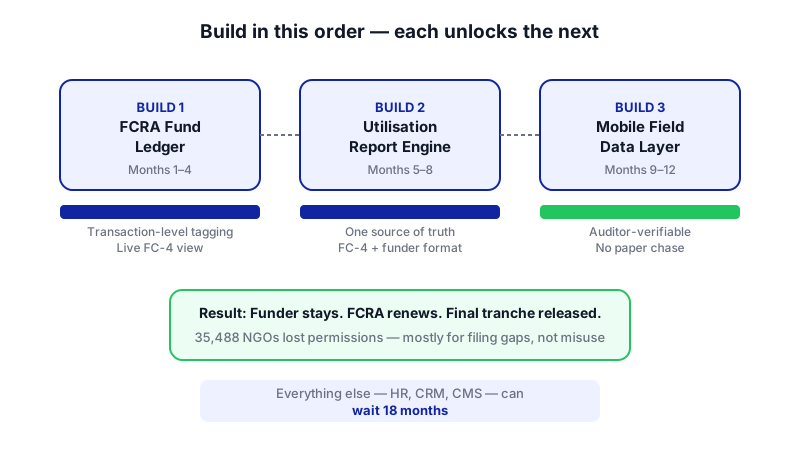
If your board just failed an FCRA renewal or a repeat funder quietly moved on, the fix is not a full nonprofit ERP. Build three things, in this order: an FCRA-compliant fund ledger that segregates foreign contributions down to the project and bank account, a donor utilisation reporting engine that outputs Form FC-4-ready and funder-ready statements from the same source of truth, and a mobile field-data layer that lets an auditor verify programme numbers without chasing paper. Everything else — HR, volunteer management, website CMS, CRM for individual giving — can wait 18 months.
This post is for the Executive Director or COO of a ₹5–50 crore NGO with 50–200 staff and at least one foreign donor. You are in the top 10% of Indian NGOs by budget (per CSIP at Ashoka University, only ~10% of Indian NGOs exceed ₹50 lakh annual budget), which means vendors pitch you enterprise suites designed for organisations ten times your size. Most of it you do not need. Some of it will actively slow you down.
The three problems that actually cost you money
1. FCRA fund segregation lives in Excel, and that is now a renewal risk
Rule 13 of the Foreign Contribution Regulation Rules requires foreign-fund expenditure to be reported account-by-account, utilisation-wise, and uploaded as audited accounts within nine months of financial year close. The MHA's November 2024 public notice codified an illustrative list of renewal denial reasons, and discrepancies in annual returns and non-utilisation of foreign contributions now sit at the top.
The scale of the problem is visible in the aggregate numbers. Foreign contributions in 2024-25 reached ₹22,974 crore, but reported unutilised balances were ₹35,968 crore — 156.6% of that year's inflows. That is not fraud. That is systemic reporting lag. And since 2015, permissions for 35,488 NGOs have been cancelled or expired without renewal, with non-compliance on annual filings — not misuse allegations — being the principal reason cited by MHA.
If your finance team maintains FCRA tracking in a parallel set of Excel sheets, reconciles them to Tally once a quarter, and rebuilds the FC-4 view manually at year-end, you are in the group that gets de-prioritised. Repeat funders — especially US and European foundations — check submission timestamps. Submitting on 30 December versus 15 October signals different things about internal controls.
2. Donor utilisation reports take three weeks and arrive after the deadline
A mid-sized NGO with five to twelve active grants typically runs each donor's utilisation report as a bespoke exercise. Different templates, different cost-head mappings, different reporting currencies, different periodicity. The finance team pulls Tally extracts, programme teams email receipts and photos, someone reconciles against the grant agreement, and three weeks later a PDF goes out.
This is now a direct financial liability for your corporate donors. Since FY 2021-22, if an NGO receiving CSR funds fails to submit utilisation certificates or project completion reports, the funding company's CSR spend is treated as 'unspent' under MCA rules. Your reporting delay becomes their compliance problem. CSR heads at listed companies now explicitly screen for NGOs that can produce utilisation reports on demand. If you cannot, you are not in next year's shortlist.
3. Field data is on paper, so impact numbers cannot be audited
The third gap is the one nobody puts in a board deck. Your programme teams collect attendance registers, health screening forms, training completion certificates, beneficiary KYC — mostly on paper, sometimes on WhatsApp, occasionally on a Google Form. By the time this reaches a funder report, it is a number in a spreadsheet with no audit trail.
A CSR auditor from a Big Four firm, hired by the donor to verify a ₹3 crore grant, will ask: show me the raw records for the 12,400 beneficiaries you claim to have trained. If the answer is 40 cartons of registers in a district office, the audit will qualify, and the funder will hold back the final tranche. This happens quietly, often, and is the single biggest reason mid-sized NGOs lose grant renewals they thought were safe.
What to build, in what order, and what changes when it exists
Build 1: An FCRA-aware fund ledger (months 1–4)
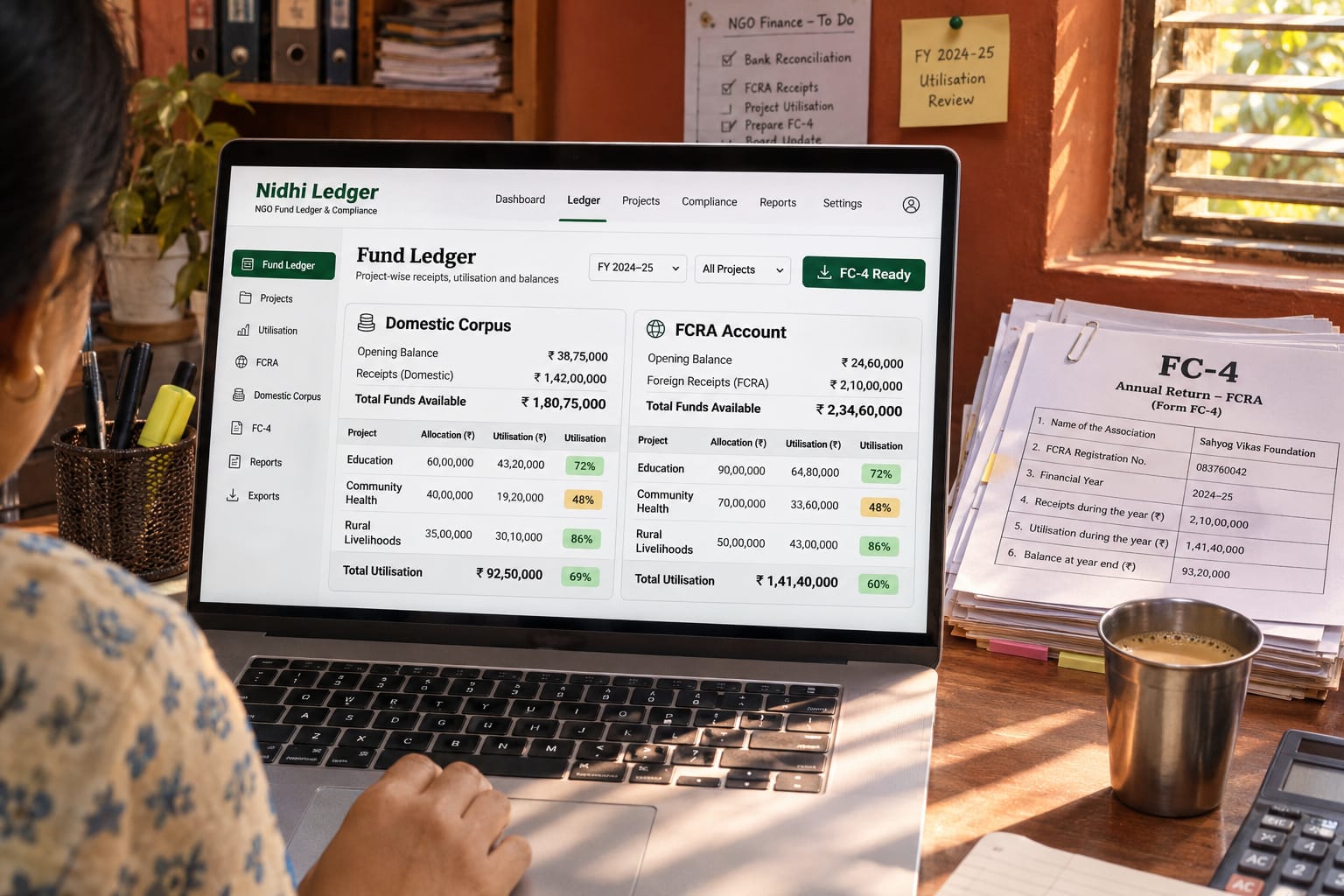
This is not an accounting system replacement. You keep Tally or Zoho Books. What you build is a layer that sits above your general ledger and enforces FCRA segregation at the point of transaction entry — project code, grant ID, FCRA vs domestic classification, designated bank account tagging, and cost-head mapping aligned to Form FC-4.
Core features worth the investment:
- Transaction-level tagging that cannot be left blank (every FCRA debit must map to a grant and a cost head before it posts)
- A live Form FC-4 view that reflects current-year position at any point in the year, not just at close
- Bank reconciliation specifically for the SBI New Delhi Main Branch designated account that FCRA now mandates
- Role-based approval for any inter-project fund movement, with an audit log a renewal inspector can read
What changes: your FC-4 goes from a three-week year-end project to a one-day export. Your statutory auditor signs off faster because the trail is clean. Your renewal risk drops because the one reason MHA cancels licences most often — reporting discrepancies — stops applying to you.
What this does not solve: it will not generate programme-level impact data, it will not replace your HR or payroll, and it will not do individual-donor CRM. Resist scope creep here. A tight fund ledger that does one job well is worth more than a half-built ERP.
Build 2: A donor utilisation reporting engine (months 4–8)
Once the fund ledger is live and clean, the reporting engine becomes mostly configuration rather than code. The engine reads from the fund ledger, applies donor-specific cost-head mappings and templates, and outputs utilisation reports, project completion certificates, and MCA-compliant CSR UCs on demand.
Build this to handle:
- Per-donor template libraries — Gates Foundation format, Azim Premji format, standard CSR UC format, EU grant format — each with its own cost-head crosswalk to your internal chart of accounts
- Multi-currency conversion at the FEMA reference rate on the transaction date, not the reporting date
- Attachment pipelines that pull bills, vouchers, and GRNs by grant ID — so a funder's auditor can drill down from a line item to a scanned bill in two clicks
- A donor portal (lightweight — this is not Salesforce) where each funder can self-serve the reports for their grants
What changes: the three-week manual cycle becomes a two-hour review-and-send. Your CSR funders stop treating your spend as 'unspent' on their books. Repeat grant conversion improves because you are now easy to fund again.
This is where AI-assisted document extraction starts paying off — auto-reading vendor bills, matching them to GRNs, and flagging anomalies before an auditor does. But do not lead with AI here. The structured data layer matters ten times more than the model on top of it.
Build 3: A mobile field-data layer (months 8–14)
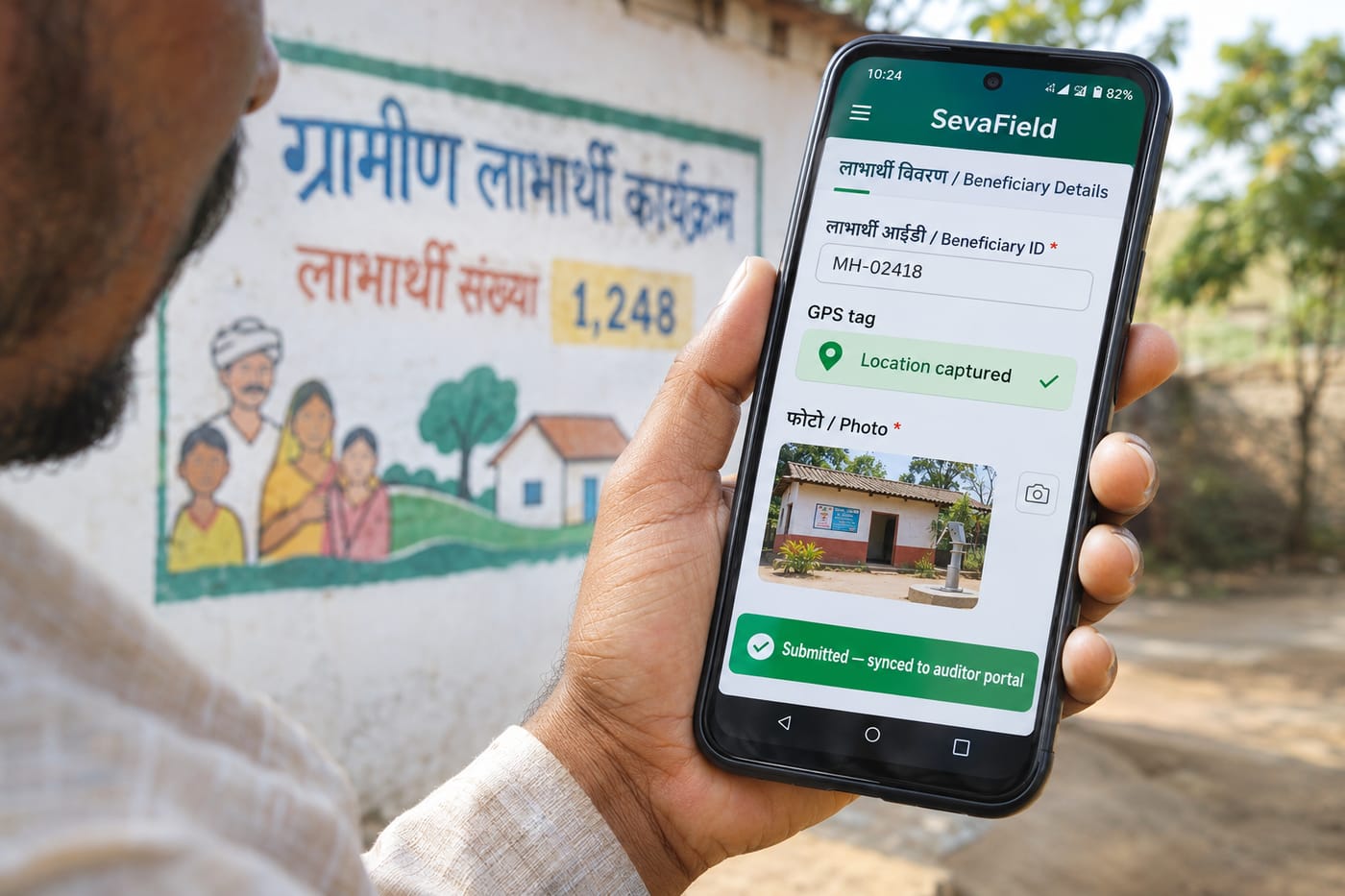
This is the longest build because it requires behaviour change in the field, not just software. You are replacing paper registers with a mobile app used by field officers on ₹8,000 Android phones, often in low-connectivity areas.
Non-negotiable features:
- Offline-first data capture with sync when connectivity returns
- Beneficiary ID with photo and, where legally appropriate, OTP-based consent — not Aadhaar storage (talk to your lawyer about what you can and cannot collect)
- GPS and timestamp on every record, so an auditor can verify that the training actually happened at the village and date claimed
- Direct mapping of field records to the grant and cost head they roll up to — so a beneficiary count in a donor report has a traceable raw record behind it
What changes: your impact numbers become auditable. A CSR auditor can sample 50 beneficiaries from a report, drill to the raw records, and verify in a morning. This is the single biggest driver of repeat grants from institutional funders.
What it is bad at: it will not change field-officer behaviour on day one. Expect six months of adoption work, local-language training, and incentive redesign. If your field leadership is not bought in, do not start this build — it will fail for people reasons, not technical ones.
What not to build yet
Vendors will push you towards these. Say no for now:
- Individual donor CRM. If 80% of your funding is institutional and FCRA, a CRM for retail giving is a distraction. Revisit when retail is over 20% of revenue.
- Volunteer management platform. A Google Sheet works until you have 500+ active volunteers.
- HRMS. Zoho People or Keka off-the-shelf is fine. Do not custom-build.
- Website rebuild. Your website does not lose you grants. Reporting does.
- A full nonprofit ERP from Salesforce or Microsoft. The India ERP market is growing fast, but enterprise suites are built for organisations with ten times your transaction volume. You will pay for 70% of features you never use, and still need custom work for FCRA specifics.
What this costs and how long it takes — honestly
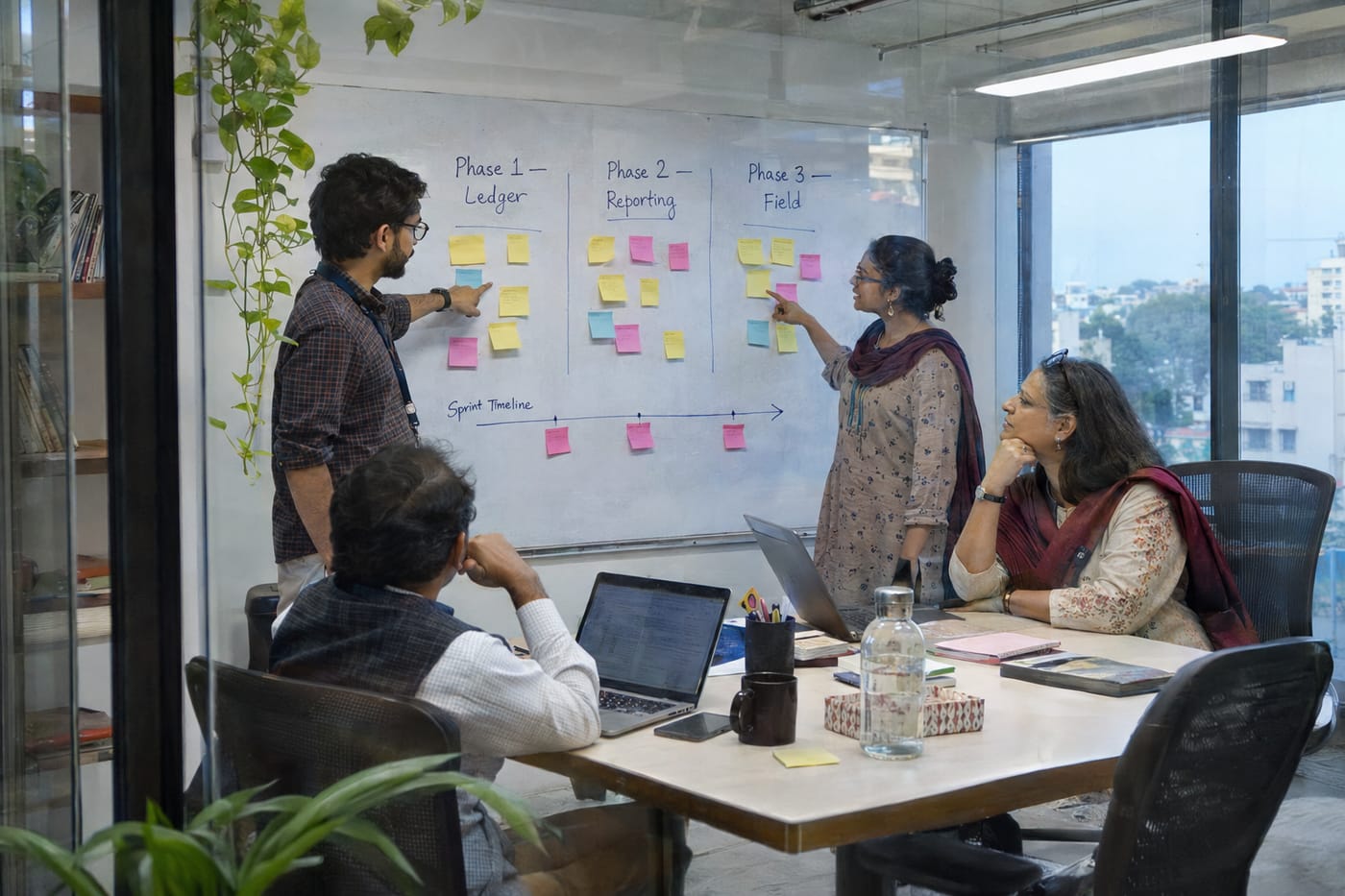
Every vendor you talk to will give you a number in the first meeting. Ignore those numbers. The real cost of building these three systems depends on four things that only emerge after a proper scoping exercise:
- How clean your current chart of accounts is. If your Tally has 400 unstructured ledgers accumulated over 15 years, the fund ledger build gets longer before it gets shorter.
- How many donor templates you need on day one. Three templates is a different build from fifteen.
- Whether field-data collection needs vernacular support and offline sync for more than two states. Each language and each connectivity profile adds real work.
- Whether you already have in-house tech leadership. An NGO with a full-time CTO or technology director runs these projects very differently from one where the Finance Director is also the IT owner.
The shape of the number: builds one and two together are typically a multi-month engagement that costs meaningfully less than a year of grant revenue lost to a single failed renewal. Build three is a longer, separate conversation — often funded by a dedicated tech grant from a foundation like Tata Trusts, Rohini Nilekani Philanthropies, or a CSR technology fund. Several Indian foundations will co-fund NGO technology builds explicitly because they know the ROI is in retained grants, not in the software itself.
To turn any of this into a real quote, three specifics need to be on the table: your current accounting system and the state of its chart of accounts, the list of active donors and their reporting requirements, and whether field-data collection is in scope for phase one or deferred. A scoping conversation with a studio that has built FCRA-aware financial systems is where those specifics become numbers.
How CodeNicely can help
The closest parallel in our portfolio is GimBooks, the YC-backed accounting SaaS we built for Indian MSMEs. The engineering problem is similar in shape: an India-specific compliance surface (GST for GimBooks, FCRA and MCA CSR rules for you), a user base that is not technical, and a reporting engine that has to be both auditor-grade and legible to a non-accountant. The patterns we developed there — tight transaction-level tagging, rule-driven reporting templates, and a reconciliation layer that an auditor can follow — are the same patterns an FCRA fund ledger needs.
We also build AI-assisted document pipelines for finance workflows, which is where the donor-reporting build gets interesting: auto-classifying bills, matching them to grants, and flagging reporting anomalies before your finance team spends a weekend on them. If you want to see how we sequence builds like this for organisations that cannot afford to pause operations, our transformation practice and India AI development page have more detail.
We are not the right fit if you want an off-the-shelf nonprofit ERP reseller. We build custom, you own the IP, and we hand off cleanly.
Frequently Asked Questions
Is there off-the-shelf FCRA compliance software for foundations in India?
There are a handful of products — mostly bolted onto Tally or Zoho Books — that handle basic FCRA tagging. They work if your donor mix is simple and your reporting templates are standard. They break when you have fifteen donor templates, multi-currency grants, and auditors who want drilldown to the voucher level. For most NGOs in the ₹5–50 crore band, a custom layer on top of your existing accounting system is a better fit than ripping it out.
What should an NGO build first — donor management or FCRA reporting?
FCRA reporting, without question. Donor management software helps you raise the next grant. FCRA reporting software stops you from losing the licence that lets you receive foreign funding at all. 22,496 FCRA registrations have been cancelled since 2015, and reporting non-compliance is the leading cause. Fix the compliance risk before the acquisition tool.
How long does it take to build an FCRA-compliant fund ledger?
The build itself is a matter of months, not weeks, and not years. The longer pole is usually cleaning the existing chart of accounts and defining the cost-head crosswalks for each active donor. An NGO with a clean Tally setup and three to five donors moves significantly faster than one with fifteen years of accumulated ledgers and twelve active grants. A scoping conversation looking at your current accounts and donor list is what turns this into a real timeline.
Can one system handle both FCRA reporting and CSR utilisation certificates?Yes, and it should. Both reports draw from the same transaction ledger — they just apply different templates and regulatory formats on top. Building them as separate systems creates reconciliation work you do not need. The fund ledger holds the truth; FC-4, CSR UCs, and donor-specific utilisation reports are all views of that truth.
Do we need to involve our lawyer and statutory auditor in the build?
Yes, from day one. Nothing in this post is legal, tax, or audit advice — your compliance counsel and your statutory auditor should sign off on the cost-head structure, the FCRA segregation logic, and the data retention policies before any of it goes live. Vendors who tell you otherwise are the ones you should not hire.
Sources & further reading
- FCRA-Registered NGOs Fall 50%, Foreign Funding Rises to ₹22,974 Crore — India CSR
- FCRA Funding in India 2024-25: Full Report — India CSR
- India Civic Freedom Monitor — ICNL
- FCRA Cancelled List 2026: Why NGOs Lose Licences — Incorpx
- India's NGOs at a New Funding Crossroads — Civilsdaily
- The Diverse Landscape of Indian NGOs — Journalism University
- NGO Funding Sources in India: Grants, CSR and FCRA 2026 — Incorpx
- India ERP Market to 2032 — Data Bridge Market Research
Get one practical guide a week
Costs, AI tools, partner selection — written for people who make the decision. No spam, unsubscribe anytime.
Thanks — you're on the list. One practical guide a week, nothing else.
That didn't work — please check the email address and try again.
Building something in Non-Profit?
CodeNicely partners with founders and tech teams to ship AI-native products that move metrics. Tell us about the problem you're solving.
Talk to our team Book a 30-min call