

Where UAE Freight Operators Should Spend Their Software Budget First

 Published by CodeNicely, the product studio founded by Meghal Agrawal and Ujjwal Agrawal in 2017
For: Owner or COO of a UAE-based freight forwarding or trucking company turning AED 20–100M annually, currently running operations on a patchwork of WhatsApp groups, Excel sheets, and a legacy TMS they outgrew two years ago — now fielding pressure from a major shipper or free-zone client who wants digital status updates and structured invoicing before they renew the contract
In this guide
If you run a UAE freight forwarder or trucking fleet turning AED 20–100M and you can only commission one software build this year, build a digital job card that captures accessorial charges at the point of operation and pushes them straight to the invoice. Not a new TMS. Not a tracking portal. The job card. It is the single build that pays for itself inside two billing cycles, because it recovers revenue you have already earned and are currently writing off. Visibility and customs automation come next, in that order, and for reasons specific to how UAE enterprise shippers and Jebel Ali actually work.
The rest of this post explains why, what each build looks like concretely, and how to sequence the spend so you are not six months into a platform rebuild when your biggest shipper's contract renewal lands.
The three places margin actually bleeds
Every TMS vendor pitching you in Dubai will show the same slide: one platform, modules for everything, dashboards on top. That is not wrong, it is just not useful for sequencing. Ignore the platform diagram and look at your P&L. In a UAE freight operation of this size, money leaks in three specific places:
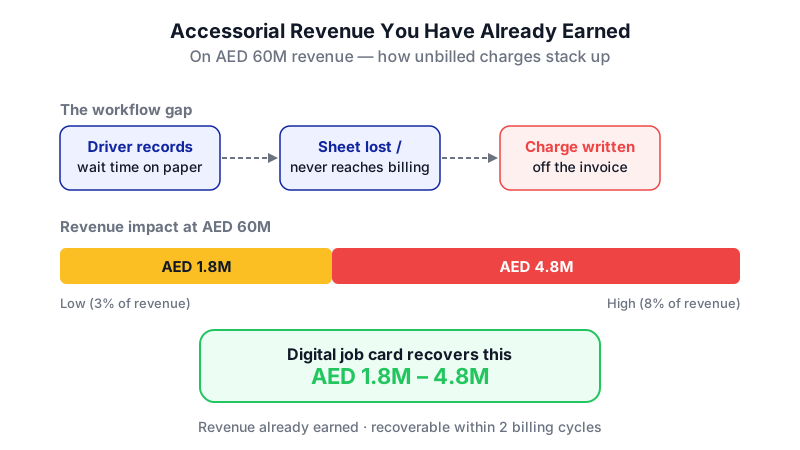
- Accessorial charges captured on paper and never billed. Detention at the consignee's yard, demurrage at Jebel Ali, fuel surcharges, waiting time at a JAFZA warehouse, extra handling for a reefer that sat an extra night. Your driver or supervisor writes it on a sheet. It never makes it into the invoice.
- Customs documentation that eats hours per shipment and causes clearance delays. HS code lookups, commercial invoice reformatting, Dubai Trade / Mirsal 2 entries, the back-and-forth with the customs broker. Every hour here is a shipment sitting at the port gate.
- Shipment visibility you cannot show the shipper. The enterprise client — a free-zone manufacturer, an FMCG distributor, an oil & gas contractor — now writes live status updates into the RFP. If you cannot provide them, you lose the renewal.
Each of these has a software answer. They do not cost the same, they do not take the same time, and critically, they do not pay back in the same order.
Build #1: The digital job card that bills accessorials
This is the one almost nobody prioritises and almost everybody should. Here is the arithmetic.
Accessorial charges — detention, demurrage, fuel surcharges, waiting time — commonly add 15–30% on top of base freight rates, yet a large share go undocumented. ATRI's 2024 research found 94.5% of trucking fleets charge detention fees but collect on fewer than 50% of the invoices they submit, and industry reporting from TIA and FreightWaves puts unbilled accessorials at roughly 3–8% of total gross revenue for mid-size brokerages. On AED 60M of annual revenue, that is between AED 1.8M and AED 4.8M of margin you have already earned and written off.
What gets built:
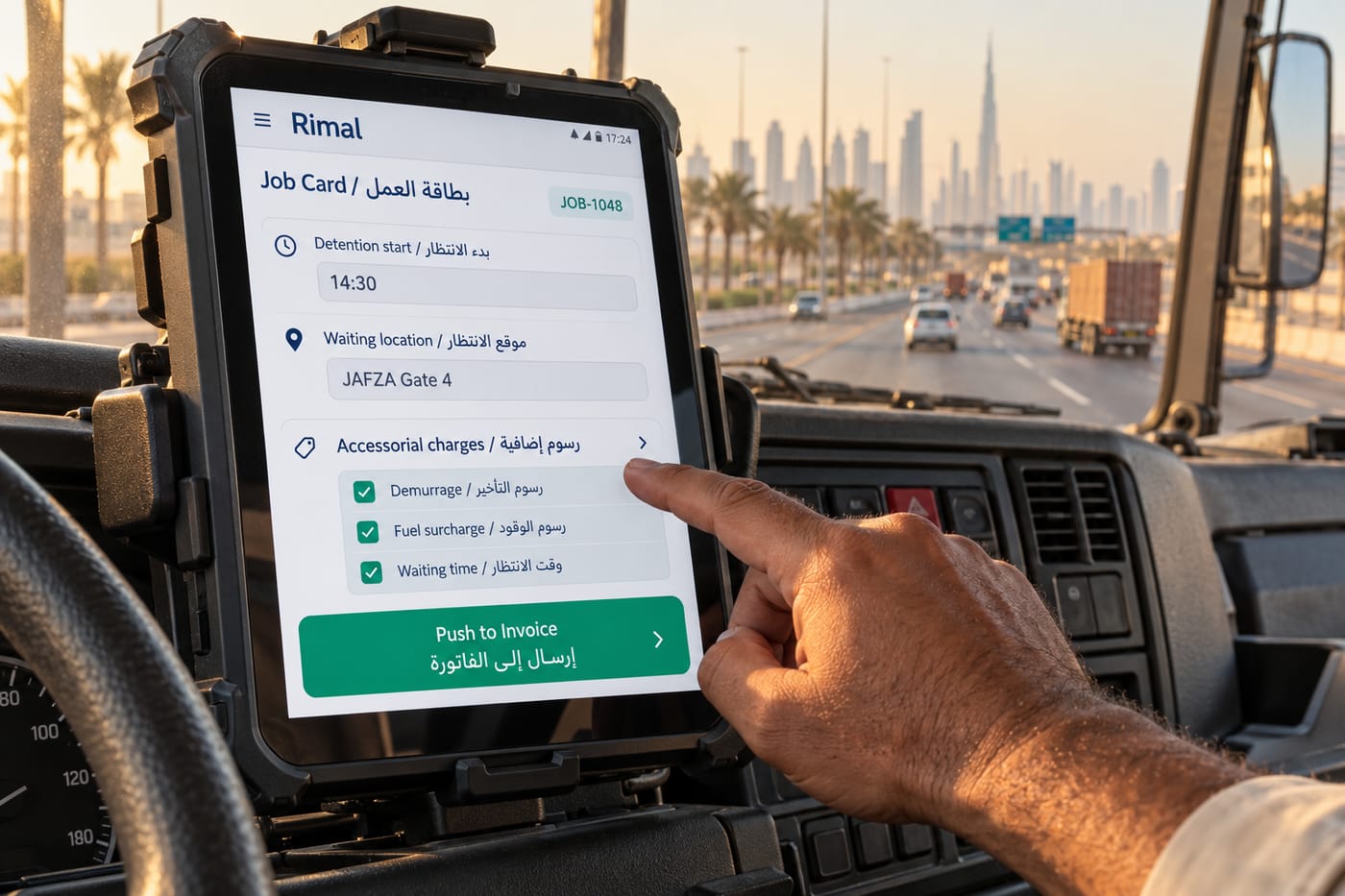
- A mobile job card the driver or dock supervisor fills in on arrival and departure — timestamped, with photo attachments for seal numbers, container condition, and gate passes.
- Pre-configured accessorial triggers: if dwell time at the consignee crosses the free period defined in that customer's contract, the system flags detention automatically. Same for demurrage against the shipping line's free days at Jebel Ali or Khalifa Port.
- A review queue for ops before the charge hits the invoice. Not every flagged event bills — relationship calls still matter — but every event is visible.
- Direct push into whatever you invoice from, whether that is your legacy TMS, Zoho Books, Tally, or a custom billing module.
What changes once it exists: your billing team stops relying on scraps of paper that come in two weeks late. The accessorial revenue line on your P&L starts showing a number. Disputes get easier because you have timestamped photo evidence. Your contract negotiations with shippers change tone — you can show them what their free-time policy actually costs you.
What it does not fix: this does not give you a new TMS. It does not solve customs. It does not give the shipper a tracking portal. It is a narrow, deep tool.
What drives cost and time: the number of accessorial types your contracts actually define (10 is different from 40), whether you have one invoicing system or three, whether your drivers have company phones already, and how much of the contract free-time logic needs to be codified per customer. A build with clean inputs and a single downstream invoicing system is a different shape of project from one where you also need to normalise five years of contract PDFs. The two or three specifics that turn this into a real scope are: how many distinct accessorial charge types you bill today, how many downstream invoicing systems it needs to write into, and whether operations will accept a mobile-first workflow for drivers who are not all literate in English.
Build #2: Shipment visibility the shipper can actually see
This is second not because it is less important — it is often the reason a contract is on the line — but because it is cheaper and faster if build #1 has already given you clean operational event data.
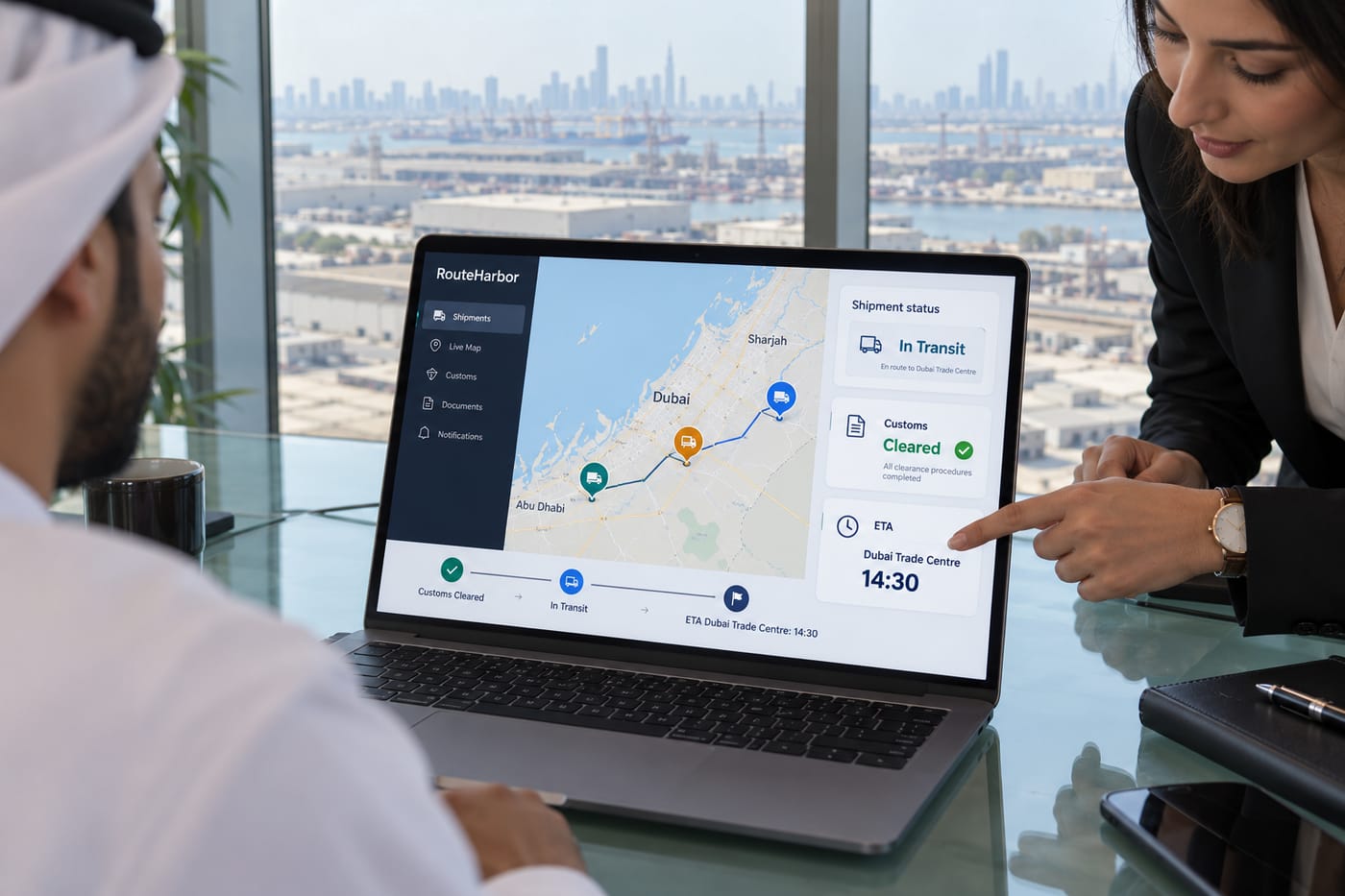
Enterprise shippers in the UAE are no longer asking for visibility as a nice-to-have. Etihad Cargo launched SmartTrack in September 2025 using GPS, cellular and Wi-Fi sensors. The UAE TMS market is forecast to grow at a 20.9% CAGR through 2033, driven specifically by demand for real-time visibility. If your biggest shipper is a JAFZA tenant or a government-linked entity, assume this is in their next RFP.
What gets built:
- A tracking layer that ingests from whatever sources you actually have — GPS from your trucks, carrier APIs for sea freight (Maersk, MSC, CMA CGM all expose them), air waybill status from IATA ONE Record or the airline's portal, and manual check-ins from your ops team for the gaps.
- A shipper-facing portal or, more often, a white-labelled view scoped to each customer. One shipper should not see another's shipments.
- Exception alerts — not a wall of green dots, but notifications when a shipment deviates from plan. Delayed at port, missed cut-off, held at customs.
- Optional: an API or EDI feed into the shipper's own ERP or control tower, which is increasingly what the sophisticated clients ask for.
What changes: the renewal conversation gets easier. You stop fielding "where is my container" WhatsApp messages at 11pm. The ops team spends its time on exceptions instead of status chasing.
What it does not fix: visibility does not make a late shipment on-time. If your underlying operation is unreliable, a tracking portal just makes the unreliability transparent. Fix the operation first, or at least in parallel.
What drives cost and time: the number of carriers and modes you need to integrate (one trucking fleet is simple; ocean + air + road + rail is not), whether shippers want a portal or an API feed, and the quality of your existing dispatch data. If your trucks already have GPS and you only move ocean and road, this is a tractable build. If you are starting from WhatsApp screenshots, the first phase is just getting clean event data.
Build #3: Customs documentation automation
Third, not because it is unimportant — Jebel Ali handles over 15.6 million TEUs annually, and documentation precision is non-negotiable — but because the ROI is more about speed and error reduction than new revenue, and because the regulatory environment is still settling.
Two regulations matter here. The PLACI program went live 1 April 2025, mandating electronic air cargo data before loading, with Do Not Load orders for non-compliance. The MPCI program extends similar pre-load data requirements to containerised sea cargo. If your air or ocean teams are still assembling data manually after the shipment is booked, you are already exposed.
What gets built:
- Document extraction from commercial invoices, packing lists, and bills of lading — using LLM-based OCR that is now reliable enough for this kind of semi-structured data.
- HS code suggestion with human review. One Jebel Ali forwarder documented cutting customs document preparation from 6 hours to 45 minutes per shipment, reducing monthly clearance delays from 12 to 2, and raising HS code accuracy from 82% to 97% using AI automation.
- Direct integration with Dubai Trade / Mirsal 2 and the Federal Customs Authority for declarations, and with the airline and shipping line portals for PLACI/MPCI submissions.
- A validation layer that catches the common rejections — mismatched values, missing certificates of origin, incorrect party details — before the declaration is submitted.
What changes: clearance times shrink, declaration rejections drop, and your customs brokerage margin — if you have that line of business — expands because the same team handles more shipments.
What it does not fix: this does not make the customs officer any faster, and it does not help with physical inspections. It compresses the paperwork, which is where most of the controllable delay sits.
What drives cost and time: the volume and variety of commodity types (consumer goods are easier than chemicals or regulated pharma), the quality of the source documents your shippers send you, and whether you need Dubai Trade integration from day one or can start with human-in-the-loop review.
What is not worth building yet
A few things vendors will push that are rarely the right first spend for an operator at this scale:
- A full TMS replacement. If your legacy TMS still handles dispatch and basic invoicing, keep it. Build the three tools above as satellites that write into it. Replace it when you have outgrown the data model, not before.
- A driver app with a dozen features. One job card screen that works offline on a cheap Android device beats a feature-rich app your drivers refuse to open.
- A customer-facing booking portal. Unless you are moving toward a self-serve SMB book of business, your enterprise shippers want API/EDI, not a portal with a login they will forget.
- Blockchain anything. Still not the answer in 2025.
- Route optimisation for a small fleet. Under about 40 trucks running non-dedicated routes in UAE urban geography, the gain is marginal. Revisit at scale.
The sequence
In order, and with the thinking behind each slot:
- Digital job card + accessorial billing. Fastest payback, lowest integration surface, generates the clean operational data the next two builds need. Start here.
- Shipper visibility layer. Build it on top of the job card data plus carrier integrations. Scope it to the two or three shippers who are actually asking, not a generic portal for everyone.
- Customs documentation automation. Highest technical complexity, biggest operational change. Do this once the first two are stable and you have ops capacity to retrain the customs team.
If a contract renewal is forcing you to lead with visibility, do #2 first — but build #1 immediately after, because the accessorial recovery is what funds the rest of the roadmap.
How CodeNicely can help
We built Vahak, India's largest online transport marketplace, which gave us a working model for how dispatch, shipper-carrier matching, live tracking, and settlement data have to flow together in a freight operation — and specifically where the data gaps are between what the driver knows, what ops knows, and what shows up on the invoice. That is the same gap that drives unbilled accessorials in a UAE forwarder.
For UAE operators, the engagement usually starts narrow: we scope the job card and accessorial recovery build against your existing TMS and invoicing stack, ship it in phases so revenue recovery starts early, then layer visibility and customs automation on top of the same event data. You keep full IP, we do not lock you into a platform, and the integrations we build with Dubai Trade, carrier APIs, and your legacy TMS are yours. More on how we work with UAE businesses on our Dubai software development page, and on how we approach legacy modernisation and AI embedding for operations like yours.
Frequently Asked Questions
How much does a custom freight management system cost in the UAE?
The honest answer is that "a custom TMS" is not one thing. A narrow accessorial billing and job card build is a different scope from a full dispatch-to-settlement platform with carrier integrations and a shipper portal. The main cost drivers are the number of downstream systems it must integrate with (your current TMS, invoicing, Dubai Trade, carrier APIs), the number of accessorial and contract rules to codify, and whether you need a shipper-facing surface. The three specifics that turn a range into a quote: your current software stack, the volume and modes you handle, and which of the three builds above you want to sequence first. A scoping conversation with us is the fastest way to get a real number.
Should we replace our legacy TMS or build around it?
Build around it, in most cases. If it still handles dispatch and invoicing without data loss, treat it as a system of record and layer the job card, visibility, and customs tools as satellites that read from and write to it. Full replacement is a 12–18 month project with meaningful operational risk; the three builds above can each ship and generate measurable return in a fraction of that time. Replace the TMS when its data model actively blocks you — not before.
Do we need to comply with PLACI and MPCI right now?
Yes if you move air or containerised sea cargo into the UAE. PLACI has been enforced since 1 April 2025 for air cargo, with Do Not Load orders for non-compliance, and MPCI applies to containerised ocean cargo. Your airline or shipping line partners will tell you the submission mechanism, but the data has to come from you. A customs documentation build should include PLACI/MPCI data assembly from day one. For specifics of how the rules apply to your operation and commodity mix, a customs broker or compliance advisor should review your workflow.
What is the ROI timeline for a digital job card that captures accessorials?
The shape of the return is the point here. If unbilled accessorials sit in the 3–8% of gross revenue range reported for mid-size brokerages, even partial recovery on an AED 60M book is measured in millions, not thousands. The build cost is small relative to that number, which is why we recommend it as the first spend. The specifics that determine your actual payback: how many of your current contracts have well-defined free-time and accessorial clauses, how much of your dwell data is already captured somewhere digital, and how willing your shippers are to pay flagged accessorials versus negotiate them. We would want to look at your last six months of invoices against your contract terms to size the opportunity properly.
Can we build this with our in-house team or do we need an external partner?
Depends on what your team has shipped before. A job card app and an accessorial rules engine are tractable for a competent small team, but the integration work — Dubai Trade, Mirsal 2, carrier APIs, your legacy TMS's often undocumented data model, PLACI/MPCI submission channels — is where in-house projects usually stall. A common pattern that works: external partner builds the first version and the integrations, in-house team takes over operations and iteration. That keeps IP and institutional knowledge with you while shortening time to first revenue impact.
Sources & further reading
- UAE Freight Forwarding Market Size and Share Analysis 2025–2032 (CoherentMI)
- How a Jebel Ali Freight Forwarder Cut Customs Clearance Prep from 6 Hours to 45 Minutes (Assistants.ae Case Study)
- Customs Clearance in Dubai: Ultimate 6-Step Guide for Best Results 2026 (Vortex Shipping)
- Upcoming UAE Regulatory Changes 2025: PLACI Program (Couriers and Freight)
- Top FAQs on UAE MPCI Cargo Filing (Trade Tech)
- Accessorial Charges Explained: Stop Undercharging (ftm.cloud, citing DAT)
- Accessorial Charges in Trucking: Revenue Your Fleet Has Already Earned and Not Collected (Millennials Trucking, citing ATRI 2024)
- The Accessorial Revenue Most Brokerages Forget to Bill (Apexify Labs, citing TIA & FreightWaves)
Get one practical guide a week
Costs, AI tools, partner selection — written for people who make the decision. No spam, unsubscribe anytime.
Thanks — you're on the list. One practical guide a week, nothing else.
That didn't work — please check the email address and try again.
Building something in Logistics & Freight?
CodeNicely partners with founders and tech teams to ship AI-native products that move metrics. Tell us about the problem you're solving.
Talk to our team Book a 30-min call