
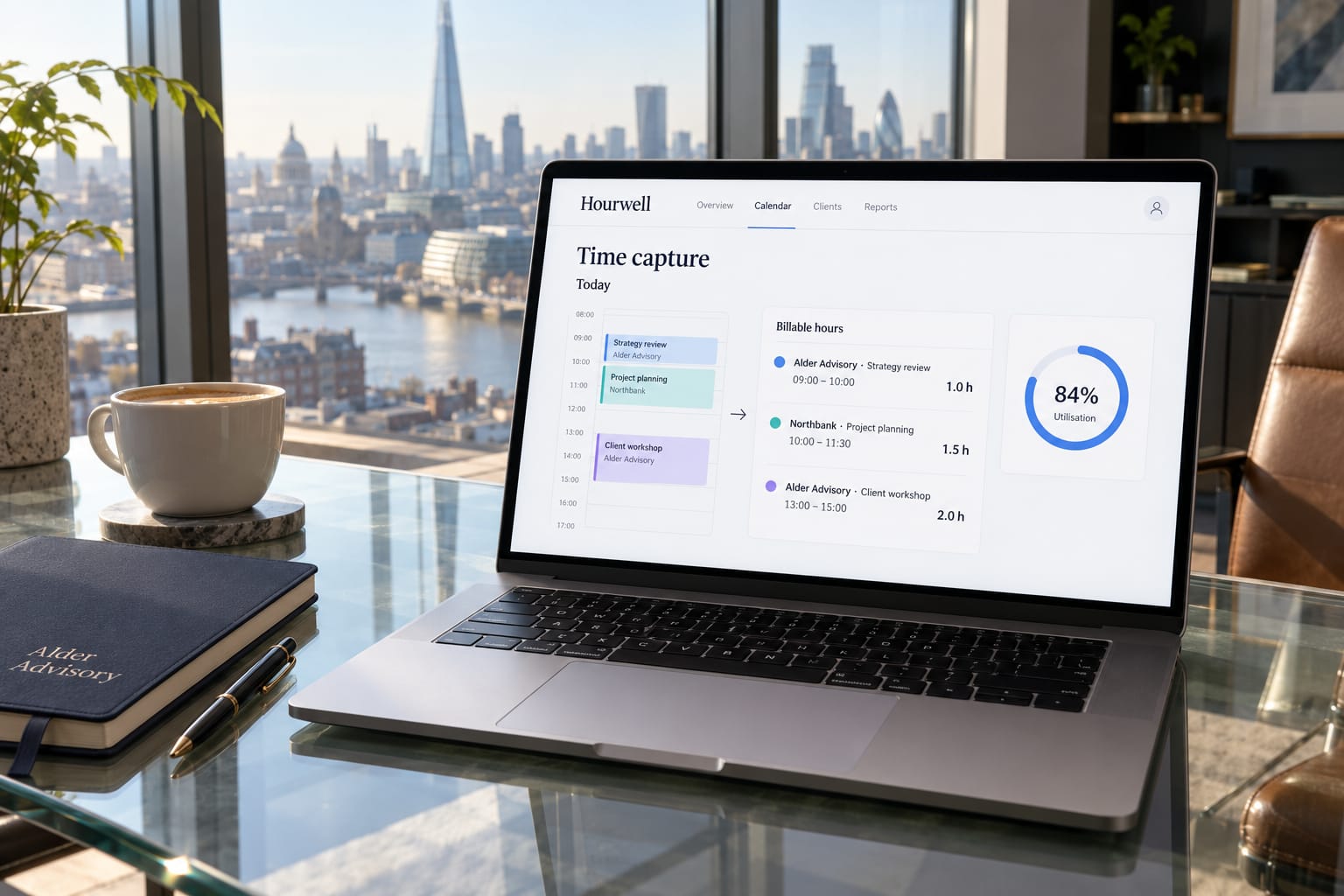
What to Build for Professional Consultancies in the UK

 Published by CodeNicely, the product studio founded by Meghal Agrawal and Ujjwal Agrawal in 2017
For: Managing partner or COO of a 20–150-person UK professional consultancy — management, legal, HR, or financial — who is losing margin to manual utilisation tracking, inconsistent proposal production, and a CRM that was never built for a billable-hours business
In this guide
If you run a UK consultancy between 20 and 150 people and you want to know which piece of software to build first, the answer is almost always the same: an automated daily time-capture tool wired to your consultants' calendars, before anything else. Not a new CRM. Not a proposal portal. Not a dashboard. The reason is boring and specific — your consultants are logging time weekly from memory, which captures roughly 36% of what actually happened by Friday afternoon — and every other operational problem you have is downstream of that gap.
This post walks through the three places a UK professional consultancy — management, legal, HR, or financial — actually bleeds margin, what to build for each, and what order to build it in. It is written for the managing partner or COO who has been pitched a generic CRM for the fifth time this quarter and knows it is not the answer.
The three places the money actually leaks
The UK consulting market is big and still growing — £21.8 billion in 2025 by MCA estimates, almost double 2018. That growth hides a margin problem that most firms feel but cannot pinpoint. SPI Research's 2026 benchmark puts industry-wide billable utilisation at 66.4% — a 19-year low, down from 73.2% in 2021, well under the 75% threshold considered the minimum for healthy margins. EBITDA across professional services firms dropped from 15.4% in 2023 to 9.8% in 2024.

If you unpack where that margin actually goes, three operational gaps repeat across firms of your size:
- Untracked utilisation. Consultants log hours weekly, from memory, often on a Friday. The hours that make it onto a client invoice are a fraction of the hours actually worked.
- Uncosted proposal effort. Pursuit teams spend four to six hours on each proposal, nobody logs it anywhere, and the firm has no idea which practice areas or client types are profitable to pursue.
- Manual client reporting. A senior consultant spends most of a day each month assembling a status pack from six systems. That is a billable day of their time, every month, every client.
Every other complaint — the CRM is bad, the forecast is wrong, we cannot see pipeline — is a symptom of these three. Fix them in order.
Build #1: Automated daily time capture, wired to the calendar
What's actually broken
Weekly timesheets are the single biggest recoverable loss in your P&L. The research on this is unusually consistent. Accelo's time-tracking study found daily-submission firms hit 89% accuracy versus 71% for weekly-submission firms. Memtime's analysis of recall data shows end-of-day memory captures 70-80% of actual work; by end of week, 36%. SPI's benchmark data puts consulting-specific under-logging losses at 15-20% of billable time.
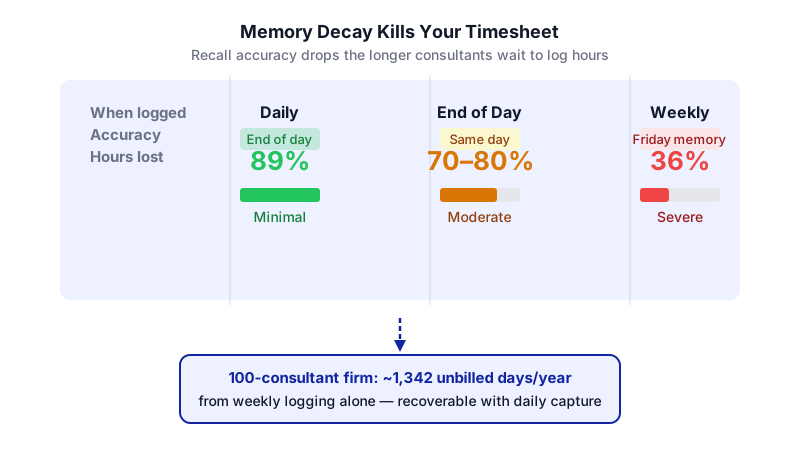
A 100-consultant firm at €1,000/day running at the 2024 average of 68.9% utilisation sits roughly 1,342 unbilled days per year below the 75% target — around €1.34 million in recoverable revenue by Saibon Group's framework. The number for your firm will differ, but the shape is the same: this is the biggest line item you are leaving on the table.
What to build
Not a timesheet. A capture tool. Specifically:
- A background service that reads each consultant's Outlook or Google Calendar, Teams/Slack activity, and document edits, and proposes a draft timesheet by 5pm each day
- A one-screen approval UI — the consultant confirms, adjusts, and submits in under 90 seconds
- Matter/engagement coding suggested from calendar metadata and client email domains, not picked from a dropdown of 400 project codes
- A nudge logic that chases unsubmitted days by 9am the next morning, and escalates to the engagement partner at 48 hours
- Write-back into whatever practice management or accounting system you already use — Xero, Elite 3E, Clio, Access Workspace — rather than replacing it
What changes
Utilisation visibility becomes real-time instead of monthly. Partners can see on Tuesday that a consultant is tracking at 40% and intervene, instead of discovering it at month-end. Realisation rates improve because the hours on the invoice match the hours worked. You will also find — uncomfortably — which engagements were genuinely unprofitable, which is useful at renewal time.
What this is bad at
Calendar-based capture under-reads work that happens off-calendar: deep focus work on a document with no meeting, phone calls on a mobile, work done on a train without a laptop. You will need manual top-up for those. It is also culturally sensitive — consultants read it as surveillance unless the partners roll it out on themselves first and the data is used for billing, not performance management.
What it takes
The cost of building this is driven by three things: how many systems it has to integrate with (calendar + practice management is cheap; calendar + practice management + DMS + two bespoke matter databases is not), whether you have clean client/matter master data or need to clean it first, and whether you want on-device ML for matter coding or a simpler rules engine. A tool that integrates with two systems and uses rules-based coding is a materially smaller build than one that uses a trained model across six systems. The two or three specifics that would turn that range into a real quote: which calendar and practice management systems you use, how many distinct matter codes a consultant typically touches in a month, and whether your client master data lives in one place or four. That is a conversation worth having with someone like CodeNicely or an equivalent build partner once you have those answers.
Build #2: A proposal engine that costs itself
What's actually broken
Pursuit work is the second-largest unlogged time sink in a consultancy. The average industry RFP win rate sits at 45%, meaning you lose on more than half of them. Four to six hours per proposal, across a firm of 80 consultants running two proposals a week each, is a serious cost centre that lives nowhere on your P&L.
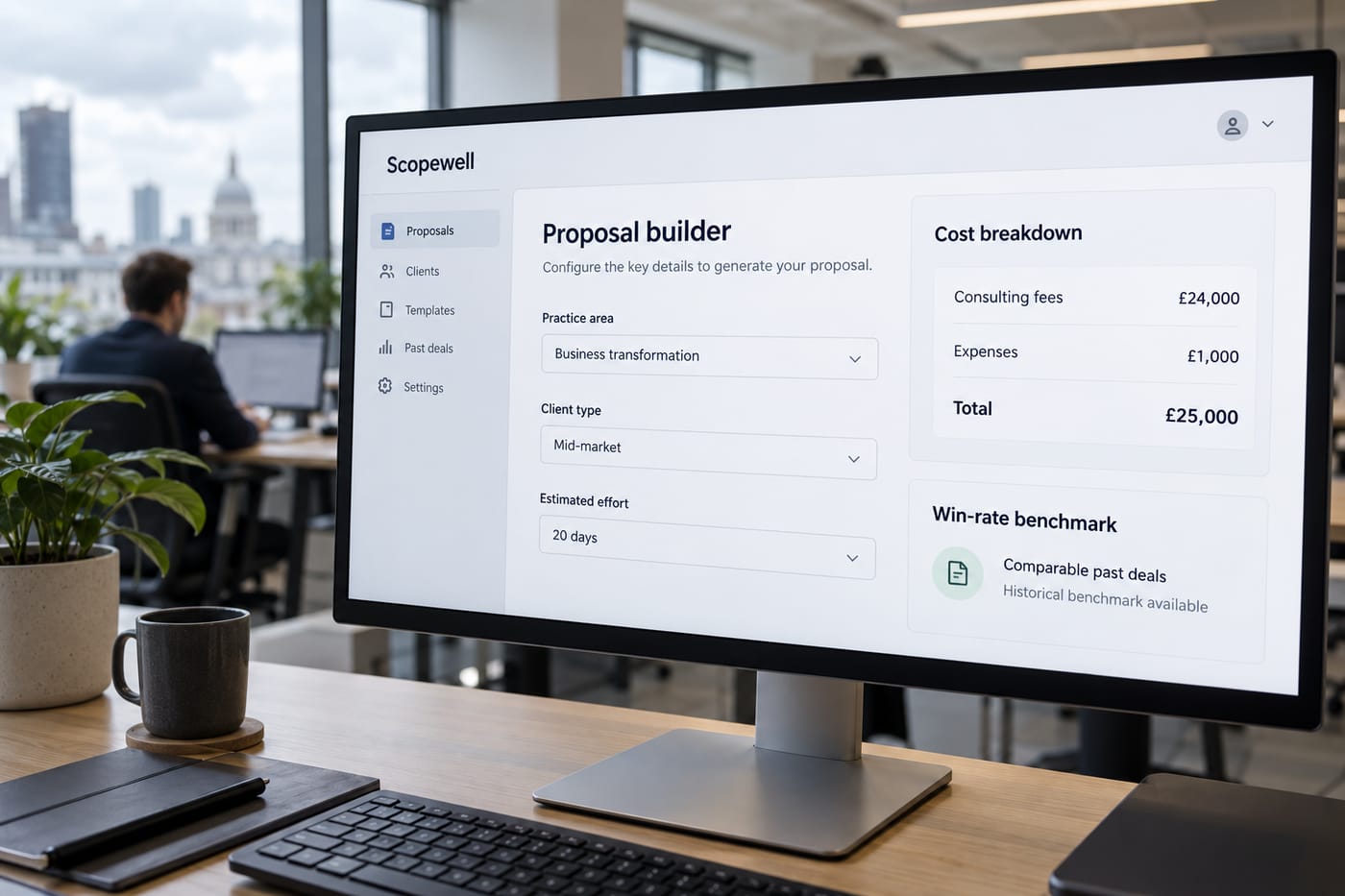
The deeper problem is that nobody knows which proposals are worth writing. The partner who won a £400k engagement last year gets another RFP from a similar client, assumes it is a good bet, and has no data to check whether that whole segment is actually profitable to pursue.
What to build
- A proposal workspace that pulls reusable content — case studies, CVs, methodology sections, pricing tables — from a tagged library instead of the last Word doc someone emailed around
- An AI-assisted first-draft generator trained on your won proposals, so the first 60% of a response is already written and the senior reviewer only edits the sections that matter
- Time capture built in — every editor's hours on a proposal are logged automatically against a pursuit code, so you can see cost-per-proposal and cost-per-win by sector, service line, and client
- A simple win/loss register with the three fields that actually predict future wins: price position, incumbent presence, decision-maker relationship
What changes
After six months you can answer the question partners cannot currently answer: "which proposal types do we win profitably, and which do we win but lose money on?" You stop chasing RFPs where you are column fodder for the incumbent. Proposal cycle time drops because the first draft takes 30 minutes instead of three hours. AI-assisted drafting is one of the few places generative AI pays back cleanly in a consultancy, because the content is structured and your historical corpus is good training data.
What this is bad at
Bespoke, high-stakes bids — the £2m+ transformation proposals — still need a human-led pursuit team. The tool helps the volume layer underneath that. It also does nothing for relationship-driven work that never goes to RFP, which in some practices is most of the pipeline.
Build #3: A client reporting layer that assembles itself
What's actually broken
A senior consultant spends six to eight hours a month per client assembling a status pack: hours burnt, milestones hit, risks, next steps, variance against budget. The data lives in your time system, your PM tool, your finance system, and three Excel sheets on someone's desktop. At £150-£300 an hour internal cost, across 40 active clients, this is a meaningful six-figure line of senior consultant time going to PowerPoint.
What to build
- A client reporting service that pulls from the time system (now accurate, because of Build #1), the finance system, and the PM tool, and assembles a branded status pack on a schedule
- Variance narratives generated from the data — "burn rate is 12% ahead of plan because of two unplanned stakeholder workshops in week 3" — reviewed by the engagement lead, not written from scratch
- A client-facing portal for the firms whose clients want it; a PDF for the ones who do not
What this is bad at
It will not write the judgement calls — the "we think the sponsor is cooling, recommend a steering meeting next week" paragraph. That is still the engagement partner's job. What it does is give them 90 minutes back per client per month to actually think, instead of copy-pasting cells.
What not to build (yet)
Three things vendors will try to sell you that are almost always wrong for a firm of your size, in this order of priority:
- A new CRM. Your CRM is probably fine. The reason the forecast is wrong is that nobody updates it, and nobody updates it because it does not reflect how consulting work actually comes in. Fix the time and proposal data first; the CRM problem shrinks.
- A full practice management replacement. Elite, Clio, Access, Intapp — these are large, expensive, multi-year programmes. If yours works, keep it and build the capture and reporting layers around it. If it does not, that is a strategic decision, not a software one.
- A knowledge management platform. Every consultancy has tried this. They mostly fail because consultants do not contribute. The proposal content library in Build #2 is 80% of the value with 10% of the effort.
Sequencing
Build in this order, and do not skip ahead:
- Time capture first, always. It is the only build that pays for the next two. Until you have accurate utilisation data, you cannot measure the ROI of anything else, and you are leaving the largest number on the table.
- Proposal engine second, because by this point you have time data to cost pursuits properly, and because the AI-assisted drafting compounds the saving month over month.
- Client reporting third, because it depends on the time data being accurate and because the senior-consultant hours you free up are the ones that should be going into Build #2's win rate anyway.
A reasonable 18-month roadmap: Build #1 live and adopted across the firm by month 6, Build #2 live for the top three practice areas by month 12, Build #3 for the top 20 clients by month 18. Faster is possible but adoption, not engineering, is the constraint.
How CodeNicely can help
The closest parallel in our work to a UK consultancy's time-and-margin problem is GimBooks, where we built accounting and billing software for a business whose entire P&L depended on capturing small, frequent, easy-to-miss transactions accurately — the same structural problem as a consultant logging 15-minute increments across six matters a day. The engineering patterns are similar: lightweight capture UX, strong defaults, nudge logic, and clean write-back into whatever system of record already exists.
Where we tend to be useful to a 20-150 person consultancy is in the first two builds above — the daily time capture tool and the AI-assisted proposal engine — because both are integration-heavy, both benefit from thoughtful ML rather than full generative AI, and both need to fit around a practice management system you already own rather than replace it. We do not sell a product; we build what you own, which matters when the IP is your operational edge. If you are earlier in the journey and need to think about how AI fits into operations across the firm before committing to a specific build, that is a reasonable first conversation.
What we are not the right partner for: a wholesale replacement of your practice management system. Those are specialist programmes and you should talk to Intapp, Elite, or Access directly.
Frequently Asked Questions
How long does it take to build an automated time capture tool for a consultancy?
The build itself is driven mainly by integration count and data quality — a two-system integration (calendar plus one practice management tool) with reasonably clean client/matter data is a materially shorter programme than a six-system build with messy master data. Adoption, not engineering, is usually the longer part: getting partners to use it themselves before rolling it to consultants. A conversation about which systems you use and the state of your matter data is what turns a range into a real timeline.
Will AI-assisted proposal writing hurt our quality or voice?
Only if you let it do the final draft. The pattern that works is AI generates the 60% of the proposal that is boilerplate — methodology, team CVs, case studies, standard pricing structures — and senior reviewers spend their time on the 40% that actually wins the bid: the client-specific insight, the pricing position, the risk framing. Firms that try to automate the whole thing get generic proposals and lower win rates.
Should we buy an off-the-shelf product instead of building custom?
For time tracking, several good off-the-shelf tools exist and are worth evaluating first — if one fits your practice management system cleanly and your consultants will actually use it, buy it. Custom becomes the right answer when you have specific workflows (matter coding logic, pricing structures, compliance requirements under SRA or FCA rules) that off-the-shelf tools force you to work around. Most firms end up with a hybrid: buy the capture tool, build the reporting and proposal layers.
How do we get consultants to actually adopt daily time entry?
Three things, in order. Partners use it on themselves for 60 days before anyone else is asked to. The tool pre-fills the day from calendar data, so the consultant is confirming rather than typing. And the data is ring-fenced for billing and utilisation reporting — not performance reviews, not comparative league tables — with that commitment made in writing. Firms that skip any of these three see adoption collapse within a quarter.
What about SRA, FCA, or GDPR compliance for the data these tools capture?
Calendar metadata, client identifiers, and matter coding fall under GDPR and, for regulated practices, SRA or FCA record-keeping rules. The specific obligations depend on your practice areas, your clients, and your data processors — a solicitor or compliance officer should review the specifics before you deploy, and your build partner should be able to produce a data flow diagram for that review. This is not something to figure out at go-live.
Sources & further reading
- Rising exports drove UK consulting industry growth in 2025 — Management Consultancies Association (via Consultancy.uk)
- UK consulting market has doubled in size since 2018 — MCA Annual Industry Report (via Consultancy.uk)
- Billable Utilization Fell to a 19-Year Low — SPI Research 2026 PS Maturity Benchmark (via CXO Corporation)
- 2025 Professional Services Benchmarks — SPI Research / Deltek
- The Hidden Cost of Consultant Bench Time: A Calculation Framework — Saibon Group
- Manual Time Tracking Pitfalls & Accuracy Statistics — Memtime
- Time Is Money: A Study into the Cost of Poor Time Tracking Habits — Accelo White Paper
- Time Tracking Accuracy: What It Really Costs — Tier2 Systems (citing SPI Research)
Get one practical guide a week
Costs, AI tools, partner selection — written for people who make the decision. No spam, unsubscribe anytime.
Thanks — you're on the list. One practical guide a week, nothing else.
That didn't work — please check the email address and try again.
Building something in Consulting?
CodeNicely partners with founders and tech teams to ship AI-native products that move metrics. Tell us about the problem you're solving.
Talk to our team Book a 30-min call