
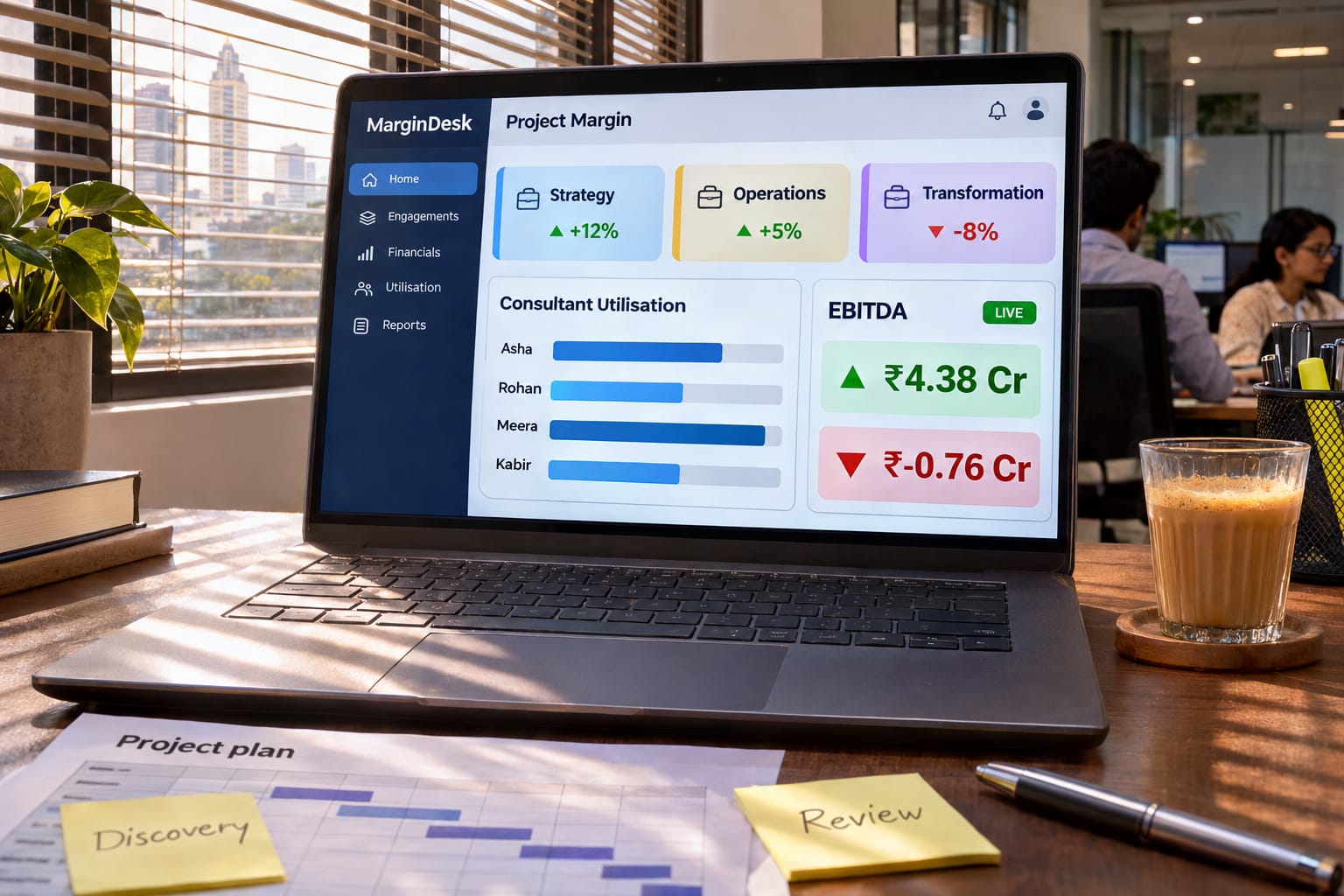
What to Build First If You Run a Consulting Firm in India

 Published by CodeNicely, the product studio founded by Meghal Agrawal and Ujjwal Agrawal in 2017
For: Founder or managing partner of a 15–80-person Indian consulting firm — strategy, finance, HR, or engineering — who is losing margin on projects they cannot track in real time and losing proposals they cannot price with confidence
In this guide
- The three gaps that actually cost you money
- Build #1: A real-time project margin and utilisation tracker
- Build #2: A proposal and pricing library — not a proposal generator
- Build #3: Billing automation and GST invoice workflow
- What NOT to build yet (even though vendors will push hard)
- Why custom, and why now
- How to sequence the build
- How CodeNicely can help
- Frequently Asked Questions
If you run a 15–80-person consulting firm in India and you are trying to decide what software to commission first, build a real-time project profitability and utilisation tracker before anything else. Not a proposal tool, not a CRM, not a full practice-management suite. The reason is narrow and specific: the two-week lag between a consultant submitting a timesheet and a partner reviewing it is where 18–25% of your billable capacity quietly disappears, and no amount of better selling at the front end recovers hours you have already burned on the wrong engagement.
Every PSA vendor in the market will pitch you the full stack — CRM, proposals, resourcing, timesheets, billing, dashboards, the lot — because that is how they price their licences. That is not the order in which the money leaks. This post is about the order in which the money leaks, and therefore the order in which to build.
The three gaps that actually cost you money
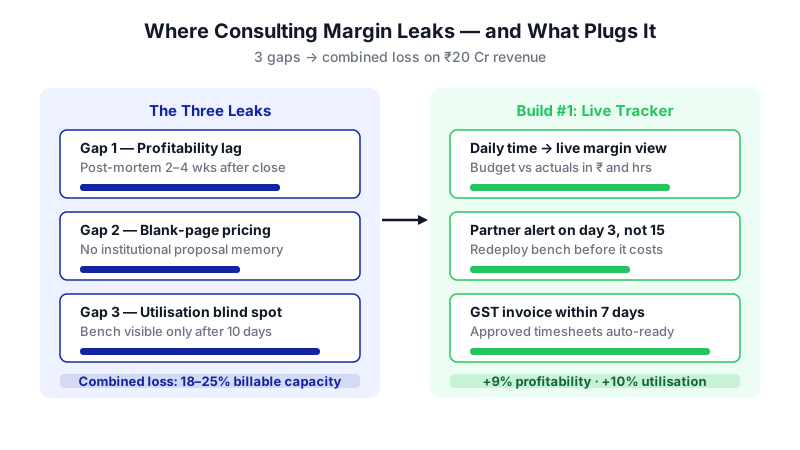
Before talking about what to build, name the leaks honestly. Across Indian strategy, finance, HR, and engineering consultancies in the 15–80 headcount band, the pattern is consistent:
Gap 1: Project profitability is a post-mortem, not a signal
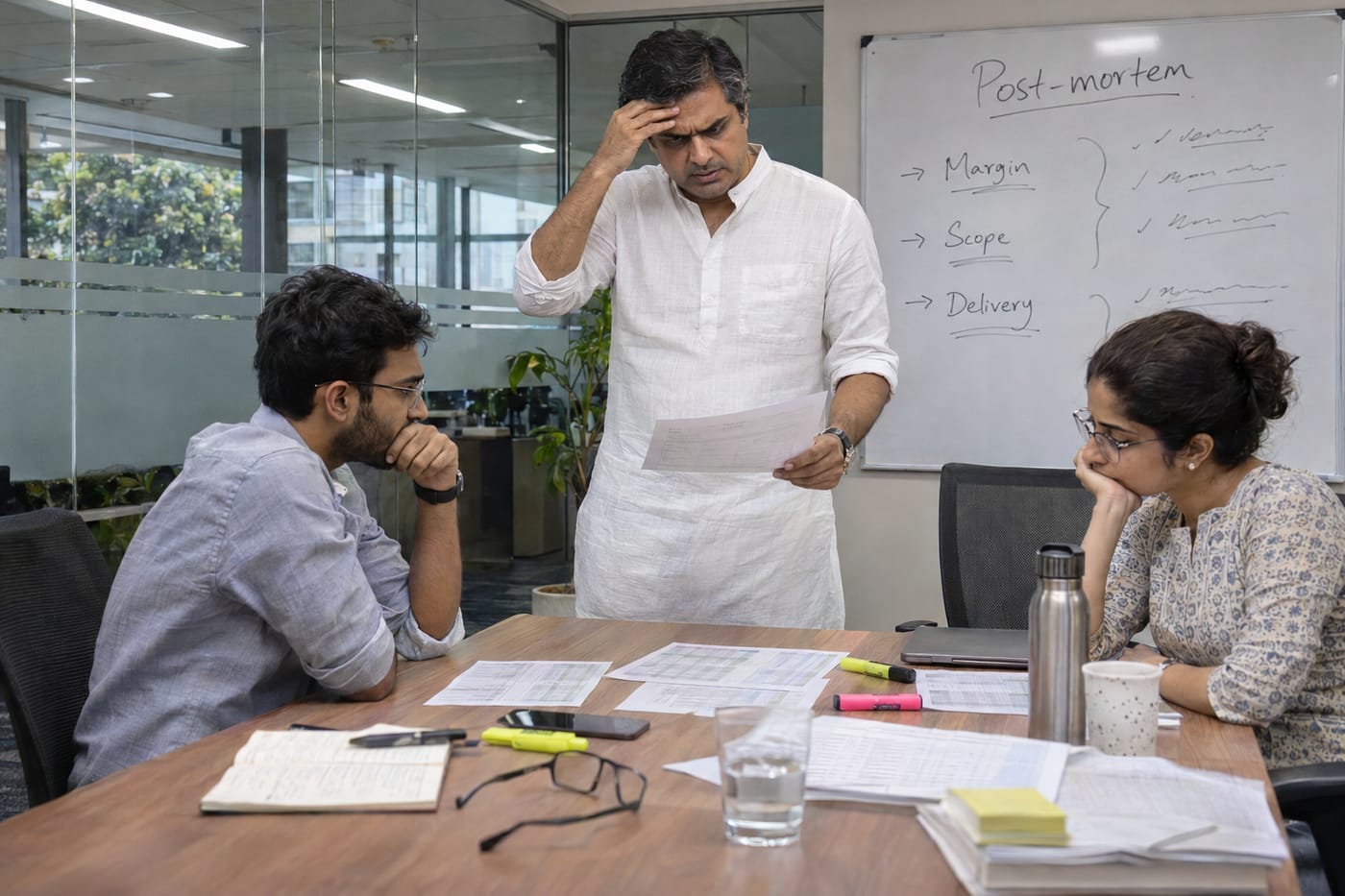
Most firms this size discover whether an engagement made money two to four weeks after it closed, when the finance team reconciles timesheets, subcontractor invoices, travel reimbursements, and the final GST invoice. By then the partner cannot renegotiate scope, cannot pull a junior off the account, cannot do anything. SPI Research found a 9% profitability gap between firms with real-time project costing and those without. On a firm doing ₹20 crore in annual revenue, that is not a reporting problem. That is a partner's bonus pool.
The broader context is worse. Rocketlane's margin erosion research puts typical undetected margin loss at 15–20% before anyone notices, against a healthy benchmark of 30–40% gross delivery margin. Only 17.2% of professional services firms hit their annual margin target in 2025, with industry EBITDA at 9.9% — well below the five-year average of 13.8%.
Gap 2: Every proposal is priced from a blank page
Ask your partners how they priced the last three proposals. You will get three different answers: one based on a prior engagement they vaguely remember, one based on what the client said their budget was, one based on headcount math done in a hotel lobby before a pitch. There is no institutional memory of what similar work actually cost to deliver, how long it actually took, or what the realised rate was after write-offs. So the firm reprices the same work from scratch, usually wrong, and the junior partner who inherits the account spends the first month renegotiating scope.
Gap 3: Utilisation is visible too late to act on
Global billable utilisation fell to 66.4% in 2025 — the lowest in SPI Research's 19-year survey history, against an optimal threshold of 75%. Indian firms rarely know their number in real time. Timesheets go in on Friday, get reviewed by a manager the following week, reach the partner through a monthly utilisation report, and by then the consultant has already been on the bench for 10 working days. Firms using PSA tools report 10% higher billable utilisation on average than those on spreadsheets — almost entirely because the alert arrives early enough to redeploy.
There is a fourth, India-specific pressure stacked on top. The GST e-invoicing mandate now covers all businesses above ₹5 crore in aggregate turnover, with a hard 30-day window to upload B2B invoices to the Invoice Registration Portal from April 2025. If your timesheet-to-invoice cycle runs 45 days because approvals are stuck in email, you are not just losing cash flow — you are at risk of rejected invoices and the client disputes that follow.
Build #1: A real-time project margin and utilisation tracker
What it is. A single system where every consultant logs time against a project code daily (not weekly), every project has a live budget-vs-actuals view in rupees and hours, and every partner sees a dashboard that flags three things automatically: engagements trending over budget, consultants below a utilisation threshold for more than five working days, and timesheets more than 48 hours overdue.
What changes once it exists. You stop finding out about margin bleed at invoice time. A partner reviewing the Monday dashboard sees that the banking engagement is 60% through its budget at 40% of scope delivered, and has a conversation with the client on Wednesday instead of writing off hours in week six. The bench conversation happens on day three, not day fifteen. The GST invoice goes out within a week of month-end because approved timesheets are already in the system.
What it is not. It is not a CRM. It is not a proposal generator. It is not a resourcing optimiser. Adding those modules at this stage is how firms end up with a six-month implementation that stalls because nobody uses the timesheet module, which is the only one that actually matters.
What drives the build. The honest cost and timeline model: a tracker like this is a function of (a) how many project codes and cost centres your finance team already runs, (b) whether you need to pull actuals from Tally, Zoho Books, or an ERP vs. enter them manually, (c) whether utilisation rules differ by practice (strategy partners bill differently from engineering delivery leads), and (d) whether GST e-invoice generation sits inside this system or stays in your accounting tool. A firm with clean project codes, a single accounting system, and uniform utilisation rules is a meaningfully shorter build than one with four practices, two accounting systems, and partner-specific exceptions. Ask any vendor who quotes you a flat number which of those four variables they assumed.
Build #2: A proposal and pricing library — not a proposal generator
Once the tracker has been live for two quarters, you have something you did not have before: a clean record of what similar work actually cost to deliver, by practice, by client size, by engagement type. That is the input for Build #2.
What it is. A structured library of past engagements — scope, team mix, hours by role, realised rate, final margin — searchable by the partner writing the next proposal. Layered on top: a pricing calculator that takes a proposed scope and team mix and returns an expected margin based on the actuals of comparable past work. Not a document generator. A pricing brain.
What changes once it exists. New proposals get priced in hours, not days, with a defensible margin floor. Junior partners stop under-pricing to win. Senior partners stop over-pricing on gut and losing to Big Four firms who have this infrastructure already.
What it is bad at. This system is useless if Build #1 is not giving you clean actuals. Garbage in, garbage out. It also does nothing for first-of-a-kind engagements where there is no comparable — partners still have to price those the old way. Do not oversell this to yourself as an AI pricing oracle. It is an institutional memory with maths on top.
Build #3: Billing automation and GST invoice workflow
Third, not first, because it only works if timesheets are already clean and approved in near-real time. Automating a broken approval chain just means you generate wrong invoices faster.
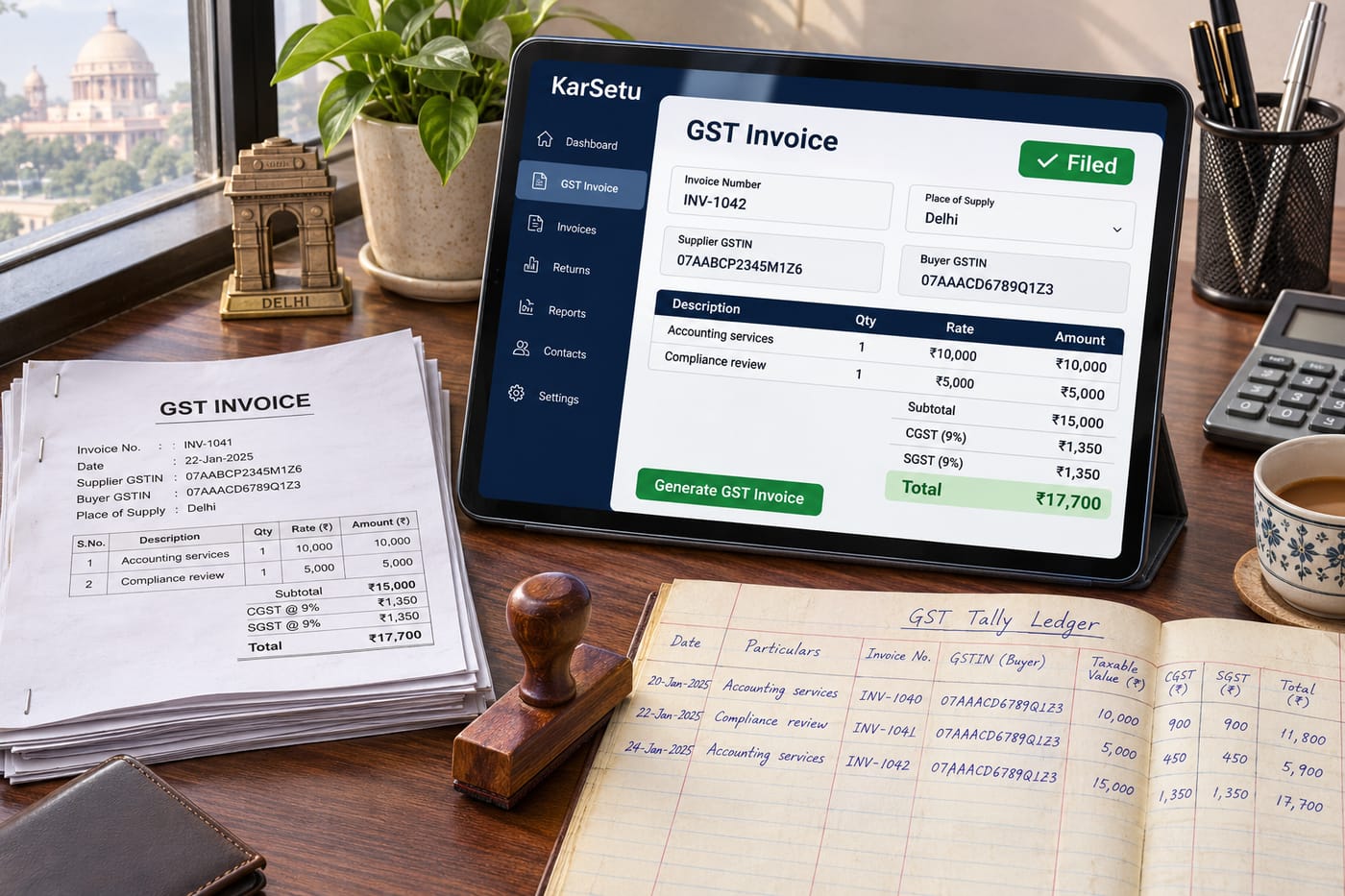
What it is. Auto-generation of draft invoices from approved timesheets on a configurable cycle (weekly, fortnightly, monthly by client), with GST-compliant formatting, direct push to the IRP for e-invoice generation, and a reconciliation view that flags any hours booked but not billed.
What changes once it exists. Days sales outstanding drops. The 30-day IRP window stops being a scramble. Finance stops being the bottleneck between delivery and cash. And — this is the quiet one — unbillable hours become visible in the same week they happen, because the reconciliation view surfaces them before the invoice goes out, not after.
What NOT to build yet (even though vendors will push hard)
- CRM with pipeline forecasting. Most 15–80-person consulting firms have 20–60 active prospects at any time. A shared spreadsheet or HubSpot's free tier handles this. Custom CRM is a Build #5 or #6 problem, not a Build #1 problem.
- Resource optimisation and skills matching. Partners already know who is good at what. Algorithmic resourcing is valuable above roughly 150 consultants, when no one partner holds the whole picture.
- Client portals. Most clients will not log in. The ones who will, want a status email and an invoice PDF.
- AI-generated deliverables. Separate conversation. Do not confuse it with the operational software stack. It belongs in a practice-level pilot, not in the firm's core operating system.
Why custom, and why now
The reasonable question is: why not just buy Kantata, Rocketlane, Mavenlink, or one of the Indian PSA tools? For some firms, that is the right answer, and an honest advisor will tell you so. Off-the-shelf PSA works well if your practices are homogeneous, your utilisation rules are standard, your GST workflow is simple, and you are willing to change your process to match the software.
Custom becomes the right answer when any of the following is true: you run multiple practices with genuinely different economics (an engineering delivery arm plus a strategy arm, say), your rate card has partner-specific or client-specific exceptions that no SaaS tool models cleanly, you need to integrate with an Indian accounting stack (Tally, Zoho Books, Busy) that global PSA vendors treat as an afterthought, or your GST e-invoicing needs tight coupling to your project data rather than a monthly export. The Indian project management software market is growing at 22.1% CAGR, the fastest among major economies, precisely because the local workflow requirements have outrun what generic SaaS handles.
The other reason is ownership. A custom tracker is your IP. You can bolt on the proposal library and the billing workflow when you are ready, on your schedule, without a per-seat licence that compounds as you hire.
How to sequence the build
- Phase 1 (first build). Timesheet capture, project budget vs. actuals, utilisation alerts, partner dashboard. Nothing else. Get this live and used daily for at least one quarter before adding anything.
- Phase 2. Proposal and pricing library, fed by Phase 1 actuals. Roll out practice by practice, not firm-wide on day one.
- Phase 3. Billing automation and GST e-invoice workflow, integrated with your accounting system.
- Phase 4 and beyond. CRM, resourcing optimiser, client portal — only if Phases 1–3 have measurably moved utilisation and margin. If they have not, more software will not help.
The temptation to build Phases 1–3 in parallel is strong and almost always wrong. The firms that do it end up with three half-finished systems and consultants who log time in none of them.
How CodeNicely can help
The closest parallel in our work is GimBooks, the YC-backed accounting and invoicing platform we built for Indian MSMEs. The engagement centred on exactly the problem a consulting firm faces at the invoice end: GST-compliant invoice generation, IRP integration, and reconciliation flows that had to work for users who did not want to think about tax law. The operational logic — clean data in, compliant invoice out, no manual firefighting at month-end — is the same logic that sits under Build #3 for a consulting firm.
For the broader operational tracker, our work with small and mid-sized businesses on custom software and embedding automation into existing workflows is the relevant reference. We do not sell a PSA product. We build the specific tracker your firm needs, integrate it with the accounting and GST stack you already run, and hand you the IP. If what you need is off-the-shelf PSA, we will tell you that too.
Turning any of the ranges in this post into a real number for your firm depends on three things: how many project codes and cost centres you run today, what accounting system holds your actuals, and whether Phase 1 needs to include GST e-invoice generation or just hand off to it. Those are the first questions worth a conversation.
Frequently Asked Questions
Should a 20-person consulting firm build custom software or buy a PSA tool?
At 20 people, buy first unless you have a genuinely non-standard rate card, multiple practices with different economics, or a tight Indian accounting integration that global PSA tools do not handle well. Run the off-the-shelf tool for a year, document every workaround your team invents, and use that list as the specification for a custom build if and when you outgrow it. Building custom from day one at 20 people is usually over-engineering.
How long does it take to build a project profitability tracker for a consulting firm?
The timeline is driven by four things: whether your project codes and cost centres are already clean, whether actuals need to pull live from an accounting system or get entered manually, how many utilisation rules you need to model, and whether GST e-invoicing is in scope for Phase 1. A firm with a single clean accounting system and uniform rules is a materially shorter build than a firm with four practices and partner-specific exceptions. Any vendor quoting a timeline without asking about those four should be asked why.
What does custom software for a consulting firm in India typically cost?
Cost scales with scope more than with headcount. The two biggest drivers are integration depth (one accounting system vs. three, GST IRP in or out of scope) and how much of your existing process needs to be modelled vs. simplified. Firms that use a build as an opportunity to simplify their rate card and approval chain pay less and get a better system; firms that insist the software match every current exception pay more and get something fragile. A real quote needs a two-hour scoping conversation, not a form submission.
Will custom software help us comply with GST e-invoicing rules?
It can, if GST e-invoice generation is explicitly in scope and integrated with the IRP. The compliance question itself — what your firm must file, when, and how — is a question for your tax advisor or auditor, not your software vendor. What custom software does is remove the operational friction (late approvals, manual re-entry, missed 30-day windows) that causes compliant firms to miss deadlines anyway.
How much utilisation improvement can we realistically expect?
Industry data from SPI Research suggests firms moving from spreadsheets to a proper PSA tool see roughly 10% higher billable utilisation on average, and real-time project costing is associated with a 9% profitability gap. Your actual lift depends on where you start: a firm currently at 55% utilisation with no visibility has more to gain than one already at 72% with weekly partner reviews. The honest answer is you will not know your own number until you measure it in the first quarter post-launch.
Sources & further reading
- India Project Management Software Market Size & Outlook, 2030 — Grand View Research
- 2026 PSO Benchmarks: Insights from SPI Benchmark Maturity Report — Deltek
- 2026 Professional Services Maturity Benchmark — Kantata / SPI Research
- The 6 metrics your professional services business should track (SPI 9% profitability gap) — Sage
- Consultant Utilization Rate Benchmarks 2025–2026 (PSA = 10% higher utilization) — Saibon.io
- Margin Erosion in Professional Services — Rocketlane
- What is e-Invoicing Under GST? Applicability, Limit, Rules and Process — ClearTax
- 2025 Professional Services Maturity Benchmark (PDF) — SPI Research / Kantata
Get one practical guide a week
Costs, AI tools, partner selection — written for people who make the decision. No spam, unsubscribe anytime.
Thanks — you're on the list. One practical guide a week, nothing else.
That didn't work — please check the email address and try again.
Building something in Consulting?
CodeNicely partners with founders and tech teams to ship AI-native products that move metrics. Tell us about the problem you're solving.
Talk to our team Book a 30-min call