
One Dev Partner or Many Specialists: Pick One

 Published by CodeNicely, the product studio founded by Meghal Agrawal and Ujjwal Agrawal in 2017
For: A seed-to-Series-A founder in Dubai who has received proposals from a full-stack studio and two specialist agencies (one AI, one mobile) and must decide how to structure their vendor relationships before signing anything
In this guide
If you're a seed-to-Series-A founder choosing between one development partner and multiple specialist agencies, the honest answer is this: consolidate with one accountable partner unless you have a technically senior co-founder who will personally own vendor coordination. The specialist route looks lower-risk on paper because each vendor is better at their slice, but splitting work transfers the integration layer — and the delivery guarantee — onto you. That trade is worth it in exactly two situations, which we'll get to. In every other situation it's a tax you'll pay in weeks of your life.
This piece walks through how to score the decision honestly, including the case against hiring any agency at all.
The decision, stated crisply
You're not choosing a tech stack. You're choosing who owns the words "it works end-to-end." That ownership is the single most valuable thing in your contract, and it can only live in one place: inside your team, inside one vendor, or nowhere. If it lives nowhere, you own it by default — and most first-time founders don't realise they've signed up for that until month three.
Three structures to compare:
- One full-stack partner, fixed scope. One contract, one project manager, one throat to choke. They subcontract or hire for gaps.
- Multiple specialists, you coordinate. An AI agency, a mobile agency, maybe a backend shop. You or your CTO own the integration contract and the finger-pointing.
- In-house hires with contractor top-ups. A technical co-founder plus one or two engineers plus specialist contractors for discrete pieces (ML, iOS, DevOps).
The Dubai context sharpens the choice. The UAE IT services market reached USD 5.88 billion in 2024 and is forecast to grow at a 9.1% CAGR to USD 12.88 billion by 2033, and Dubai Internet City alone hosts more than 4,000 businesses and over 31,000 tech professionals. You're not short of vendors. You're drowning in them — and the Dubai Chamber of Digital Economy supported 1,210 new digital startups in 2024, a 120% increase year-on-year, so every good shop in the city is quoting three other founders this week.
The five axes that actually decide it
1. True total cost, including the coordination tax
When you ask three vendors to quote, you compare three line-item totals and pick the mix that looks cheapest. That comparison is wrong because it omits the single largest hidden cost in multi-vendor builds: coordination overhead.
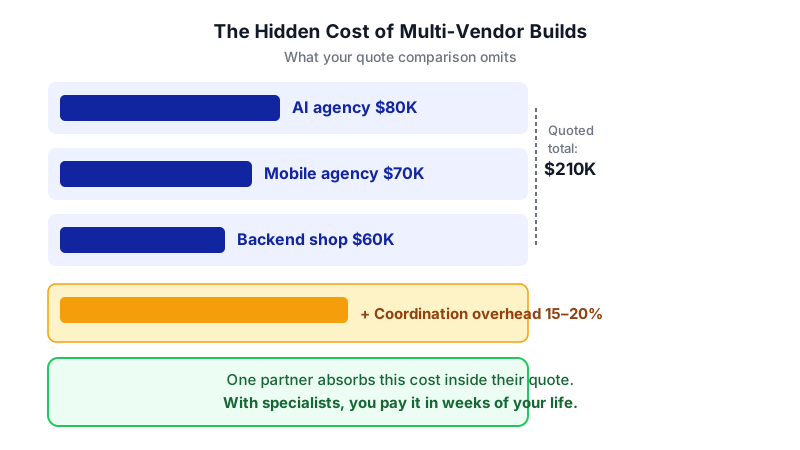

Industry benchmarks put project-management overhead on offshore and multi-vendor software projects at 15–20% of direct labor costs, and the overhead compounds when vendors are concurrent. The same source notes that three simultaneous projects at 20% overhead can absorb up to 60% of senior management time before any strategic work begins. Biosistemika's benchmarks confirm the 15–20% range for complex or multi-vendor engagements.
In practice: a quote stack of "$80K AI + $70K mobile + $60K backend = $210K" doesn't include 15–20% of someone's time managing the three of them. If that someone is you, you're not building the business. If it's a fractional CTO, add their fee. If it's nobody, it will show up as rework.
A single fixed-scope partner absorbs that cost into their quote. You pay for it either way. The question is whether it's priced or hidden.
2. Who owns integration risk
This is the one that quietly ends projects. 84% of all system integration projects fail or partially fail, with failed integrations costing organisations an average of $2.5 million in direct costs plus opportunity losses. Separately, Gartner data suggests integration-related failures account for 30–40% of all unplanned IT downtime.
When two vendors each build to their own interpretation of a spec, the seam between them is nobody's contractual problem. Your mobile vendor will say the AI vendor's API is slow and inconsistent. Your AI vendor will say the mobile client is calling it wrong and not handling retries. Both are probably right. You're the only person who can arbitrate, and you can't, because you're not an engineer deep enough to adjudicate.
With one partner, the integration layer is inside their statement of work. If it breaks, it's their fix. That contractual simplicity is worth more than any single specialist's technical edge.
3. Speed to first value
Specialists win on isolated depth. If you need a fine-tuned LLM pipeline shipped in six weeks and nothing else, a dedicated AI shop will beat a generalist. But "first value" for a startup is almost never one isolated capability — it's a user flow that touches auth, data, UI, and the model. Every vendor boundary inside that flow adds a kickoff, a standup rhythm, a Slack channel, and a two-week delay on the first real integration test.
A single partner can start with a thin end-to-end slice in week one. Three partners spend the first month agreeing on API contracts.
4. Key-person risk and what happens in month six
Six months in, you'll want to change something significant. You'll pivot the pricing model, add a new region, or discover your original AI approach doesn't work and needs replacing. Ask yourself, concretely, for each structure:
- Single partner: you renegotiate one SOW. If the partner is bad, you fire them and the knowledge transfer is painful but bounded.
- Multiple specialists: you renegotiate three SOWs, and any one of them can hold the others hostage because they own a critical seam.
- In-house: your lead engineer leaves and takes the context with them. Replacement takes four months.
The McKinsey/Oxford study of 5,400+ large IT projects found they run 45% over budget on average, deliver 56% less value than predicted, and 17% go so badly they threaten the very existence of the company. The failure mode isn't bad code. It's the change-of-direction tax, which is highest in multi-vendor structures and lowest in single-partner ones.
5. The IP and lock-in question
This cuts the other way. A single partner, badly chosen, can become a lock-in. Make sure any contract — single or multi-vendor — gives you full source, documentation, deployment access, and clean IP assignment on delivery. If a vendor resists this, that's your answer about whether to sign.
Multi-vendor structures are naturally harder to lock into because no one party has the whole picture. That's a real benefit if you're paranoid about dependency. It's also, obviously, the same reason integration breaks.
Scoring the three structures honestly
| Axis | Single partner | Multiple specialists | In-house + contractors |
|---|---|---|---|
| True cost including coordination | Best — priced in | Worst — hidden 15–20% | Middle — your time |
| Integration risk ownership | Vendor owns it | You own it | You own it |
| Speed to first end-to-end slice | Fastest | Slowest | Middle |
| Depth on any single specialism | Middle | Best | Depends on hires |
| Flexibility at month six | Good | Poor | Best, if team stays |
| Key-person risk | Low | Medium | High |
| Lock-in risk | Medium — manage via contract | Low | None |
The case against hiring any agency
Worth saying plainly, because no agency blog ever does: if you can hire a strong technical co-founder in Dubai or remotely, do that first. Equity is cheaper than cash at seed stage, context compounds, and the person who builds v1 is usually the person best placed to rebuild it when you learn what customers actually want.
Agencies make sense when: you can't find a co-founder, you need to ship faster than hiring allows, your product requires specialist capability (ML, computer vision, regulated-industry compliance) that a single generalist hire can't cover, or your runway dictates a fixed-scope spend rather than an open-ended headcount commitment.
If none of those apply, hire. If any apply, keep reading.
What drives cost and timeline in either model
Buyers always want a number. Here is the honest shape of it, without inventing figures nobody can stand behind.
Cost is driven by, roughly in order of impact: the number of distinct user roles and permission tiers; the number of external integrations (payments, identity, third-party APIs, each adds weeks); whether you have existing data to migrate and in what state; the regulatory surface (healthcare, finance, and KYC each add compliance scope); the sophistication of any AI or ML component (a wrapper around a hosted LLM is weeks; a trained custom model with eval infrastructure is months); and the quality bar for the first release — a design-partner beta tolerates rough edges a public launch does not.
Timeline is driven by the same factors plus one more: decision velocity on your side. The fastest-shipping founders we see make product calls in hours, not committees. The slowest spend more waiting for their own approvals than vendors spend writing code.
What a buyer controls: scope discipline, decision speed, willingness to ship an ugly v1. What a buyer doesn't control: integration partner response times, regulatory review cycles, the labour market for senior engineers.
Illustrative example, with assumptions stated: a two-integration mobile MVP with hosted-LLM features, no existing data to migrate, one user role, and a design-partner-grade quality bar typically moves through discovery, build, and launch in a single-digit number of months with one partner. Add a second user role, a payments integration, and a custom-trained model and the timeline roughly doubles. These are shapes, not quotes.
To turn any range into a real number for your situation, three specifics matter most: the exact integration list, whether the AI component is a hosted-model wrapper or a trained model with its own eval loop, and whether launch means "ten design partners" or "public app store with support SLAs." Those three answers move the quote more than anything else. A scoping conversation with any serious partner — including CodeNicely's Dubai team — should land them in the first hour.
If you're in situation A, do X
Pick one full-stack partner if:
- You are non-technical or your technical co-founder is part-time.
- Your product is a standard web/mobile app with AI features that are important but not the entire product (most B2B SaaS, most marketplaces, most fintech apps).
- You need to ship an end-to-end MVP in months, not quarters.
- You value one accountable throat over best-in-class depth on any single component.
This is the right answer for the majority of seed-to-Series-A founders. Examples of what this looks like in practice: a YC-backed accounting SaaS, a logistics marketplace with route optimisation, an e-pharmacy with AI drug-interaction checks.
Split across specialists if:
- You have a full-time, technically senior CTO or co-founder who will own vendor coordination as a core part of their job — not as a side task.
- Your product has one component so specialised (frontier ML research, hardware, regulated-industry workflows) that no generalist partner credibly covers it.
- You've done this before and know, from scar tissue, where the integration seams will leak.
Even then, make one vendor the integration owner by contract. Don't leave the seam ownerless.
Hire in-house instead if:
- You can find and afford a strong technical co-founder, and your product is simple enough that one or two engineers can carry v1.
- You expect the product to iterate heavily post-launch — in-house teams compound context in a way agencies don't.
- Your investors expect to see engineering headcount on the cap table.
Red flags in any vendor conversation

- They won't commit to full source and IP transfer in writing. Walk.
- They quote a fixed price without a scoping phase. The quote is fiction.
- They can't name the specific people who will work on your project. You're buying a brochure, not a team.
- They don't ask you about your decision-making process. They don't understand that your velocity caps theirs.
- They promise AI capabilities without showing a specific past project. Real AI work has visible scars — eval loops, failure modes, cost-per-call conversations.
Frequently Asked Questions
Is it cheaper to hire one development partner or multiple specialists?
Headline quotes almost always favour the specialist stack because each vendor is quoting only their slice. Once you add the coordination overhead — benchmarked at 15–20% of direct labor costs for multi-vendor projects — and the cost of integration failures the single-partner option is usually cheaper in true all-in terms. The exception is when one specialist capability is so narrow that forcing a generalist to cover it would waste more than the coordination overhead saves.
How do I protect against vendor lock-in with a single partner?
Three contract clauses do most of the work: full IP assignment on delivery, full source and documentation handover at any contract exit, and deployment access to all production infrastructure in your accounts, not theirs. If a vendor pushes back on any of these, that is the signal to choose a different vendor — not to split the work across more vendors.
Should a non-technical founder in Dubai hire a local agency or an offshore one?
Local presence matters most when your product requires frequent in-person workshops, regulated-industry sign-offs, or Arabic-language user research. Offshore partners with a strong Dubai or Gulf footprint can cover most other cases at better rates. The decisive factor is not geography but whether the partner has shipped something that resembles what you're trying to build, and whether their project manager is in a timezone you can get a same-day answer from.
What does a realistic MVP timeline look like for a seed-stage startup?
It depends almost entirely on scope and decision velocity rather than vendor choice. A tightly-scoped MVP with two or three integrations and hosted AI features typically moves in a single-digit number of months; adding regulated workflows, custom-trained models, or multiple user roles roughly doubles that. To turn a range into a quote, scope the integration list, the AI approach, and the launch definition — those three answers do most of the estimate.
Can I start with one partner and bring in specialists later?
Yes, and this is often the smartest path. Ship v1 with one accountable partner, learn where the real complexity sits, and bring in a specialist for the component that genuinely needs depth once you know what it is. The reverse — starting with specialists and trying to consolidate under one partner later — is painful because knowledge is already fragmented across teams who no longer have an incentive to document it.
Sources & further reading
- The Hidden Cost of Managing a Software Vendor — Yameo
- UAE IT Services Market Size, Share, Trends, Growth & Forecast 2025-2033 — IMARC Group via Vocal Media
- Top IT Outsourcing Companies in Dubai (2026) — Lumitech
- Dubai's Digital Economy Booms with 1,210 New Startups in 2024 — Fast Company Middle East
- Data Transformation Challenge Statistics: 50 Stats Every Technology Leader Should Know in 2026 — Integrate.io
- Why ERP Implementation Failures Exceed 50% Rates (citing McKinsey/Oxford study) — Pemeco
- What Is Enterprise Integration? The Plain-English Guide Every IT Leader Needs in 2026 (citing Gartner downtime & integration failure data)
- How to Estimate the Costs of Software Development Projects — Biosistemika
Get one practical guide a week
Costs, AI tools, partner selection — written for people who make the decision. No spam, unsubscribe anytime.
Thanks — you're on the list. One practical guide a week, nothing else.
That didn't work — please check the email address and try again.
Building something in Software & Technology?
CodeNicely partners with founders and tech teams to ship AI-native products that move metrics. Tell us about the problem you're solving.
Talk to our team Book a 30-min call