
What Your Dev Contract Should Say When You Want to Walk Away

 Published by CodeNicely, the product studio founded by Meghal Agrawal and Ujjwal Agrawal in 2017
For: A seed-to-Series-A SaaS founder who is three months into a build with an offshore dev partner, starting to lose confidence, and realizing for the first time that nothing in the contract tells them how to get their code, credentials, and documentation back if they pull the plug
In this guide
If your contract only says either party may terminate with 30 days notice, you do not have an exit — you have a notice period. A real exit clause spells out what gets delivered, in what format, by when, and at whose cost: the Git repositories with full history, every cloud and third-party credential, the environment variables, the build and deploy scripts, the architecture docs, the data exports, the model weights and training data if any, and a named engineer available for a defined handover window. Without that, your vendor controls the pace of your exit no matter what the termination notice says.
This post walks through the termination and transition-out clause family specifically — the part of a software development contract that governs what happens when you want to walk away. It is written for the founder who is three months into a build, losing confidence, and realising for the first time that the paperwork does not actually give them a way out. This is not legal advice. Get a lawyer who has reviewed software development agreements before to redline anything you intend to sign.
Why this clause family matters more than founders think
The data on how often these relationships end is sobering. Dun & Bradstreet's Barometer of Global Outsourcing finds that 20–25% of all outsourcing relationships fail within two years, and 50% fail within five years. Deloitte's 2024 Global Outsourcing Survey found that 70% of executives had selectively insourced scope previously held by a third party over the prior five years. You are not being paranoid for planning the exit. You are being normal.
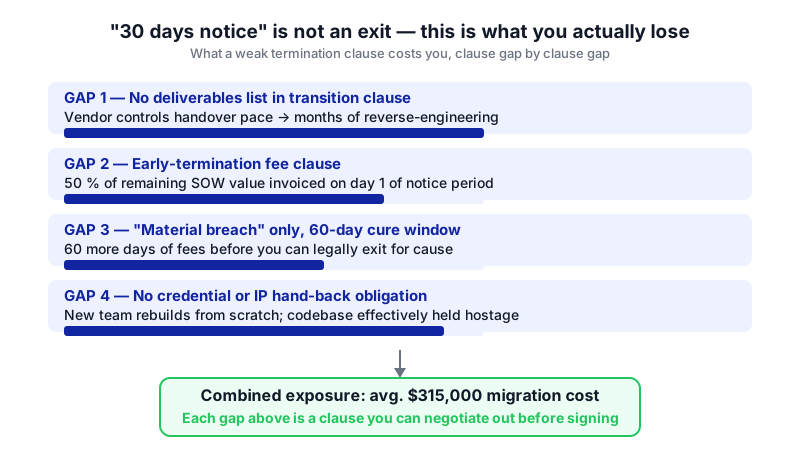
The money side is uglier. CIO Dive puts the average enterprise vendor migration project at $315,000, and that figure already assumes lock-in has set in. For a seed-stage SaaS company, the migration cost is not just dollars — it is the three months of runway you burn while a new team reverse-engineers an undocumented codebase. The clauses below are what stand between you and that bill.
The termination and transition-out clause, line by line
1. Termination for convenience
What it is for. The right to end the engagement without having to prove the vendor did anything wrong. You just want out.
Wording that protects you: Client may terminate this Agreement or any Statement of Work, in whole or in part, for any reason or no reason, upon fifteen (15) days written notice to Vendor. Upon such termination, Client shall pay for Services properly performed and accepted through the effective date of termination, and no further amounts shall be due.
Wording that quietly does not: Either party may terminate for convenience upon ninety (90) days notice, with early-termination fees equal to 50% of the remaining SOW value payable upon termination. That is not an exit — that is a settlement. Watch for the phrases early termination fee, cancellation charges, unamortised set-up costs, and minimum commitment. Any of them can turn a 30-day notice into a six-figure invoice.
Ask the vendor: If I terminate for convenience in month four of a twelve-month SOW, what is the exact total you will invoice me on day one of the notice period? Get the answer in writing before you sign.
2. Termination for cause
What it is for. Letting you exit immediately, without a notice period or termination fee, when the vendor has materially failed.
Wording that protects you: Client may terminate immediately upon written notice if Vendor (a) fails to meet any acceptance criteria defined in a Statement of Work and does not cure such failure within fifteen (15) days of written notice; (b) misses two or more milestone delivery dates by more than fourteen (14) days each; (c) suffers a security incident affecting Client data; or (d) breaches its confidentiality or IP assignment obligations. Enumerate the triggers. Do not rely on material breach alone — that word has to be litigated to mean anything.
Wording that quietly does not: Either party may terminate for material breach that remains uncured sixty (60) days after written notice. Sixty days is a long time to keep paying a vendor you have already decided to fire, and material is a fight you probably do not want.
3. Transition assistance — the actual exit mechanics
This is the clause almost no founder reads carefully and almost every founder later wishes they had. The termination clause tells you when the relationship ends. The transition assistance clause tells you what you actually get. Selleo's analysis of software-house lock-in is blunt: lock-in happens when one vendor controls the code, the knowledge, the infrastructure, and the exit process simultaneously. The transition clause is where you break that grip.
Wording that protects you. Spell out, as a numbered deliverable list, exactly what the vendor must hand over and by when. A workable template:
Within seven (7) calendar days of termination for any reason, Vendor shall deliver to Client, at no additional charge:
- All source code, including complete Git history, pushed to a Client-controlled repository (GitHub organisation or equivalent to be nominated by Client).
- A written inventory of every third-party service, SaaS account, API key, cloud resource, DNS record, domain, and credential used in the development, staging, or production environments, with ownership transferred to Client-nominated accounts.
- All environment configuration files, .env templates, infrastructure-as-code definitions, Dockerfiles, CI/CD pipeline definitions, and deployment runbooks.
- All data belonging to Client or Client's users, in a documented, machine-readable format (SQL dumps, JSON exports, or equivalent), together with the schema.
- Where AI or machine-learning components are involved: all model weights, training datasets, fine-tuning datasets, prompts, evaluation sets, and documentation sufficient to retrain or re-deploy the models.
- Architecture documentation, API documentation, and a written knowledge-transfer document covering known bugs, technical debt, and operational quirks.
Vendor shall additionally make a nominated senior engineer available for up to forty (40) hours of handover support, at no additional cost, during the thirty (30) days following termination, including live walkthroughs of the codebase and infrastructure with Client's incoming team.
Wording that quietly does not: Vendor shall provide reasonable transition assistance at its standard hourly rates. Reasonable is whatever the vendor says it is. Standard hourly rates on an exit are rarely standard. This phrasing is the single most common reason exits go sideways.
Ask the vendor: Walk me through the first seven days after I send a termination notice. Who on your team pushes the repo? Who transfers the AWS account? Who hands over the Stripe keys? Get names, not role titles.
4. IP assignment — the clause that decides whether you own what you paid for
If the IP assignment is weak, every other clause above is theatre. You cannot force a handover of code you do not own. This is where founders have been bitten hardest and most recently.
Under U.S. copyright law, payment alone does not transfer code ownership — without an explicit work-for-hire or IP assignment clause, rights remain with the creator. The landmark case Aymes v. Bonelli went further: a developer was ruled to own the copyright to software a company had paid for, even though the contract used work-for-hire language, because the court found him to be an independent contractor rather than an employee. For a buyer, that means work-for-hire language on its own is not enough. You need an explicit present-tense assignment.
Wording that protects you: All work product, deliverables, source code, object code, documentation, designs, data, and derivative works created by Vendor or its personnel in connection with this Agreement (collectively, "Work Product") shall be deemed a "work made for hire" to the fullest extent permitted by applicable law. To the extent any Work Product does not qualify as a work made for hire, Vendor hereby irrevocably assigns, and shall cause its personnel and subcontractors to assign, to Client all right, title, and interest in and to such Work Product, including all intellectual property rights, effective upon creation. Vendor shall execute any further documents reasonably required to perfect such assignment.
The phrases that matter: hereby irrevocably assigns (present tense, not shall assign in the future), and shall cause its personnel and subcontractors to assign (because the vendor's offshore contractor may not be bound by the vendor's own employment terms), and effective upon creation (so you own it from the moment the keystroke happens, not when the invoice clears).
Wording that quietly does not: Upon full payment of all amounts due, Vendor shall assign the Work Product to Client. If you ever dispute an invoice, the vendor owns the code. The AgileSoftLabs 2026 case study documents a SaaS company whose offshore vendor demanded $200,000 for a clean IP transfer during Series A due diligence because the original assignment was vague. SCIO Dev documents a fintech startup whose vendor reused the core codebase to launch a competing product after the relationship ended, because the contract was silent on exclusivity.
5. Credentials, infrastructure, and the account-ownership question
This is not usually a drafting problem. It is an operational one that drafting can fix. If your vendor is the owner of the AWS organisation, the GitHub organisation, the Vercel team, the Stripe account, the Firebase project, the OpenAI API key, the domain registrar, or the Google Workspace — you are already locked in regardless of what the paper says.
Wording that protects you: All production and staging infrastructure accounts, source-code repositories, domain registrations, third-party SaaS subscriptions, and API accounts used in connection with the Services shall be created in Client's name, under Client's billing, with Client as the account owner. Vendor personnel shall be added as collaborators with the minimum access necessary. Vendor shall not create accounts or acquire credentials in its own name on Client's behalf without Client's prior written consent.
Then enforce it in week one, not month six. Ask your vendor to send you the list of every account that currently exists. If anything is in their name, move it now.
6. Source-code escrow — when it is worth it and when it is theatre
Escrow (a neutral third party holding a sealed copy of the code, released on defined triggers) is useful when you cannot get continuous access to the repo during development. If you insist on your own GitHub organisation with Vendor as a collaborator from day one — which you should — escrow is largely redundant. It is still worth insisting on for enterprise buyers whose procurement teams require it, and for engagements where the vendor runs the production infrastructure.
If you do use escrow, the triggers that matter are: vendor insolvency, vendor failure to deliver within a defined cure period, and vendor acquisition by a competitor of yours. The last one is often forgotten.
7. Post-termination non-compete on the codebase
Separate from IP assignment, add a clause that bars the vendor from reusing any Client-specific code, architecture, or data for any other customer. The SCIO Dev fintech case above is exactly why. Blanket non-competes on the vendor working in your industry are usually unenforceable and vendors will not sign them. A non-reuse clause on your actual code and data is reasonable and standard.
What this looks like when you actually invoke it
Assume you have a well-drafted contract with everything above. Here is the sequence, illustratively — your situation will differ:
- Day 0. Send written termination notice citing the specific clause (convenience or cause). Attach the transition-assistance deliverable list from the contract as a reminder.
- Day 1–3. Vendor pushes final code to your Git organisation. You verify the commit history is complete, not squashed.
- Day 3–7. Credential inventory handed over. You rotate every key, change every password, and transfer ownership of every third-party account.
- Day 7–14. Documentation delivered. Your incoming team (internal or new vendor) reads it and books handover calls with the nominated senior engineer.
- Day 14–30. Live walkthrough sessions. By day 30 your new team can deploy a code change end-to-end without the outgoing vendor present.
That sequence costs you weeks, not months, and dollars, not six figures. The contract is what makes it possible. The vendor's goodwill is not.
What drives the real cost of a bad exit
Founders ask how much a messy exit costs. There is no clean number — the $315,000 CIO Dive figure cited above is an enterprise average and will overstate the picture for a seed-stage SaaS with a four-month-old codebase. What actually drives your number:

- How much code exists and how undocumented it is. Reverse-engineering an undocumented codebase routinely takes a new team 30–50% as long as it took to build it the first time.
- Whether production is live with real users. A live system with paying customers makes every day of transition risk expensive. A pre-launch MVP does not.
- Whether critical infrastructure is in the vendor's name. Transferring an AWS organisation with running workloads is a project in itself.
- Whether the IP assignment is clean. If a lawyer has to litigate ownership, the cost is unbounded.
- Whether you have anywhere to go. Lining up an incoming team takes four to eight weeks even when you have budget.
The two or three specifics that turn this into a real number for your situation: how many lines of code and how much documentation exist today, whether production is live, and who owns the infrastructure accounts. Scope those three and the picture clarifies fast.
How CodeNicely can help
We have been on both sides of this. When we built GimBooks — a YC-backed accounting SaaS for Indian SMBs — the engagement was structured from day one around clean IP assignment, Client-owned repositories and infrastructure, and documented handover standards, because GimBooks was raising capital and investor due diligence would look at exactly those things. That is the posture we recommend to any founder who is still in-flight with another vendor: whether or not you plan to switch, get your IP, your accounts, and your documentation into a shape that would survive a Series A legal review.
If you have decided to switch, we can act as the incoming team — scoping the codebase, taking ownership of the handover, and continuing the build with full IP assignment and no vendor lock-in. If you want to understand what good looks like before you commit to anything, our offerings page lays out how we structure engagements. For founders who want an honest read on whether their current contract gives them an exit at all, a scoped review conversation is the right starting point.
Frequently Asked Questions
Can I force my current vendor to hand over the code if my contract does not require it?
Sometimes, depending on jurisdiction and the specific wording. If your contract has any IP assignment language and you have paid for the work, you have an argument. If it is silent on IP, you have a harder problem — Aymes v. Bonelli and similar cases have gone in the developer's favour. Get a lawyer to read your actual contract before you send any termination notice; what you say in that notice matters.
What does a clean handover from an offshore dev partner usually involve?
At minimum: Git repositories pushed to your organisation with full history, a written inventory of every credential and third-party account with ownership transferred to you, environment and deployment configurations, data exports in a documented format, architecture and API documentation, and scheduled time with a named senior engineer who can walk your incoming team through the code. If any of those are missing, the handover is not complete.
How long does it take to transition a mid-build SaaS to a new development partner?
The honest answer is a range driven by three things: how much code exists, how well documented it is, and whether production is live. A pre-launch MVP with a well-maintained repo can transition in weeks. A live production system with an undocumented codebase and infrastructure in the outgoing vendor's name takes months. The specifics that turn that range into a real estimate are the lines of code, the state of the documentation, and the account-ownership map — those are what a new partner needs to see before quoting anything.
Is work-for-hire language enough to make sure I own the code?
In the U.S., not reliably on its own — courts have ruled against buyers whose contracts relied on work-for-hire alone with independent contractors. The safer construction is work-for-hire language plus an explicit present-tense assignment (Vendor hereby irrevocably assigns…) that also binds the vendor's personnel and subcontractors, and that takes effect on creation rather than on payment. A lawyer should draft the final wording for your jurisdiction.
Should I use source-code escrow with my development partner?
Only if you do not already have continuous access to the repository. If you insist from day one that the Git organisation is in your name and the vendor is a collaborator, you already have what escrow is supposed to give you. Escrow still matters for engagements where the vendor runs production infrastructure, for enterprise procurement checklists, and where you want a defined release trigger on vendor insolvency or acquisition by a competitor.
Sources & further reading
- Offshore Software Development Market Size & Share, 2032 — Kings Research
- Offshore Software Development Market Size By Application — Verified Market Research
- IT Outsourcing Statistics 2026: Market Size, Cost Savings & Trends — Stealth Agents
- Why Software Development Outsourcing Fails Most of the Time — WINaTALENT (citing Dun & Bradstreet)
- Vendor Lock-In in the Age of AI: Risks and How to Avoid Them — Kong (citing CIO Dive $315K stat)
- How to Hire Offshore Developers Risk-Free 2026 — AgileSoftLabs (Series A IP horror story)
- The Cost of Not Having an IP Risk Plan: Real-World Case Studies — PatentPC
- Legal and IP Risks in Offshore Contracts (And How to Avoid Them) — SCIO Dev
Get one practical guide a week
Costs, AI tools, partner selection — written for people who make the decision. No spam, unsubscribe anytime.
Thanks — you're on the list. One practical guide a week, nothing else.
That didn't work — please check the email address and try again.
Building something in Software & Technology?
CodeNicely partners with founders and tech teams to ship AI-native products that move metrics. Tell us about the problem you're solving.
Talk to our team Book a 30-min call