

Where a Retail Chain Should Spend Its Software Budget First

 Published by CodeNicely, the product studio founded by Meghal Agrawal and Ujjwal Agrawal in 2017
For: Owner or COO of a 10–50-location US retail chain running on a patchwork of a legacy POS, manual inventory spreadsheets, and a disconnected e-commerce storefront, now losing margin to shrink and stockouts they cannot see in real time
In this guide
If you run a 10–50-location retail chain and you can only commission one piece of software this year, build the system that tells you what inventory you actually have — not what the POS claims you have. Pricing automation comes second. The customer data layer and loyalty app come third, despite being what every vendor leads their demo with. The reason is boring and unglamorous: phantom inventory and promotional misfires bleed more margin per month than a loyalty program will ever recover, and they bleed it invisibly, which is why owners keep underestimating them.
This post walks through the three real operational gaps in a mid-size US retail chain, what gets built to close each, and the honest order to spend in.
The three problems that actually cost you money
Every retail software vendor will pitch you a platform. Ignore the platform framing. There are three specific holes in a typical 10–50-location chain's operations, and they are not equally expensive.
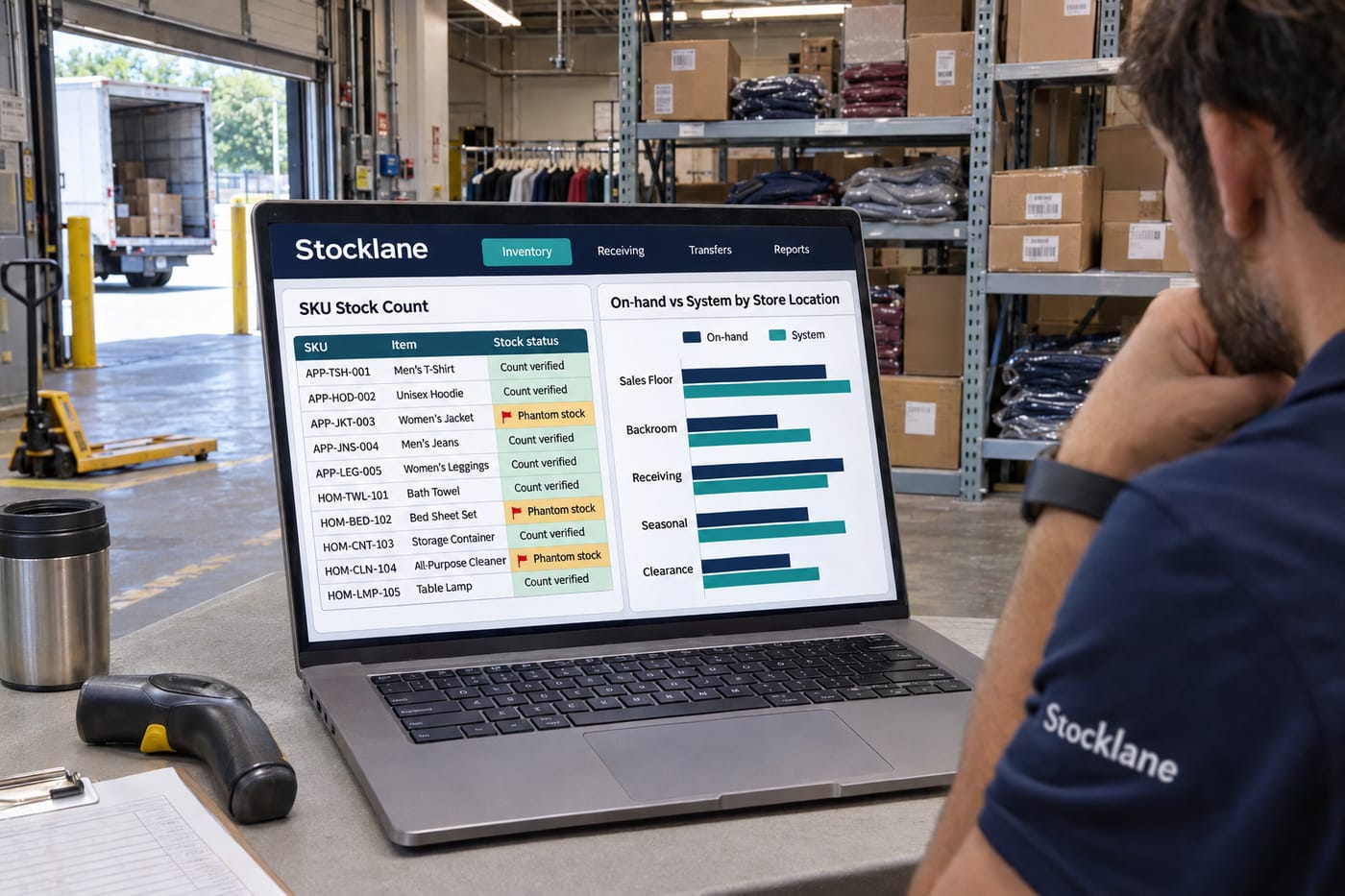
1. Inventory that lies to you
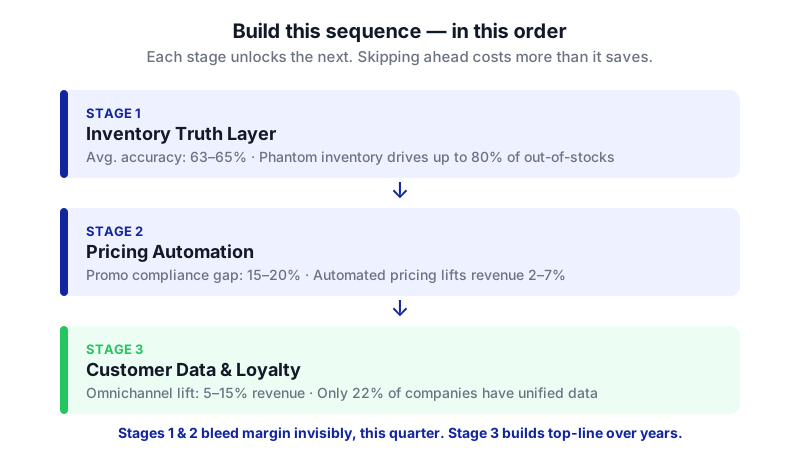
The average inventory accuracy rate in US retail store environments sits at roughly 63–65%, per Auburn University RFID Lab research. One in three SKU records is wrong at any given moment. 58% of retail brands run below 80% inventory accuracy, usually because legacy POS and back-office systems do not share a source of truth.
The specific flavor that destroys margin is phantom inventory — items the system shows as available but which are damaged, misplaced, miscounted, or stolen. Phantom inventory accounts for roughly 8% of all inventory losses and, more damaging, causes up to 80% of out-of-stock incidents. Most empty shelves in your stores are not actual deplenishments. They are errors that were already baked into the record the day the truck arrived.
The scale of this is not theoretical. US retail shrink hit $112.1 billion in FY2022, the last authoritative NRF figure before they discontinued the annual report. Global inventory distortion — out-of-stocks plus overstocks — reached $1.77 trillion in 2023. The best-run operator in apparel, Inditex, closed 2024 with 0.57% unsold inventory versus an industry range of 10–20%. The gap is almost entirely about real-time visibility.
2. Promotional pricing that misfires
When a regional promo gets keyed into each store's POS manually — or worse, into a header-level system that does not cascade to every SKU variant — compliance across the chain typically lands at 80–85%. The 15–20% that misfires is split between items that ring at full price (customer complaints, chargebacks, refunds) and items that stay discounted long after the promo ends (margin leak you will not find until month-end).
McKinsey research cited across pricing automation studies puts the revenue uplift from automated pricing at 2–7%. The compounding effect of a 5% pricing compliance gap across a national promotional calendar runs into seven figures for a chain doing even modest volume.
3. Customers you cannot recognize across channels
In-store purchases sit in the POS. E-commerce orders sit in Shopify or similar. Loyalty, if it exists, is a punch card or a half-dead app from a 2019 vendor engagement. There is no join key.
This is a real problem, but it is a smaller problem than the first two. McKinsey finds that omnichannel personalization done well lifts revenue 5–15%, and only 22% of companies currently have unified customer data. Shoppers who buy both online and in-store are worth roughly 30% more over their lifetime than single-channel shoppers. These numbers are real. But the uplift is a top-line number spread over years of loyalty maturity. The inventory and pricing problems are bottom-line, this quarter, right now.
The build order, and what each stage actually is
Stage 1: An inventory truth layer (build this first)
This is not an inventory management system in the ERP sense. You probably already have one of those and it is part of the problem. What you are building is a layer that sits above your existing POS and back-office, ingests every signal that touches stock — POS sales, receiving scans, transfer logs, returns, cycle counts, loss reports — reconciles them in near real time, and surfaces the deltas.
What changes once it exists:
- Phantom inventory becomes visible. You see which SKUs at which locations consistently show in-system but do not sell through at expected velocity, which is the signature of stock that is not actually on the shelf.
- Cycle counts become targeted. Instead of annual physical counts across the chain, you count the 5–10% of SKUs the system flags as suspect.
- Replenishment stops ordering ghosts. Right now your reorder points trigger off system quantity. When system quantity is 35% wrong, so are your orders.
- You get a defensible number for shrink by location, by category, by shift — which turns a vague loss into a managed one.
What this is bad at: it does not, by itself, stop theft or damage. It tells you where they are happening. You still need operational response. And it will not fix a POS that cannot export granular transaction data — if your POS is genuinely closed, the inventory layer stalls until you either replace the POS or get middleware in front of it, which is a separate project.
Scope shape: the build is driven by how many data sources have to be integrated (POS, WMS, e-commerce, supplier EDI, loss prevention), how clean the SKU master is across locations, and whether you can get an RFID or computer-vision signal in-store or you are reconciling only on transactional data. A chain with one POS vendor and a clean SKU master across 20 stores is a very different project from a chain that acquired three regional brands and runs four POS systems. The honest first conversation is about those integrations and the state of your SKU master, not about features.
Stage 2: Centralized promotional pricing with cascade to every location
Once inventory is trustworthy, pricing automation becomes the next highest-ROI build. The system is simpler than the inventory layer: a central promotions engine, a rules model (effective dates, locations, SKU groups, price ladders, stacking rules), and reliable push down to every POS, e-commerce PDP, and digital signage endpoint.
What changes:
- A buyer or category manager sets a promo once. It lands correctly at every till by open the next day.
- End dates actually trigger. The 11-day margin leak after a weekend promo stops.
- You get promo-level reporting — lift, cannibalization, compliance by location — that tells you which promos to repeat and which to kill.
What this is bad at: it is only as good as its weakest endpoint. If two of your 32 stores run a POS that cannot accept API-driven price updates, those two stores stay manual and stay broken. The project scope almost always includes either upgrading or wrapping those endpoints, and that is where the timeline moves.
Scope shape: the main drivers are how many channels receive prices (POS variants, web, app, signage, marketplace listings), how complex the rule model is (simple percent-off vs. threshold-based bundles with exclusions), and whether a staging and approval workflow is needed for compliance or franchise reasons. Two or three endpoints and a simple rules model is a much tighter build than a nine-endpoint cascade with franchisee overrides.
Stage 3: The customer data layer, then loyalty
Only after inventory and pricing are solid does the customer data layer earn its spot. The reason is sequencing, not importance. A loyalty program that promises customers an item is in stock when it is not, or that honors a promo at one store and not another, is worse than no loyalty program. It actively erodes trust.
The customer data build is a classic identity resolution and event pipeline: ingest in-store transactions (via POS loyalty capture or payment-instrument hashing where legally appropriate — talk to counsel before you design the identity graph), ingest e-commerce events, resolve identities, land a unified profile that marketing, merchandising, and store ops can query.
What changes:
- You can finally measure cross-channel LTV, not just channel-level revenue.
- Targeted promotions replace blanket ones, which both lifts response and protects margin.
- Store managers can see a customer's online history at the counter, which is the single highest-impact in-store personalization move and does not require a consumer app.
What this is bad at: it will not make a bad assortment good. If the customer data tells you half your stores are stocking the wrong mix, you still have to fix the mix. And the loyalty app itself — the one every vendor demos first — is the last 20% of this stage, not the first. Build the data layer, prove the segmentation moves revenue, then decide whether an app or a simpler SMS/email loyalty program is the right surface.
If you are a US operator weighing a build partner for any of these, we have written more about the build-vs-buy call on our US practice page, and the broader framing for retrofitting AI into existing operations sits on our digital transformation hub.
What this costs and how long it takes
Every retail chain asks this first, and every honest answer is a range. Here is the shape of the number.

Four things move the cost and timeline of each stage more than anything else:
- POS openness. A modern POS with a documented API is weeks of integration work. A closed or heavily customized legacy POS can double or triple the project because you are building middleware before you build the actual solution.
- SKU master cleanliness. If the same product has three different SKUs across three acquired brands, step zero is a data reconciliation project. This is often half the Stage 1 effort and almost no vendor demo mentions it.
- Number of integration endpoints. Two POS systems, one e-commerce platform, one WMS is a tractable surface. Four POS variants, two e-commerce platforms, franchisee-owned stores, and a marketplace channel is a different project entirely.
- In-store signal choice. Reconciling on transactional data alone is cheaper and faster. Adding RFID or computer-vision for shelf-level truth adds hardware, rollout, and change management, but closes the phantom inventory gap much harder.
Illustrative only: a 20-location chain with one modern POS, a reasonably clean SKU master, no RFID, and Stage 1 scoped to transactional reconciliation across POS, WMS, and e-commerce is a meaningfully smaller build than the same chain with four POS variants and an RFID rollout. The first might be a single-quarter engagement with a small team; the second is a multi-quarter program with hardware procurement on the critical path. Neither of those is a quote — your scoping conversation needs to pin down POS openness, SKU master state, and endpoint count before any number is real.
What turns a range into a quote: (1) a list of every system that holds stock, price, or customer data today and whether each has an API; (2) a sample of your SKU master across locations to assess reconciliation effort; (3) a decision on in-store signal (transactional-only vs. RFID vs. computer vision). With those three, scope stops being a guess.
The sequencing argument in one paragraph
Build inventory truth first because it unlocks every downstream decision — replenishment, shrink response, and honest promotional planning all depend on knowing what you actually have. Build pricing automation second because it is the fastest margin recovery once inventory is reliable, and because a pricing engine on top of bad inventory data just misfires faster. Build the customer data layer third because its returns compound over years and because premature loyalty investment on a broken operational base erodes the customer trust you are trying to build. The loyalty app that vendors lead with is a Stage 3.5 question, not a Stage 1 question.
Frequently Asked Questions
Should we replace our legacy POS first, or build around it?
Usually build around it unless the POS is actively blocking Stage 1 — meaning it cannot export transaction-level data or accept API price updates. POS replacement is a 12–18 month organizational change on its own and competing it with inventory and pricing work usually means neither project finishes. If your POS has even modest API surface, middleware is faster and lower-risk.
Is RFID worth the investment for a mid-size chain?
It depends on category and unit economics. For apparel, footwear, and high-shrink categories, RFID shifts inventory accuracy from the 65% baseline toward the Inditex-style 99%+ range, which is why Inditex closed 2024 at 0.57% unsold inventory. For low-ticket consumables with thin margins per unit, the per-tag cost often does not pencil. The right first move is usually a pilot in one category at 2–3 stores before any chain-wide commitment.
How do we know phantom inventory is actually our problem and not something else?
A quick diagnostic: pull your top 200 SKUs by revenue, compare system-on-hand to actual counts at five stores, and measure the delta. If accuracy is below 80% — which it is for 58% of brands per industry benchmarks — phantom inventory is costing you more than you think. The second signal is your out-of-stock pattern: if SKUs are going out-of-stock without the sales velocity that should have drained them, the stock was never there.
Can we do all three stages in parallel to move faster?
Technically yes, operationally almost never. Each stage requires cross-functional change — store ops training for inventory, category management workflow for pricing, marketing and merchandising alignment for customer data. Running three parallel change programs across 10–50 locations usually produces three stalled programs. Sequential execution with 3–6 month overlap at the boundaries is the realistic pace.
What should we ask a build partner to prove they can do this?
Ask for their integration playbook for your specific POS, not a generic capability deck. Ask how they handle SKU master reconciliation across locations with different historical masters. Ask what their phantom inventory detection logic actually is — if the answer is just "we reconcile transactions," they are missing the harder half. And ask who owns the code and data at the end; full IP ownership with no vendor lock-in is a reasonable baseline to insist on.
Sources & further reading
- The Curious Case of Phantom Inventory — Appriss Retail
- Phantom Inventory: Retail's Hidden Cost — Solvoyo
- Phantom Inventory Explained: Causes, Cost & Detection — ShelfOptix
- After more than 3 decades, NRF won't publish its annual shrink report — Retail Dive
- 10 Causes of Retail Shrinkage and How to Prevent Them — NetSuite
- Retail Shrinkage Statistics (2026): Causes and Costs — WhiteBox (citing IHL Group 2024)
- Retail Inventory Accuracy: The Inditex 0.57% Benchmark — Impinj
- 27 Inventory Accuracy Statistics for eCommerce Stores — Opensend (citing CAPS Research / Auburn University RFID Lab)
Get one practical guide a week
Costs, AI tools, partner selection — written for people who make the decision. No spam, unsubscribe anytime.
Thanks — you're on the list. One practical guide a week, nothing else.
That didn't work — please check the email address and try again.
Building something in Retail?
CodeNicely partners with founders and tech teams to ship AI-native products that move metrics. Tell us about the problem you're solving.
Talk to our team Book a 30-min call