
What HIPAA Demands of a UAE Health Tech Vendor You Hire

 Published by CodeNicely, the product studio founded by Meghal Agrawal and Ujjwal Agrawal in 2017
For: CIO or VP of Digital at a UAE private hospital group or regional health insurer that has signed a data-sharing agreement with a US partner and been told by legal that any vendor touching that data must be HIPAA-compliant — a regime they have never had to procure against before
In this guide
- What triggers the HIPAA obligation on your side
- What HIPAA demands of the architecture — not the policy binder
- What HIPAA demands of the vendor you hire
- How long readiness actually takes — and what drives the range
- The three things teams discover far too late
- How CodeNicely can help
- The practical closing checklist
- Frequently Asked Questions
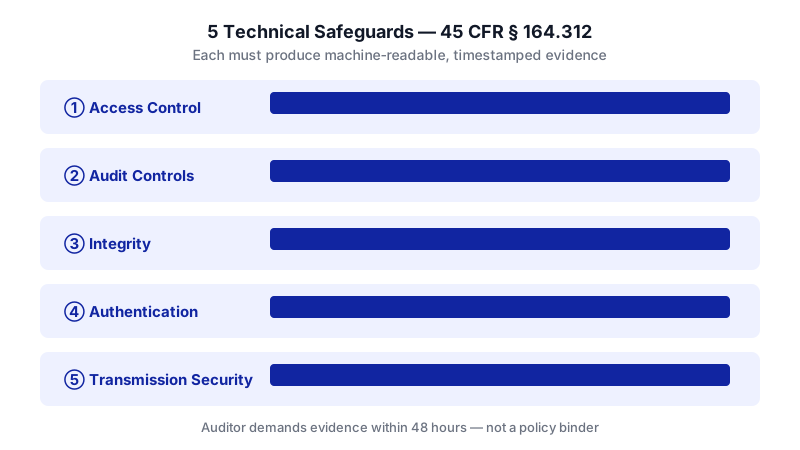
If a US partner has told you any vendor touching their patient data must be HIPAA-compliant, the short version is this: you need a signed Business Associate Agreement (BAA) with your software vendor, and that vendor's architecture must produce auditable evidence for five named technical safeguard categories under 45 CFR § 164.312 — access control, audit controls, integrity, authentication, and transmission security. The BAA is the legal instrument. The logs, encryption keys, access reviews, and incident timelines are what an auditor or a breach investigator will actually ask for. A vendor who cannot produce them within 48 hours of your request has already failed, regardless of what the contract says.
This is unfamiliar territory for most UAE health tech buyers. The ADHICS standard and DHA data residency rules you know well overlap with HIPAA in spirit but diverge sharply on evidence, breach timelines, and vendor liability. Below is what actually matters when you are commissioning a build, scoping an integration, or evaluating a dev partner against this regime for the first time.
What triggers the HIPAA obligation on your side
HIPAA applies to Protected Health Information (PHI) — identifiable health data — that originates with a US Covered Entity (a US hospital, clinic, or health plan) or its Business Associates. The moment your organisation, sitting in Dubai or Abu Dhabi, receives that data under a data-sharing agreement to process, store, transmit, analyse or display it, you become a Business Associate under US law. Jurisdiction follows the data, not the server.
Three common triggers we see for UAE enterprises:
- A private hospital group opens a medical tourism intake pipeline with a US health system and receives patient records before arrival.
- A regional insurer signs a reinsurance or claims-processing arrangement with a US carrier and ingests member eligibility files containing US ePHI.
- A health tech scaleup wins a pilot with a US provider network and the pilot involves even a single live patient record.
In all three, every downstream software vendor — the firm building your intake portal, the AI team training a triage model, the integrator wiring your HL7 feed — is a subcontractor Business Associate, and HIPAA liability flows contractually from you to them. If they leak data, OCR can enforce against you. In 2024, OCR closed 22 HIPAA investigations with financial penalties totalling roughly USD 9.9 million, and large breaches (500+ individuals) affected around 276 million people across 721 incidents. Enforcement is not theoretical.
What HIPAA demands of the architecture — not the policy binder
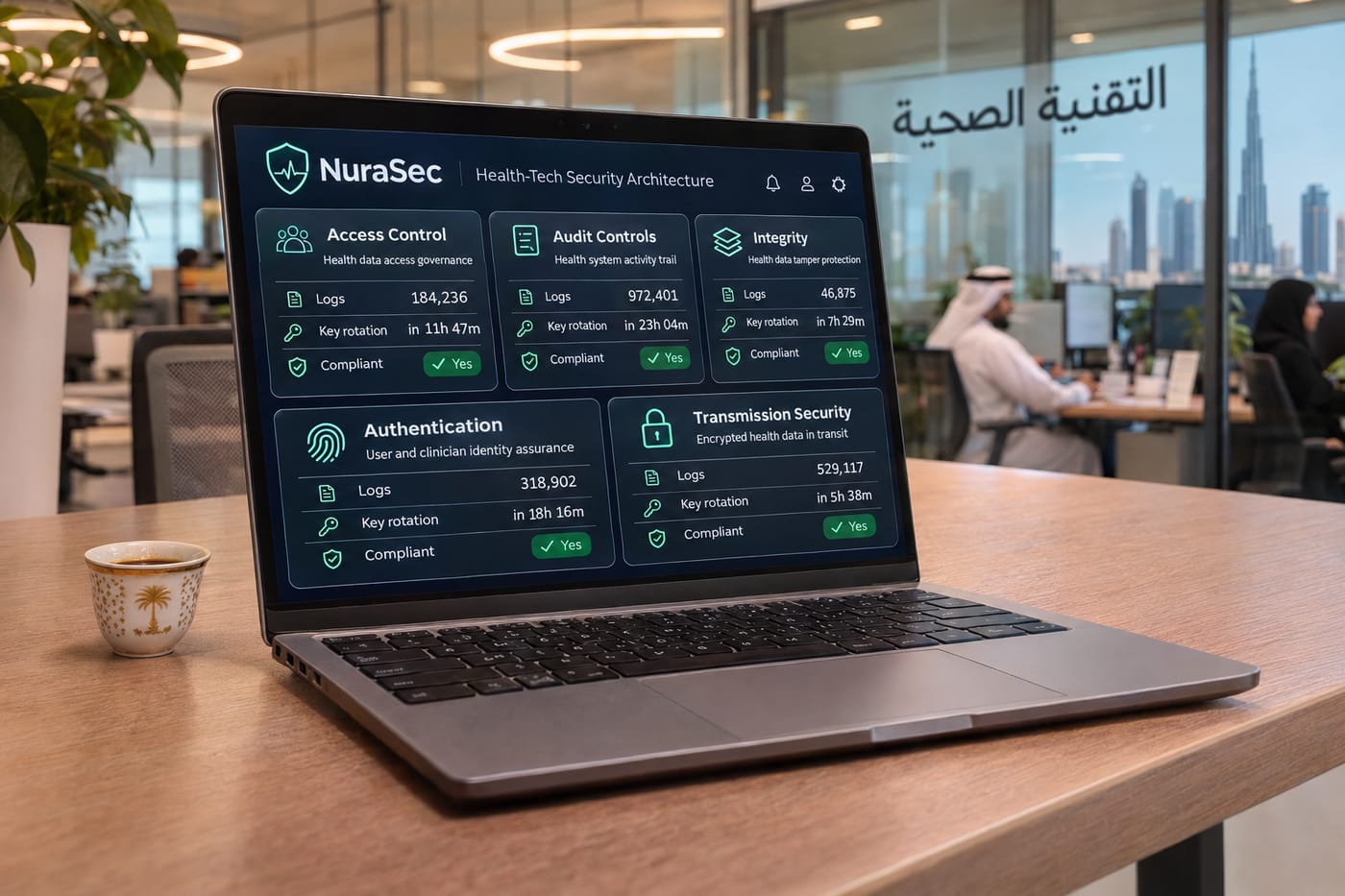
The Security Rule is the part that touches the code. Its technical safeguards (45 CFR § 164.312) break into five standards. Treat each as a design constraint, not a checkbox.
1. Access control (§ 164.312(a))
Every user and service identity that can reach ePHI must have a unique identifier, role-scoped permissions, and an emergency access procedure. Automatic logoff of inactive sessions is required. Encryption of ePHI at rest is required in practice — the current rule calls it "addressable", but the pending January 2025 NPRM (90 FR 898) proposes to make it mandatory and remove the addressable loophole entirely. Build as if it is already mandatory.
Evidence an auditor will ask for: IAM policy export, role-to-permission matrix, session timeout configuration, key management documentation (KMS, HSM, or equivalent), and quarterly access reviews with sign-offs.
2. Audit controls (§ 164.312(b))
Every read, write, export, and administrative action on ePHI must be logged. Logs must be tamper-evident, retained (six years is the common Privacy Rule retention benchmark used across the industry), and reviewable. This is where most "HIPAA-compliant" vendors quietly fail. They log application events but not database-level PHI access, or they let developers read production data without an audit trail.
Evidence: a sample log extract showing who accessed which patient record at what timestamp from which IP, plus the log review cadence and who signs off.
3. Integrity (§ 164.312(c))
ePHI must be protected from improper alteration or destruction. In practice this means database-level change tracking, checksums or digital signatures on records exchanged with partners, and immutable backups.
4. Person or entity authentication (§ 164.312(d))
You must verify that a person or system seeking ePHI is who they claim to be. The 2025 NPRM proposes mandatory multi-factor authentication for all ePHI access. Again — build as if final.
5. Transmission security (§ 164.312(e))
TLS 1.2 or higher for everything in motion. No unencrypted SFTP, no emailing CSVs. If you are moving HL7 v2 or FHIR between a US partner and your core systems, that channel must terminate inside a boundary where encryption, logging, and access control are all enforced — not at a reverse proxy that then speaks plaintext to a legacy backend.
The administrative and physical safeguards
Alongside the technical five, the Security Rule also mandates administrative safeguards (risk analysis, workforce training, incident response plan, contingency planning) and physical safeguards (facility access, device and media controls). Your cloud provider handles most of the physical layer if you are on AWS, Azure, or GCP under their respective BAAs. The administrative layer is yours.
What HIPAA demands of the vendor you hire
Here is the contractual and operational checklist for any UAE or offshore software partner you are about to commission. Walk through it line by line in procurement.
A Business Associate Agreement — but a real one
The BAA is non-negotiable and must be signed before any ePHI touches the vendor's environment. It must specifically cover: permitted uses and disclosures, safeguard obligations, subcontractor flow-down (any sub-processor the vendor uses must also sign a BAA), breach notification timelines, and return or destruction of PHI on termination. Many vendors will hand you a template BAA that excludes indemnity or caps liability at the contract value. For a breach involving even a few thousand records, that cap is meaningless — negotiate it.
Documented, annually audited evidence of each technical safeguard
The pending 2025 NPRM would require Business Associates to annually verify in writing that the required technical safeguards are implemented. Even before that rule finalises, ask the vendor for last year's evidence. If they cannot produce it, that answers the question.
A 24-hour incident notification commitment
The 2025 NPRM proposes that Business Associates notify Covered Entities of any security incident — including sub-breach-threshold events — within 24 hours of discovery. Write this into your contract now. The current statutory breach notification window from a Covered Entity to affected individuals is 60 days; you cannot meet that if your vendor tells you about an incident on day 55.
Semi-annual vulnerability scans and annual penetration tests
The NPRM would make both mandatory. Ask for the last scan report and the last pentest report (redacted is fine). If the pentest was scoped to a marketing website and not the ePHI application, it does not count.
A named security officer and an incident response runbook
Not a title on a slide — an actual person, reachable, with a runbook they have tested. Ask when they last ran a tabletop exercise.
Sub-processor transparency
If the vendor uses an LLM provider, an analytics tool, a background job queue hosted elsewhere, or an offshore QA team — every one of those is a sub-processor. Each must be under a BAA or formally out of ePHI scope. The AI piece matters more every quarter: feeding PHI into a general-purpose LLM endpoint without a BAA is a breach on day one.
Data residency that aligns with both regimes
HIPAA does not mandate US-only storage, but your US partner's internal policy often does. Simultaneously, UAE data protection law and the DHA/DoH frameworks may require certain classes of data to stay in-country. Reconcile these two before architecture, not after. Sometimes the answer is a dual-region deployment with careful routing of which records live where.
How long readiness actually takes — and what drives the range
There is no honest single number here, and anyone who gives you one is selling. Readiness timelines are driven by five variables:
- Starting posture. A greenfield build on a modern cloud with a HIPAA-eligible service catalogue moves faster than a retrofit of a ten-year-old monolith with shared database credentials.
- Scope of ePHI. A read-only intake viewer touches far less surface area than a bidirectional EHR integration with AI-assisted triage.
- Existing identity and logging stack. If you already have federated SSO, centralised logging, and a SIEM, you are months ahead. If not, that foundation has to be laid first.
- Evidence maturity. Implementing controls is the fast part. Producing documentation, policies, risk assessments, and audit evidence that would survive OCR scrutiny is the slow part — and it is where most projects underestimate.
- Which rule you are targeting. Current Security Rule versus the pending 2025 NPRM, which proposes a ~240-day compliance window after finalisation and raises the bar significantly.
Illustrative only: a two-integration patient intake MVP, on AWS with the AWS BAA in place, no legacy data migration, one US partner, no AI inference on PHI, with an internal team already running SSO and centralised logs — can reach a defensible HIPAA posture faster than a multi-system EHR overlay with offshore development teams and three sub-processors. The gap between those two scenarios is measured in quarters, not weeks. To turn any range into a real estimate for your situation, you need three specifics nailed down: the exact data flows touching ePHI, the current state of your identity and logging infrastructure, and whether you are building to the current rule or pre-emptively to the NPRM. That is a scoping conversation — talk to our Dubai team if you want help running it.
The three things teams discover far too late
1. Non-production environments are in scope
If any real patient record — even a single de-identification-failed row — makes it into staging, dev, or a developer's laptop, that environment is now in HIPAA scope. Most teams discover this when an auditor asks for the access logs of the staging database and there are none. Build synthetic data generation into the project from day one.

2. The LLM question has no easy answer
If your build includes AI — summarising clinical notes, extracting data from intake forms, triaging symptoms — the model endpoint is a sub-processor. OpenAI, Anthropic, and Azure OpenAI all offer BAAs under specific commercial tiers; the consumer APIs do not. Open-source models you host yourself keep the data in your boundary but push the infrastructure burden to you. Decide this architecturally before you prototype, because rebuilding the AI layer to swap the provider is expensive.
3. The BAA chain breaks at one weak link
Your contract with your US partner is fine. Your BAA with your main software vendor is fine. But the vendor uses a third-party email service for transactional notifications, and that service has not signed a BAA. A password-reset email containing a patient name just triggered a reportable breach. Map the full sub-processor chain in writing. On this and on contract language generally, you should have a US healthcare lawyer review the specifics — this post is a procurement framework, not legal advice.
How CodeNicely can help
We have built regulated healthcare software end-to-end. HealthPotli is the engagement most relevant here — an e-pharmacy platform where we designed the data model, access controls, audit logging, and an AI drug-interaction checker under a regime that required us to treat patient medication data with the same seriousness HIPAA demands of ePHI. That project forced us to answer the hard questions: how do you log every read of a prescription without destroying application performance; how do you let a pharmacist override a drug-interaction warning while leaving an unalterable trail; how do you de-identify data for an ML training pipeline without creating a re-identification risk.
For a UAE hospital group or insurer about to commission a HIPAA-scoped build, that is the capability profile you want: a team that has designed audit-first architectures in healthcare, that understands cloud BAA scoping on AWS and Azure, and that can reason honestly about the AI-plus-PHI question rather than hand-waving it. We work with full IP transfer and no vendor lock-in, which matters when your US partner later asks who controls the code and the keys. If this maps to where you are, our Dubai team runs the scoping conversation, and the AI Studio handles the model and inference architecture.
The practical closing checklist
Before you sign anything with a software vendor on a HIPAA-scoped project:
- Confirm the data-sharing agreement with your US partner and understand exactly which data elements qualify as ePHI.
- Require a signed BAA with the vendor before any ePHI access, including for discovery or data-modelling workshops.
- Ask for last year's audit evidence against each of the five § 164.312 technical safeguards.
- Write a 24-hour incident notification clause into the contract.
- Map the sub-processor chain, including AI providers and email services, and require a BAA from each.
- Decide data residency by reconciling US partner policy with UAE in-country requirements before the first architecture diagram.
- Have a US healthcare lawyer review the BAA and the data-sharing agreement. This is not optional.
HIPAA is not a brand of compliance you buy. It is a set of controls you can produce evidence for on 48 hours' notice. The UAE digital health market is growing at roughly 19.9% annually through 2030, and cross-border US partnerships will become routine. The vendors that will matter in that market are the ones who can show the logs.
Frequently Asked Questions
Does HIPAA actually apply to a UAE-based company?
Yes, if you receive, process, store, or transmit ePHI from a US Covered Entity or its Business Associates. Jurisdiction follows the data, and your US partner is contractually obligated to flow HIPAA requirements down to you. Enforcement against non-US entities happens through the contract chain and through your US partner's regulators, not through OCR knocking on a Dubai door — but the commercial consequences of a breach (contract termination, indemnity claims, loss of US market access) are usually worse than the fine.
Is a signed BAA enough to call a vendor HIPAA-compliant?
No. The BAA is a legal instrument that creates obligations; compliance is the evidence that those obligations are being met. A vendor is HIPAA-compliant when they can produce, on demand, logs and documentation for each of the five technical safeguards in 45 CFR § 164.312, a current risk assessment, workforce training records, and an incident response runbook. Many vendors sign the BAA and cannot produce any of that. Ask before you sign, not after a breach.
How does HIPAA interact with UAE data residency rules like ADHICS and DHA?
They are additive, not substitutive. HIPAA is silent on where data physically sits; UAE sectoral regulators often require certain patient data classes to remain in-country. The common architectural answer is a regional deployment in a UAE cloud region (AWS Bahrain/UAE, Azure UAE North) with careful routing so that US-partner ePHI and UAE-resident patient data are segregated by control plane. Reconcile both regimes with legal and technical input before design freeze.
What does it cost to make a healthcare build HIPAA-ready?
The cost model is driven by starting posture (greenfield vs retrofit), scope of ePHI (one integration vs full EHR overlay), maturity of your existing identity and logging stack, whether AI is in the data path, and whether you are targeting the current Security Rule or the pending 2025 NPRM. The evidence and documentation work is almost always underestimated and often costs as much as the control implementation itself. To turn a range into a real number, you need the data flows mapped, the infrastructure baseline documented, and the target rule confirmed — that is a scoping engagement, not a quote.
What is changing with the 2025 HIPAA Security Rule NPRM, and should we build to it now?
The January 2025 NPRM proposes to make encryption at rest and in transit mandatory, require MFA for ePHI access, mandate semi-annual vulnerability scans and annual penetration tests, require Business Associates to notify Covered Entities of incidents within 24 hours, and require annual written verification of safeguards. The final rule is still pending as of late 2026 and would come with a ~240-day compliance window. For any new build, design to the NPRM — retrofitting MFA and encryption at rest later is more expensive than building them in.
Sources & further reading
- UAE Digital Health Market Size, Share & Forecast to 2030 — Research and Markets
- OCR Reports to Congress on HIPAA Compliance and Data Breaches in 2024 — HIPAA Journal
- HIPAA Enforcement Statistics: Fines, Breaches & Trends (Updated 2026) — ComplyMD
- 2024 Healthcare Data Breach Report — HIPAA Journal
- HIPAA Security Rule Technical Safeguards Series #4 — HHS OCR (official government PDF)
- HIPAA Security Rule NPRM: Encryption, MFA, and the End of 'Addressable' — Safeguard.sh
- HIPAA Security Rule: What's Changing, What's Coming, and How to Prepare Now — Qubika
- HIPAA Business Associate Agreement Compliance Guide (Importance, Requirements, Risks) — Linford & Co.
Get one practical guide a week
Costs, AI tools, partner selection — written for people who make the decision. No spam, unsubscribe anytime.
Thanks — you're on the list. One practical guide a week, nothing else.
That didn't work — please check the email address and try again.
Building something in Healthcare?
CodeNicely partners with founders and tech teams to ship AI-native products that move metrics. Tell us about the problem you're solving.
Talk to our team Book a 30-min call