

What KYC Actually Requires of Your Software Architecture

 Published by CodeNicely, the product studio founded by Meghal Agrawal and Ujjwal Agrawal in 2017
For: A COO or Chief Compliance Officer at a Series C or later fintech, payments, or lending enterprise who has just been told by a bank partner or enterprise customer that their KYC program needs to be auditable end-to-end — and has realized their current stack cannot produce the evidence
In this guide
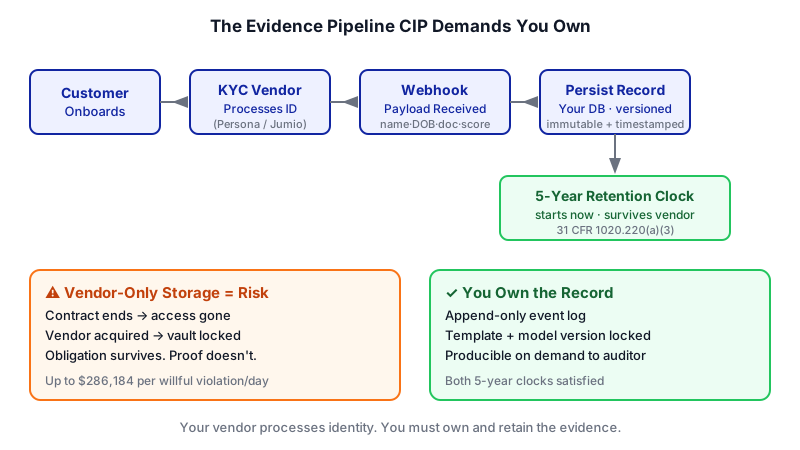
If a bank sponsor or enterprise customer has told you your KYC program must be auditable end-to-end, the uncomfortable answer is this: your identity verification vendor is not your KYC program. The Customer Identification Program rule at 31 CFR 1020.220 requires you to retain specific identifying fields and verification evidence — for five years after account closure, on two separate clocks — in a form you can produce on demand. Most SaaS KYC widgets write that evidence to their vault, not yours. When the contract ends or the vendor gets acquired, your retention obligation survives. Your access to the proof does not.
This post is about what the regime actually demands of your architecture, your vendor contracts, and your evidence pipeline — not what the policy binder says you do.
What triggers the obligation
You are on the hook for a CIP under the Bank Secrecy Act if you are a US bank, a broker-dealer, a mutual fund, or a futures commission merchant. If you are a fintech, payments company, or lender, you are usually on the hook through your bank sponsor, who has made their CIP your contractual problem. Under 31 CFR 1020.220(a)(6), a bank that delegates CIP duties to a third party must receive annual certification that the third party has implemented the bank's CIP — and the bank remains ultimately responsible for compliance. That cascade is why your bank partner's audit team is suddenly asking you questions that sound like they are addressed to a depository institution. For your purposes, they are.
The enforcement picture is the reason this is now an architecture conversation, not a policy one. Global AML fines totaled $4.6 billion in 2024, and the record $51 million in KYC-specific fines in H1 2024 doubled year-over-year. In October 2024, FinCEN issued a $1.3 billion civil money penalty against TD Bank — the largest BSA penalty ever against a US-chartered depository institution. Under 31 CFR 1010.821, FinCEN can assess between $71,545 and $286,184 per willful BSA violation, and each day of an ongoing AML program failure counts as a separate violation. Your bank sponsor has read these numbers too. That is why the question changed from "do you have KYC?" to "show me the record."
What CIP actually demands of your architecture
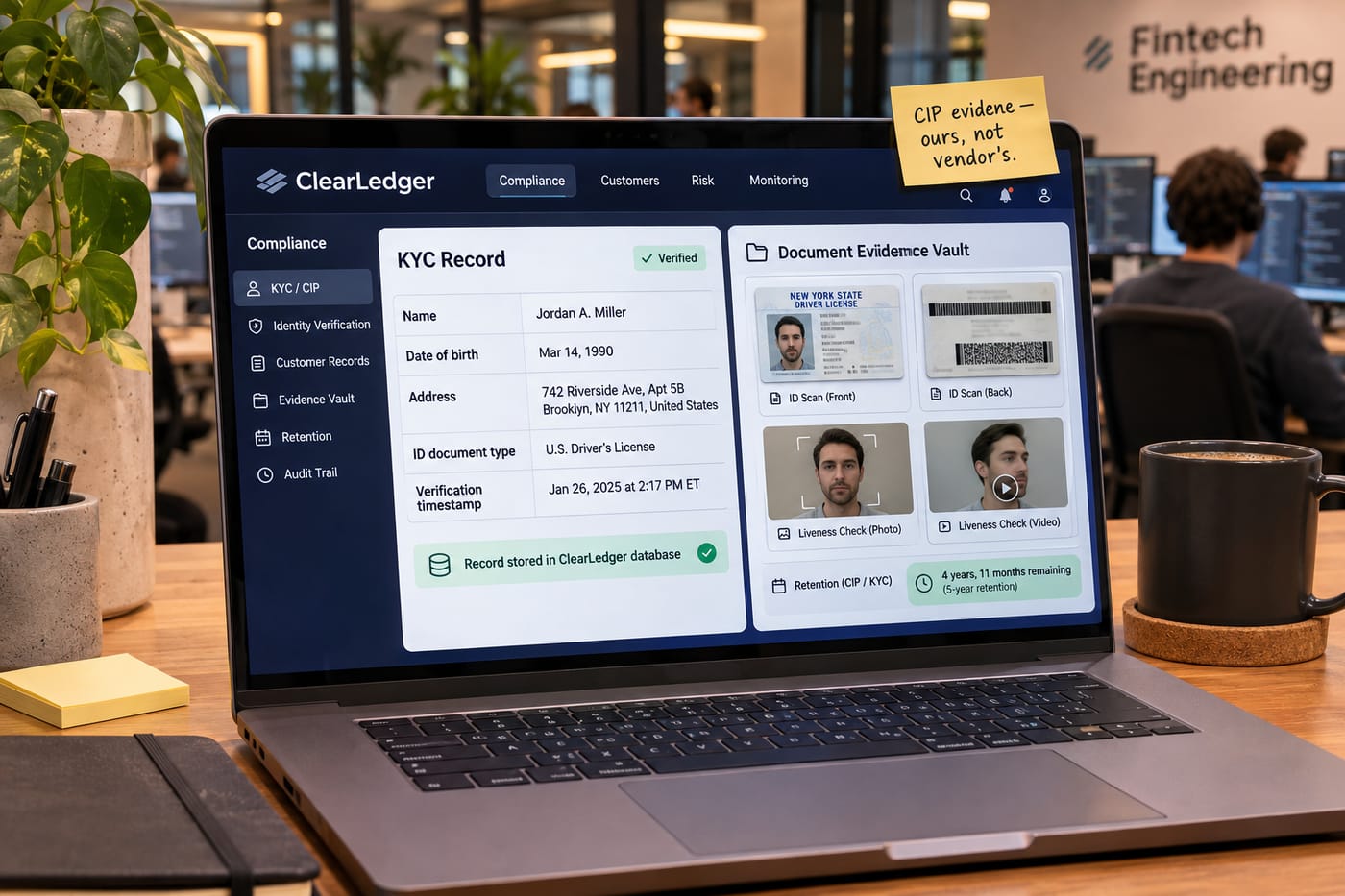
This is where most teams discover their stack cannot answer the question. The CIP rule does not just require that you did identity verification. It requires that you produced, and can retrieve, a specific record. Per 31 CFR 1020.220(a)(3), the record must include:
- All identifying information obtained about the customer (name, DOB, address, identification number)
- A description of every document relied on — type, identification number, place of issuance, and date of issuance and expiration
- A description of the methods and results of any non-documentary verification
- A description of the resolution of any substantive discrepancy discovered when verifying identity
Two retention clocks run. Identifying information must be kept for five years after the account is closed. Verification and discrepancy records must be kept for five years after the record is made. Both clocks survive the end of your relationship with the vendor that produced the record.
Translate that into architecture:
1. The decision record must live in a database you own
Not in Persona's dashboard. Not in Jumio's vault. In your production database, under your backup and retention policy, queryable by your engineers. The vendor's webhook payload is the raw material. You need a persisted, versioned record keyed to your customer ID that captures every field the CIP rule names — including the document's place of issuance and its issue and expiry dates, which are fields many vendor payloads either omit or bury in nested JSON that your ingestion pipeline silently drops.
2. Every input and every output must be versioned together
"We verified Jane Doe on March 3, 2023" is not a record. "We verified Jane Doe on March 3, 2023, using the Persona template itmpl_x7, which at that time required a US driver's license plus a selfie liveness check, and the risk model that returned score 0.14 was risk-engine v2.4.1, trained on data through February 2023" is a record. An auditor two years from now will ask what rules were in force on the day of onboarding. If your template IDs, risk model versions, and rule configurations are not immutable and timestamped, you cannot answer.
3. Re-verification events are first-class records, not updates
When a customer re-verifies at a higher transaction tier, when sanctions screening re-fires, when an address change triggers a new document check — each is a separate CIP-relevant event with its own five-year clock. Teams that model customer identity as a mutable record (one row, latest status wins) destroy the audit trail every time they update it. The correct shape is an append-only event log with the mutable "current state" view derived from it.
4. Discrepancy resolution must be captured as reasoning, not just outcome
"Address mismatch resolved" is useless. The rule requires a description of how the discrepancy was resolved. If a human analyst accepted a secondary utility bill, that decision, that analyst's identity, that document's metadata, and the timestamp all belong in the record. If an automated rule accepted a fuzzy name match on a known transliteration pattern, the rule version and its match score belong in the record.
5. Retrieval must be fast enough for audit requests
Auditors ask for samples. Bank partners ask for samples quarterly. Being able to produce, within hours, the full decision record for any customer onboarded in the last five-years-plus-account-life is an operational requirement. If that involves someone exporting CSVs from a vendor dashboard and manually reconciling them, your program is already failing at scale.
What this demands of the vendors you hire
The CIP rule does not prohibit using third parties. It makes you responsible for what they do. KYC vendor due diligence under that framing looks less like a procurement exercise and more like an architecture review of a critical supplier.
Ask the questions whose answers determine whether your audit record survives a vendor change:
- Webhook completeness. Does the vendor push every field named in 1020.220(a)(3), including document issuance geography and expiry, in machine-readable form? Or does their API return a pass/fail decision with the underlying document metadata only visible in a PDF?
- Raw artifact export. Can you retrieve the actual document images, selfie frames, and liveness video they captured, at any time, via API — and can you continue to retrieve them for the retention period after you terminate the contract? Most vendors say no to the post-termination part. That is the single most dangerous clause in a KYC SaaS agreement.
- Template and model versioning. Does the vendor expose, in every decision payload, the exact template and model version that produced it? Not "our v3 engine" — a specific, immutable identifier you can reference five years later when they are on v9.
- Annual CIP certification. Under 1020.220(a)(6), your bank sponsor needs an annual certification. Does the vendor produce one, specific to your bank's CIP, in a form their compliance team will accept?
- Sub-processor transparency. Document verification is often a chain — your KYC vendor calls a document authenticator, which calls a government database. Discrepancies and resolution details may originate three hops away. What does the vendor expose about that chain?
A useful summary of the operational hazard here is FinQub's writeup on preserving audit history across a vendor switch, which is worth reading before you sign the next renewal.
The vendor-fragmentation problem is getting worse, not better. The KYC software market was about $2.35 billion in 2024 and is projected to hit $5.89 billion by 2031 at 14.2% CAGR. More tools, more swaps, more surfaces where the audit trail breaks across systems that were never designed to hand off their evidence to each other.
How long readiness takes, and what drives it
Treat any "we can be audit-ready in six weeks" claim with the suspicion it deserves. What determines the real timeline is not the compliance checklist. It is the shape of your existing data.
The variables that move the number:
- How your current KYC events are stored. Teams with an append-only event log of onboarding decisions are months ahead of teams with a mutable
userstable whosekyc_statuscolumn gets overwritten on every re-verification. The latter group has to reconstruct history from vendor logs — assuming those still exist. - How many KYC vendors are in the stack. One is manageable. Three, acquired over time for different product lines, means reconciling three different event schemas into one canonical record.
- How much historical remediation is needed. If your bank partner is asking for evidence on customers onboarded three years ago, and those records live partially in a vendor you no longer use, the backfill is the project.
- Whether your risk scoring, sanctions screening, and PEP screening are versioned. If they are not, instrumenting them is a prerequisite to anything else.
To make that concrete — and labelling this as illustrative, not a quote: a Series C lender with one primary KYC vendor, an existing event log for onboarding but mutable fields for re-verification, and roughly two years of historical records to reconcile would typically be looking at a multi-month engineering effort spanning data model changes, backfill, vendor contract renegotiation, and evidence pipeline buildout — not a sprint. A fintech with three vendors, no event log, and five years of history to reconcile is in a materially larger project.
The three specifics that would turn that range into something real: the current shape of your KYC event data (append-only or mutable), the number of active identity and screening vendors involved, and the historical window your bank partner expects evidence for. Those three answers mostly determine the scope. If it is useful, our team is happy to walk through them with you.
Three things teams discover far too late
1. The vendor owns the images. You owe the retention.
Your contract with Persona or Jumio likely says they retain document images for X years during the contract term, and for a short tail after termination. Your obligation under 1020.220 is five years after account closure. If a customer closes their account in year four of your vendor relationship, you owe their verification record until year nine — and you will be on a different vendor by then. Negotiate perpetual export rights into the contract, or set up automated export of raw artifacts to your own storage from day one.

2. The "decision reason" field is a single string.
Engineering teams routinely store the KYC result as status: approved, reason: "passed". This is unauditable. The rule requires a description of the methods and results of verification. "Passed" is not a description. What rules fired, what signals they evaluated, what thresholds they used, what document the result rested on — all of it belongs in the record, in structured form, not a string.
3. Nobody mapped who the record custodian is on the day the vendor contract ends.
The question "where is the CIP record for customer 48291 going to live on the day after we switch from Vendor A to Vendor B" has a technical answer and an operational answer. Most teams have neither. By the time the switch is happening, the engineering team that built the original integration has turned over twice. The compliance team assumes the data was exported. It was not.
A practical note: KYC and AML compliance are legal regimes with real liability. This post describes architectural patterns. It is not legal advice. Your bank sponsor's compliance team and outside counsel should review your specific CIP against the exact wording of your bank partnership agreement and applicable regulations.
How CodeNicely can help
Most of this work is not a KYC vendor replacement. It is building the evidence spine that sits underneath whichever vendors you use — the versioned event log, the raw artifact export pipeline, the queryable decision record, the retrieval tooling your auditors and bank partners will actually touch.
Our engagement with Cashpo is the closest analog to what most readers of this post are dealing with. Cashpo is a lending business where KYC is not a feature — it is the product's load-bearing wall. We built the identity verification architecture, the credit scoring layer, and the decision record pipeline together, as one system, because they have to be queryable together when a regulator or sponsor bank asks. That is the same integration problem a Series C fintech faces when it realizes its KYC vendor output, risk engine, and transaction monitor are three disconnected logs.
If you are earlier in the stack-modernization conversation — pulling legacy onboarding flows off a monolith, or consolidating three vendor integrations into a single internal API — our digital transformation practice is where that work lives. Full IP ownership, no vendor lock-in, and the evidence spine stays yours.
The bottom line
Your bank partner is not asking whether you do KYC. They are asking whether you can produce, on their timetable, a complete and specific decision record for any customer you have ever onboarded, for five years past account closure, in a form that survives the vendors you used to collect it. That is an architecture problem. Policy binders do not solve it. Vendor dashboards do not solve it. An event-sourced, vendor-neutral, versioned record that your database owns does.
Frequently Asked Questions
Does using a KYC vendor like Persona or Jumio satisfy our CIP obligations?
No — not by itself. Under 31 CFR 1020.220(a)(6), you (or your bank sponsor) remain responsible for compliance even when a third party performs the verification. The vendor provides the verification mechanism; you still owe the record, the retention, and the ability to produce it on demand. Most vendor contracts do not guarantee post-termination access for the full five-year retention window.
What exactly does the CIP record have to contain?
Per 31 CFR 1020.220(a)(3): the identifying information you obtained, a description of every document relied on including type, identification number, place of issuance, and issue and expiry dates, a description of the methods and results of any non-documentary verification, and a description of how any substantive discrepancy was resolved. Most KYC widget outputs do not capture all of these fields in a form your database stores.
How long do we have to retain KYC records?
Two clocks. Identifying information must be retained for five years after the account is closed. Verification and discrepancy records must be retained for five years after the record is made. Both obligations survive the termination of your contract with any vendor involved in producing the record — which is why export rights and your own storage matter from day one.
How much does building an audit-ready KYC architecture cost, and how long does it take?
The cost and timeline are mostly driven by three things: whether your current KYC events are stored as an append-only log or as mutable fields, how many vendors are in your stack, and how much historical data needs backfill or reconciliation. A single-vendor shop with a clean event log is a materially smaller project than a three-vendor stack with mutable state and five years of history to reconcile. Those three answers will turn a range into a scoped number — worth a conversation before anyone commits to anything.
Can we switch KYC vendors without losing our audit history?
Only if the current vendor's contract permits bulk export of raw artifacts (document images, liveness frames, decision payloads) and your architecture already persists structured decision records in your own database. If evidence lives only in the vendor's dashboard, switching vendors breaks your retention obligation even though the regulatory clock keeps running. Negotiate export rights before you sign, not when you want to leave.
Sources & further reading
- 31 CFR § 1020.220 – Customer Identification Program Requirements for Banks (Law.Cornell.edu)
- FFIEC BSA/AML Manual – Assessing Compliance: Customer Identification Program
- Fenergo – FinCrime Enforcement Actions Up 31%, H1 2024 (via A-Team Insight)
- AML Fines Globally 2024: Statistics & Trends – FluxForce AI (citing Fenergo Annual Report 2025)
- Crypto KYC Compliance: Requirements & Checklist 2026 – Zyphe (H1 2025 fine data)
- FinCEN Civil Penalty Amounts – 31 CFR 1010.821 (via Zyphe)
- KYC Software Market Size 2024–2031 – 6Wresearch
- Switching a KYC or KYB Vendor Without Losing Your Audit History – FinQub
Get one practical guide a week
Costs, AI tools, partner selection — written for people who make the decision. No spam, unsubscribe anytime.
Thanks — you're on the list. One practical guide a week, nothing else.
That didn't work — please check the email address and try again.
Building something in Fintech?
CodeNicely partners with founders and tech teams to ship AI-native products that move metrics. Tell us about the problem you're solving.
Talk to our team Book a 30-min call